The first castles to be
built in England for eight centuries (since the Roman Saxon Shore Forts) were
constructed in the middle of the 11th century by Edward the Confessor and followed
the pattern being developed by the Normans who has conquered France. A mound,
or motte, was raised up to one hundred feet in height. These could be
a natural feature, a man made mound of earth or a combination of the two. A
wooden fortification, a keep, protected the top of the motte and another
surrounded the motte and some adjacent land forming a bailey where most
of the inhabitants lived. A ditch outside the bailey was an additional defence.
An example of one of the first castles of this design is Richard's Castle in
Herefordshire.
The Norman Invasion
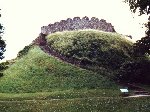
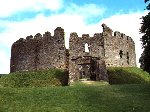
After the invasion was complete there was time for more extensive defences to be built up in the most important cities. By 1085 there were approximately 100 well defended fortifications built both by the king and his Barons. Wood was readily available across most of the country but is not the ideal defence because of its flammability so existing structures were rebuilt in stone over the next 100 years.
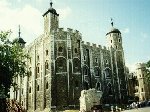
There was an outbreak of castle building during the Civil War between 1135 and 1154 when eleven hundred and fifteen fortifications were built. Almost all were demolished after hostilities ended and little remains of them.
Enlargement and Strengthening
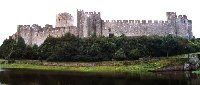 Towards the end of the 12th
century castle building became a royal prerogative as the Barons had lost much
of their earlier power. The designs slowly evolved with the emphasis towards
high walls which were well fortified with towers. The keep lost its importance
and was often replaced by a tall strong gatehouse - a barbican. The towers
then were placed closer together and were more numerous. For additional protection
some were built on a hill or a rocky crag and outer baileys with additional
walls and towers were added to provide a concentric structure where a
breach in the outer wall could still be defended from an inner defensive structure
e.g. Pembroke & Beeston castles. Additional baileys protected with walls
were also added to existing castles such as Corfe and Chepstow.
Towards the end of the 12th
century castle building became a royal prerogative as the Barons had lost much
of their earlier power. The designs slowly evolved with the emphasis towards
high walls which were well fortified with towers. The keep lost its importance
and was often replaced by a tall strong gatehouse - a barbican. The towers
then were placed closer together and were more numerous. For additional protection
some were built on a hill or a rocky crag and outer baileys with additional
walls and towers were added to provide a concentric structure where a
breach in the outer wall could still be defended from an inner defensive structure
e.g. Pembroke & Beeston castles. Additional baileys protected with walls
were also added to existing castles such as Corfe and Chepstow.
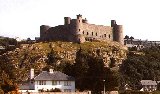 The
most highly refined concentric castles date from the early 14th century during
the invasion of Wales when a string of purpose built structures was erected
across North Wales e.g. Caernarvon, Harlech castles. These were the last of
the massive residential castles to be built by the monarchs and all are still
in good condition, due mainly to the strength of their construction.
The
most highly refined concentric castles date from the early 14th century during
the invasion of Wales when a string of purpose built structures was erected
across North Wales e.g. Caernarvon, Harlech castles. These were the last of
the massive residential castles to be built by the monarchs and all are still
in good condition, due mainly to the strength of their construction.
Whilst renovation of the
existing major castles continued, new developments in England between 1350 and
1450 were limited to smaller structures such as fortified manor houses
built with strong walls and towers, and tower houses, like stand alone
keeps. These were built mainly by rich landowners rather than the nobility and
were often constructed of brick, rather than stone. Tower houses are most commonly
found in the north and east of the country.
A New Design
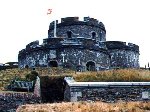
The Civil War
This period, from 1642
to 1660, caused the downfall of so many of the once splendid castles of England
and Wales. Sieges and cannon bombardment caused massive damage, and towards
the end of the war many were punished by slighting or destruction of
the major defences to prevent them being used for future conflicts. Following
such damage the most common outcome was that the castle was abandoned and its
stone was removed for building local houses. Castles that were spared this damage
were mainly those held by the Parliamentary troops, which is why those like
Windsor and Dover castles are still in such good condition today.
Modern Warfare
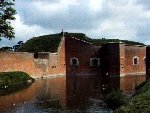
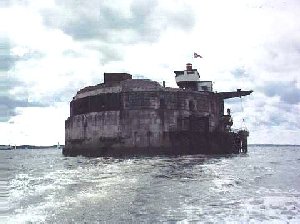
The most extensive, and final, construction of major fortifications was that of the 79 Palmeston forts of the 19th century defending the Thames and the south coast naval bases of Plymouth, Chatham, Milford Haven and Portsmouth. These were a mainly land based forts but six additional structures were built in the shallow waters approaching three of the ports.