The Redkat
Infantry FightingVehicle
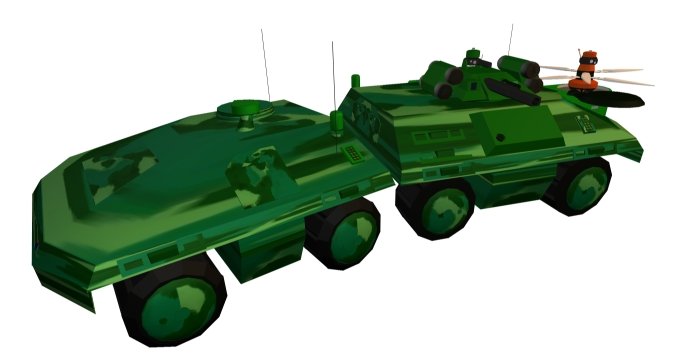
| Above: FV844 Redkat Armed Recce Vehicle
on trials with The Volunteer Light Dragoons about to launch a Snapdragon
recce drone.
“The more I see of the Redkat the more I am impressed by its spirit. It just won’t back down, not even to an Afanc twice its size. Considering the situation with the Argentines I can’t help thinking the Redkat makes a pretty good role model for our infant colony.
Catherine Wellon: Field Notes and Personal Diaries, Volume 1 2207
As Wellon has matured as a nation, gradually decreasing its reliance on
the While still heavily reliant on the One project brought in under this initiative was the Family of Wheeled
Combat Vehicles procured in the early to mid ‘90s to replace the collection
of old wheeled, tracked and hover support vehicles that had accumulated
over time in various second line roles. While first-line Wellon forces
were scheduled to receive the Rifleman HIFV and Cavalier HBT, second-line
units and those operating in adverse terrain such as Wellon’s
desert, jungle and arctic regions, required a vehicle of their own,
one that was ideally cheap, all-terrain capable and designed and built
in Wellon. The resulting competition was won by the newly established Military Vehicles Division of North Wellon Vehicles of Knightsbridge with their Redkat submission. The result was bitterly contested, going all the way to the Court of Appeals as Woolf Military Vehicles, backed by the regional government of its New Birmingham stronghold, and the not inconsiderable influence of its Grafton Arms parent, charged that the award had been decided on political grounds outside of those acceptable under Wellon tender law, with the primary intent of placing a major procurement in the economically stagnant Wellon Arctic Territories. A second argument of their suit alleged that the whole programme aimed at developing a wider based arms industry was counter to both Wellon law and an artificial subsidy incompatible with Wellon’s politico-economic norms. The dispute was long, legally complex and drew much attention in both the press and parliament, but in the end their Lordships upheld the MoD’s position that they were at liberty to select any supplier who met the tender requirements, even if that meant favouring a new supplier over an established one with a submission of equal quality and a lower tender price. FV841 Redkat Infantry Fighting Vehicle FV8411 Redkat Command Post Vehicle FV8412 Redkat Armoured Personnel Carrier FV8413 Redkat Anti-Armour Vehicle FV8414 Redkat Fire Support Vehicle FV8417 Redkat Drone Launch Vehicle FV844 Redkat Armed Reconnaissance Vehicle Despite the controversy raging over its selection, the Redkat moved through
troop trials with no more than the usual number of problems—evidence
that NWV’s extensive headhunting on behalf
of the Military Vehicles Division had borne fruit. Without an established
range of vehicles to draw on for design inspiration NWV were able to
approach the requirement with a clean-sheet design that is practically
unique in modern military vehicle design. Technically an 8X8, the Redkat
is perhaps better considered as two linked 4X4s. The front half of the
vehicle, the Command Module, contains the driver commander and gunner
seated three abreast with the driver’s position in the centre and slightly
forward of the other two seats to ease direct communication between
commander and gunner. Access hatches are located above both Commander’s
and Gunner’s positions. The Command Module is common to all configurations
although in some cases no gunner is carried. The crew workstations use
a standard set of inceptors and displays, reconfiguring the operation
of each as necessary. The driver uses a joystick for control of the
vehicle, but all three positions have standard Commonwealth voice, dataglove, trackball, touchscreen
and neural jack inputs. Crew helmets are the TISS compatible Black Arrow
Integrated Combat Vehicle Helmet and include helmet-HUD functionality
for use when riding head-out. The second,
Both modules have engine bays in the lower-half of the
hull, the engines, or more correctly generators, outputting onto a multiply-redundant
power-bus feeding electric motors in all eight wheels. The Redkat suffers
a less than 5% mobility loss from the loss of any single wheel, 10%
from any two wheels on different modules or different sides of the same
module. It suffers a 30% loss in mobility from the loss of any three
wheels not all on the same side or module, but is theoretically immobilised
by any other combination of wheel loss (during the New Africa campaign
one Redkat crew from Jameson’s Scouts managed to bring their severely
damaged vehicle out of the FEBA despite the loss of four wheels and
destruction of the Command Module’s engine bays by swapping all four
surviving wheels onto the barely-functional Command Module, powering
them from the Mission Module and using the Command Module to drag the
wheel-less Mission Module over swampy ground as a sledge). The fuel-cell engines of the Redkat are an interesting design element.
The Command and Mission Module engines are identical units, each further
subdivided into four identical sub-units. For all intents and purposes
the Redkat has eight engines and the redundancy that goes with them.
As part of considerable thought that went into maintenance the sub-units
are each mounted on slide-out trays and can be changed-out by two men
in no more than ten minutes, fifteen if only a single man is available
and he is forced to use the lifting frame built into the hull. With
support from an ARV’s powered lifting arm
change-outs have been accomplished in as little as five minutes from
coming to a halt. As an alternative to the engine sub-units the mounting
trays are also capable of mounting a specially designed battery pack
for vacuum ops, or even compact internal combustion powered generators
if the customer should so choose. The vehicle is pre-plumbed for droppable
long-range fuel or oxidiser tanks to be mounted on the sides of the
Mission Module allowing extended range or to allow the fuel cells to
be used in noxious atmospheres or even in vacuum. Performance reaches the levels laid down by the original requirements,
with the flex-coupling giving a useful increase in traction at some
cost in reliability. Any negative maintainability impact of the flex-coupling
is generally considered to be more than outweighed by the gains in engine
maintainability over more conventional installations. A secondary advantage
of the two module design is the ability to ‘mix-and-match’ battle-damaged
vehicles to get at least a portion of them back into the field in relatively
short order. The flex-coupling can be disconnected or reconnected in
as little as fifteen minutes making ‘mix-and-match’ the preferred tactic
for forward repair units whenever they have more than one damaged Redkat
on hand. While it is possible to drive a Command Module without an attached Mission Module (and this is in fact the recommended method of mating a Command Module to a disconnected Mission Module), the forward module alone has too short a wheelbase for its height to be entirely stable cross-country and the WEME team certifying acceptance for Controller (Ground) Release insisted that the vehicle be fitted with a governor to limit ground speed to 5KM/H in this configuration. In practise any WEME mechanic and most Redkat crewmen are perfectly capable of removing the governor in only a few minutes.
Springing from the Family of Wheeled Combat Vehicles requirement, the
Redkat was always intended to form the basis for an entire family of
variants and NWV staffed their design department with the intention
of rapidly establishing a complete range of Redkat variants, both to
meet the requirements of the MOD and to attract the attention of other
customers. |
|
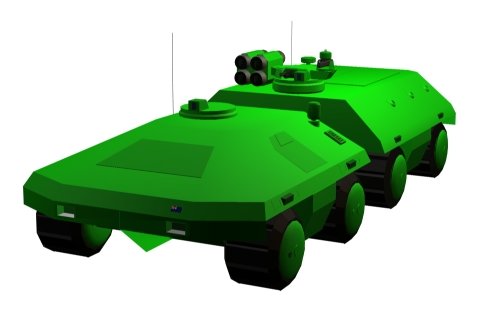
The standard section carrier vehicle, the FV841 carries a driver, commander
and gunner in the Command Module and eight dismounts in the rear module.
The armament package consists of the Class A1 turret mounting an L647A2
Plasma Gun (the same basic model used on the Bowman combat walker, but
with increased rate of fire) and a coaxial VR5 7.5mm MG. Four Green
Hunter AVMs are mounted on the side of the turret and a Verlet Defender
Point Defence System on the turret roof completes the package. The dismounts
are provided with firing ports in the hull side (three to each side)
and rear (two). If need be the commander can also fight the turret,
but standard practise is for the commander to operate the vehicle sensors
with the gunner concentrating solely on weaponry. A Class A2 Turret
is also available, replacing the Plasma Gun with a 25mm autocannon
for customers who prefer that option.
|
||||||||||||||||||||||||||||||||||||||||||||||||||||||||||||||||||||||||||||||||||||||||||||||||||||||||||||||||||||||||||||||||||||||||||||||||||||||||||||||||||||||||||||||||||||||
|
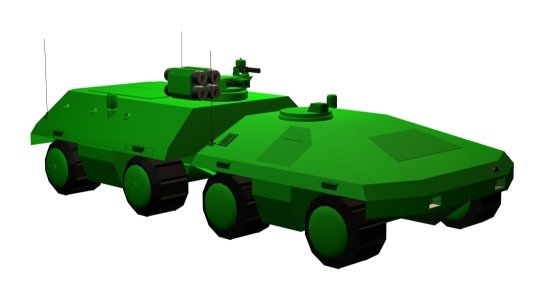
The Redkat Command Post Vehicle entered service at the same time as the
Redkat-IFV in the company command vehicle role, but has slowly been
spreading into other roles as additional software packages become available.
Redkat-CPs are now standard at both
battalion and company level in Redkat equipped units and are also operational
in the FAC, Forward Observer and Drone Controller Roles. The FV8411
carries the same Class A1 turret as the FV841, making it difficult to
distinguish between the two in combat, but internally the dismounts
have been traded for four workstations and a detailed examination will
reveal a considerable number of conformal antennae. In theory the vehicle
should carry a WEWS network technician and four command staff, but the
net-tech is often displaced to one of the support vehicles to give additional
space in the cramped rear module, swapping into the Redkat-CP only for
problems that can’t be resolved remotely.
|
||||||||||||||||||||||||||||||||||||||||||||||||||||||||||||||||||||||||||||||||||||||||||||||||||||||||||||||||||||||||||||||||||||||||||||||||||||||||||||||||||||||||||||||||||||||
|
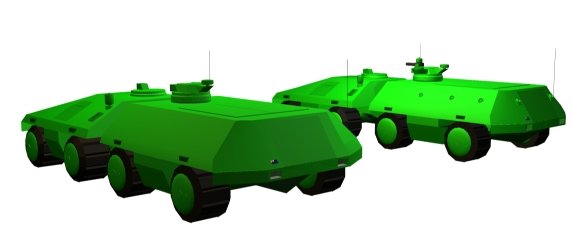
The Redkat-APC is a simpler, less expensive vehicle than the Redkat-IFV
and actually preceded the baseline vehicle into service by several months.
The vehicle mounts the Class B turret with a VR-5 and a co-axial VR-8
30mm AGL in place of the more expensive Class A package. A Verlet Defender
is an optional add-on to the Class B turret, which is referred to as
the Class B1 with the PDS and Class B2 without. In all FV8412s the turret
is controlled by the vehicle commander rather than carrying a specialist
gunner. Intended as the baseline for a sub-family of specialist Combat
Support vehicles, the roofline of the Mission Module is 0.4M higher
than that of the Redkat-IFV giving greater internal volume for the specialist
role packages. The baseline APC configuration is referred to as the
Mod 0. The FV8412 has been procured as an armoured logistics vehicle for use
by the Wellon Logistic Corps with the troop seats stripped out and a
cargo handling system installed, this configuration is referred to as
FV8412 Mod 1, the Class B2 Turret is standard. The FV8412 Mod 2 is an
armoured ambulance capable of carrying three stretcher cases and three
seated wounded along with two med-techs. FV8412 Mod 2s were originally
procured without turrets but those vehicles destined for the French
Arm have been re-equipped with the Verlet Sentry Remote Weapon Station
as the FV8412 Mod 2*. FV8412 Mod 3 is a workshop configuration vehicle
for use by WEME, the B2 turret is standard. FV8412 Mod 4 is a more extensive
modification into a Combat Engineering Vehicle fitting a rear-mounted
dozer blade, shovel arm and various other specialist engineering tools.
The B1 Turret is standard, and the flex-coupling is a specially strengthened
variant to allow the vehicle to direct the full power of the 8*8 configuration
through the dozer blade. As the dozer blade is mounted where the rear
ramp would normally be located a hatch on the left-hand side of the
Mission Module provides access for the four engineers carried, who function
as dismounts as well as equipment operators. RWE mixes Mod 0 and Mod
4 vehicles on a 1 for 1 basis in its field squadrons. Mod 5 is a recovery
vehicle for WEME that mounts a lifting arm on the Mission Module roof,
the B1 turret is standard.
|
|||||||||||||||||||||||||||||||||||||||||||||||||||||||||||||||||||||||||||||||||||||||||||||||||||||||||||||||||||||||||||||||||||||||||||||||||||||||||||||||||||||||||||||||||||||||||||||||||||||||||||||||||||||||||||||||||||||||||||||||||||||||||||||||||||||||||||||||||||||||||||||||||||||||||||||||||||||||||||||||||||||||||||||||||||||||||||||||||||||||||||||||||||||||||||||||||||||||||||||||||||||||||||||||||||||||||||||||||||||||||||||||||||||||||||||||||||||||||||||||||||||||||||||||||||||||||||||||||||||||||||||||||||||||||||||||||||||||||||||||||||||||||||||||||||||||||||||||||||||||||||||||||||||||||||||||||||||||||||||||||||||||||||||||||||||||||||||||||||||||||||||||||||||||||||||||||||||||||||||||||||||||||||||||||||||||||||||||||||||||||||||||||||||||||||||||||||||||||||||||||||||||||||||||||||||||||||||||||||||||||||||||||||||||||||||||||||||||||||||||||||||||||||||||||||||||||||||||||||||||||||||||||||||||||||||||||||||||
|
FV8413 Redkat Anti-Armour Vehicle The Redkat-AT is possibly the most controversial of the basic Redkats as it mounts the indigenous Viperelle
Heavy AVM rather than the Skystreak that would have been preferred by
a considerable faction within the Army. Nevertheless the Viperelle
is proving to be an effective weapon with subtleties of operation the
Skystreak lacks. The Class A turret is standard, the Green
Hunter being retained for use against close-in, pop-up targets. The
troop bay, however has mostly been displaced by a VLS holding eight
ready-to fire Viperelles. Two gunners are
carried in a reduced troopbay at the front
of the Mission Module accessed via a small hatch on the left side of
the hull. A portable Viperelle control station
is carried, allowing the gunners to deploy forward on foot as needed
while still being able to command launch Viperelles
without unmasking the vehicle.
FV8414 Redkat Fire Support Vehicle The Redkat-FS is looked on as something of an orphan-child within the
Army. Conceived as a heavily armed variant able to beef-up the fire
of Redkat-IFVs, the problem has been finding a place for it within
the TOE of existing units. Redkat Mechanized Infantry battalions are
allocated six Redkat-FSs.
Depending on the battalion those vehicles may be found acting as a recon
platoon, as a fire support platoon within the Support Company or even
parcelled out on a single vehicle scale at platoon level. The
Redkat-FS mounts a turret based on that of the Templer
IFV (inevitably referred to as the Class T turret, although the name
has no official standing) with the Templer’s 51mm L88A1 MDC, but replacing the L87A2 Heavy Plasma
Gun with the L647A2 of the Redkat IFV and adding a VR5 GMG in the space
freed up by mounting the smaller plasma weapon. The quad Green Arrow
canister of the Class A turret has also been added, with a Verlet Defender
completing the weapons array. Ammunition stowage space for the MDC means
that the troop bay is reduced to space for four dismounts only.
|
||||||||||||||||||||||||||||||||||||||||||||||||||||||||||||||||||||||||||||||||||||||||||||||||||||||||||||||||||||||||||||||||||||||||||||||||||||||||||||||||||||||||||||||||||||||||||||||||||||||||||||||||||||||||||||||||||||||||||||||||||||||||||||||||||||||||||||||||||||||||||||||||||||||||||||||||||||||||||||||||||||||||
|
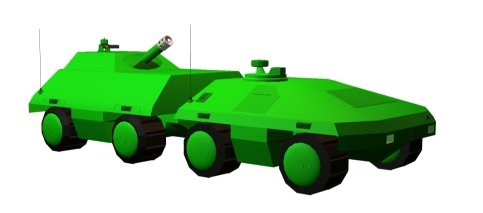
The Redkat-M represents a compromise between firepower and the weight
of the vehicle. The Army would have preferred a vehicle carrying the
standard 165mm light gun, but simulation showed there was no practical
way for the Redkat to sustain the recoil of the full power weapon while
maintaining an acceptable level of mobility. The answer lay in a reduced-power,
short-barrelled variant of the 165mm that had been developed for patrol
boats and assault craft involved in riverine
operations in Wellon’s less-lawful southern coastal regions. Type Classified
as the L73 165mm Heavy Mortar, the weapon uses standard 165mm shells
with a smaller propellant charge or specially developed light-case shells
which take advantage of the reduced firing stresses to incorporate a
heavier payload. Even with the smaller weapon, fitting it and an automatic
loader into a Mission Module was a tight squeeze and it proved impossible
to mount the weapon with 360 degrees of rotation. Instead of a turret
the weapon is mounted in a fixed barbette, with the weapon itself capable
of slewing 30 degrees either side of the vehicle centreline. A Verlet
Defender is mounted on the barbette roof and two gunners are carried
in a crew bay at the front of the Mission Module.
FV8416 Redkat Anti-Aircraft Vehicle The Redkat-AA shares considerable similarities with the Redkat-AT, but
replaces the Class-A turret with a unique version mounting twin L647A3
Plasma Guns (a rapid fire variant of the L647A2 with active cooling
and a further increased rate of fire), a Verlet Defender and a pod with
4 British Exospace Asp SRAAMs modified for
the ground-launched role. 6 Guiscard Aero-27 MRAAMs,
again modified for ground-launching, are carried in the VLS (two VLS
cells are sacrificed for plasma-cartridge stowage in comparison to the
Redkat-AT). The sensor suite is boosted to give greater range in the
air-search role although cueing from a networked long-range sensor vehicle
is needed to exploit the full range of the Aero-27s. Typically the gunner
in the Command Module will operate the turret in a point defence role
while the gunners in the Mission Module will control the Aero-27s and
manage the onboard sensors and networked data.
FV8417 Redkat Drone Launch Vehicle The Redkat Drone Launch Vehicle is intended to give infantry battalions
their own reconnaissance and attack aviation capability. The Mission
Module is entirely given over to the stowage of eight drones in vertical
launch canisters, with only a Verlet Defender mounted as defensive armament.
The FV8417 is incapable of controlling its own drones and the standard
Drone Platoon within Support Companies contains two Redkat-CPs
in addition to the two Redkat-Ds. Standard load-out
is two Snapdragon recce drones and six Hurricane
attack drones.
FV844 Redkat Armed Reconnaissance Vehicle The Redkat-ARV is a derivative of the Redkat-FS developed at the request
of RWAC’s armoured reconnaissance units after
their first experience with the Redkat. While the baseline Redkat-IFV
was mobile enough for the ARV role the recce specialists judged its
armament was too light for a vehicle that would have to operate on its
own over extended distances. Selecting the Redkat-FS as the baseline,
a joint WMV/RWAC team developed a variant optimised for the long-range
scouting role. In comparison with the Redkat-FS the troop bay has been
reduced to only three scouts and ammunition stowage for the MDC has
been almost halved, but the extra space has been used to accommodate
a further two engine modules and additional fuel giving the FV844 the
best performance of any Redkat. The sensor suite has been extensively
enhanced in comparison with standard Redkats
and the comms suite is identical to that fitted to the Redkat-CP.
Extended-range drop-tanks are a standard fitting and a Snapdragon recon
drone is carried in a canister clipped to the rear of the hull, necessitating
the replacement of the rear ramp with a small hatch). In order to best exploit the endurance of the Redkat-ARV the dismount
scouts are usually trained to function as a relief crew, allowing the
vehicle to continue to operate with one crew awake in the Command Module
while a secondary crew tries to sleep in the Mission Module’s troop
bay. The FV844 has just started to enter service with Wellonese armoured
reconnaissance units, but strong consideration is already being given
to the development of a Mod 1 vehicle mounting either the Viperelle
or Skystreak in addition to the current armament. Project start
is believed to be imminent, with entry into service scheduled for not
later than 2306.
|
||||||||||||||||||||||||||||||||||||||||||||||||||||||||||||||||||||||||||||||||||||||||||||||||||||||||||||||||||||||||||||||||||||||||||||||||||||||||||||||||||||||||||||||||||||||||||||||||||||||||||||||||||||||||||||||||||||||||||||||||||||||||||||||||||||||||||||||||||||||||||||||||||||||||||||||||||||||||||||||||||||||||||||||||||||||||||||||||||||||||||||||||||||||||||||||||||||||||||||||||||||||||||||||||||||||||||||||||||||||||||||||||||||||||||||||||||||||||||||||||||||||||||||||||||||||||||||||||||||||||||||||||||||||||||||||||||||||||||||||||||||||
18/08/05
Copyright 2005, David Gillon