Frequently asked questions
How do you decide on the poses?
Some customers have a detailed list of the poses they require, others will leave it up to me, "a set of Afrikakops please" or "ten Sioux with horses". The first task is to draw up a list of poses. This can be surprisingly difficult . The number of realistic poses that can be moulded is limited as there must be no undercuts or deep sections.
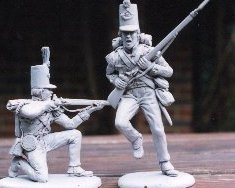
Why do the same poses reoccur in different sets of figures?Reviewers often accuse the sculptor of a lack of imagination, this is not so. it is often necessary to use similar poses in different sets as manufacturers always want to see action and lots of guns. Because of this it often comes down to the same old basic poses,i.e. standing firing rifle, kneeling firing rifle, charging with bayonet, throwing grenade etc.etc. Once these have been modeled a few more unusual figures can be added to give the set variety.
How do you ensure that all details are accurate?
After the customer has approved the poses there must be careful research into uniforms and weapons There are a lot of people out there all to ready to criticize! The excellent Osprey Books are a good place to start but in my opinion the best source of all must be contemporary photographs.
How large is the master model?
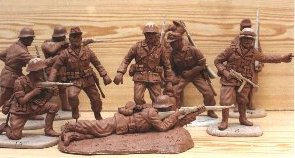
I sculpt my figures about 150mm in height This size allows a lot of detail to be modeled without the moulds becoming too large. I first make a full size sketch of the figure, this is used as a guide when making the wire armature. Clay is applied to the armature to build up the model and when the figures are finished they are photographed for final approval. Once this is given they are ready for casting.
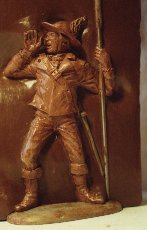
clay model ready for casting
How will a 150mm clay model become a 35mm plastic figure?
|
|
|
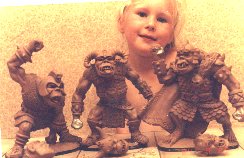
Clay models of orcs . (These figures are about 180mm) |
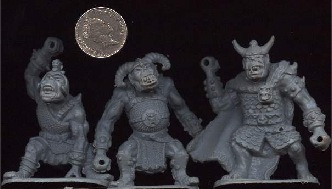
The final plastic molded figures. (These are about 60 mm ) |
The clay models are passed onto the pattenmaker who casts a two part female mould of each figure (the original clay is destroyed when this mould is split). After all the clay is cleaned out of the mould it is ready for the last stage. Using a pantograph the Toolmaker achieves the incredibly difficult task of copying and reducing in size the detail from the resin mould into a block of tool steel. the finished injection moulding tool will be assembled from more then one hundred of these blocks.