Tony Carter – Founder Member and Past Chairman C.I.G.P.E.
Editor’s Note: This is part of a short series of recollections about the formation and early days of the Group.
It is speculated that life on earth was precipitated by electrical impulses, lightning strikes impinging on the primeval sludge, creating amino acids and amoebic life forms from which man has evolved. Women, of course, had a less rough ride and were created from man’s fifth rib so, what is all the fuss about meat off the bone?
Where was I? Oh yes, those electrical impulses.
Not many people know that the Channel Islands Group of Professional Engineers started with an electrical impulse. Before that moment, all was darkness and those members of the Engineering Institutions living and working in the Island surrendered their subs to London and got little in return except news of all the exciting things that were happening elsewhere.
Not for us the edification of meetings at Savoy Place, Great George Street and Birdcage Walk, learned papers, tea and biscuits in the Members Room or the opportunity to rub shoulders with such demi-gods as The Secretary or, even, the President, to whom we rendered our tithes.
And then, into our little lives came – Mr. Balbi – and, Z-Z-Zapp, the electrical impulse. I have to say that I knew little or nothing of his genesis, except that it was said that he had been a significant figure in the Institution of Electrical Engineers. He was a slight man with a goatee beard, bright eyes and the manner of a magician. Although of mature years, he was not about to lay down and die or, to let us do so.
What brought him to Jersey, I do not know but he soon acquainted himself with the half a dozen, or so, "Electricals" who lived and worked here in those days and he held the beacon before us. It shone the more brightly when he also told us of the possiblility of getting financial support from headquarters and, hence, some of our money back.
He appointed himself as that most important of men, The Hon.Secretary, and formed us into a Sub-Centre of the i.e.E. I think that the Centre must have been somewhere in Hampshire but we, loftily, dealt only with London.
Mr. Balbi clearly knew that he was making history and arranged that our first meeting should be photographed.
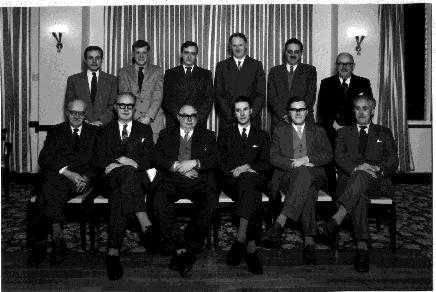
Mr. Balbi identified a suitable Chairman in the considerable shape of Sydney Longson, then The Manager (no C.E.O. or M.D. in those days) of the Jersey Electricity Company and he called us to a meeting. He also invited The Manager of Guernsey Electricity Department, Ian Young, in the first move to create a Channel Islands group – and then he arranged for us to be photographed for posterity.
The photograph shows the pioneers. In the front row, the heavyweights, and on the left Mr. Balbi himself. We only ever knew him as "Mister Balbi", though, I believe that he was known to his mother as "Charles". On his left is Brian Burt who had distinguished himself during the Second World War by converting the electrical systems on the American "lease-lend" destroyers from U.S Standards to the best of British Standards. His conversion was probably the most substantial thing about those mass-produced, all-welded, light weight vessels. He was a man of great presence and, I believe, a director of Ferguson Paillin Switchgear – a major British switchgear manufacturer before the depredations of Arnold Weinstock and G.E.C.
Next, is the solid figure of Sydney Longson, father of al well known Jersey architect of the same name. The senior Sydney was the Manager of the J.E.C. and his elegant neighbour is Ian Young who presided over Guerney Electricity.
The genial, bespectacled, young person in the front row is John Iceton who was responsible for bringing Jersey’s electrical distribution and protection systems to the state of the art and completing the Jersey front row, is Len Hawkley, Commercial Manager of the J.E.C., raconteur, author of a history of the J.E.C. and general nice guy. He became the Group’s first Treasurer and, subsequently a Chairman.
The back row, from the right, reveals George Burt, M.D. of Tubeolight, manufacturers of illuminated signs, and, on his right, Terrence Gaudin, another Jersey business man. The tall fellow is Fred Shute, who was the able assistant to John Iceton and to his right, a mystery man. A mystery to me, that is, but I think that he worked at T.V. Research, one of the light engineering companies that were able to operate in Jersey at that time. His neighbour is Norman Medway, an engineer with R.C.A. who made video heads for the embryonic video recorder market. Both of those companies have now been lost to Jersey and, with them, opportunities in engineering for young people.
Last, but, I hop, not least, is yours truly. I was responsible for the mechanical and electrical engineering aspects of the construction and operation of the Bellozanne plant and the island’s main drainage system.
At our first meeting, we electricals could not have inspired ourselves with much confidence because a proposal to expand to include Mechanicals and Civils was soon adopted and the Joint Group was born. You will also note from the letter from our Treasurer that high finance was also much on our minds. I wonder if our younger members will be able to translate 7/6d into "seven and sixpence" or 37.5p. A modest price for such a record.
In our early days, we were rather high minded and conscious of our "learned society" status. Subjects of lectures were somewhat abstruse. I recall a lecture by a visiting expert on high voltage d.c.transmission technology – totally lost on the civils and mechanicals and even deeply mysterious to the electricals. We soon learned to keep it light, well illustrated and accompanied by food and wine. Female company was provided by our only lady – member Sarah Ferguson, a grand daughter of Brian Burt, and she must have been relieved when our meetings were open to guests, both male and female.
I think that we preceded the development of the integration of the engineering fraternity in the U.K. where the Council of Engineering Institution was formed. The Jersey Joint Group of Electrical, Mechanical and Civil Engineers opened its membership to all grades of member of other engineering institutions represented in Jersey at a very early stage. This wise step helped to make the Group the vigorous body that it is today.
One of the first Group Chairman was William Wedgewood, the M.D. of the Jersey Gas Company. Bill had style and a strong sense of dignified image. He travelled to his office in a chauffeur driven Daimler – Jag, wearing a black jacket and pin stripe trousers. He soon recognised the need for a chain of office for the Group Chairman and generously donated the magnificient bauble still sported by the Chairman. Gold name plates are attached to the supporting ribbon to record the long succession of chairman and it is now beginning to resemble a flak jacket. Future Chairman are likely to be chosen for their capacity as weightlifters as much as for their other qualities.
I served my turn as local Secretary, Group Secretary and eventually, Chairman and I am delighted to see the next generation of my family take over the reins of the Group.
It may be that, in my rambling, I have made one or two factual errors and, if so, I would welcome correction – if only as a signal that there is someone else out there with fond memories of a happy association and pride in the achievements of the Group.