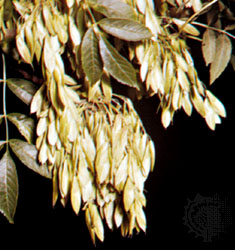
Eighteen species of ash are found in the United States, with five furnishing most of the ash lumber cut. The most important are the white ash (F. americana) and the green ash (F. pennsylvanica), which grow throughout the eastern and much of the central United States and northward into parts of Canada. These two species furnish wood that is stiff, strong, resilient, and yet lightweight. This "white ash" is used for baseball bats, hockey sticks, paddles and oars, tennis and other racket frames, and the handles of shovels, spades, hoes, rakes, and other agricultural tools.
The black ash (F. nigra) of eastern North America, the blue ash (F. quadrangulata) of the Midwest, and the Oregon ash (F. latifolia) of the Pacific Northwest furnish wood of comparable quality that is used for furniture, interior paneling, and barrels, among other purposes. The Mexican ash (F. uhdei), a broad-crowned tree that is widely planted along the streets of Mexico City, reaches a height of 18 m and has leaves with five to nine leaflets.
The European ash (F. excelsior), with 7 to 11 leaflets, is a timber tree of wide distribution throughout Europe. A number of its varieties have been cultivated and used in landscaping for centuries. Notable among these are forms with dwarf-like or weeping habits, variegated foliage, warty twigs and branches, and curled leaves. The flowering ash (F. ornus) of southern Europe produces creamy white, fragrant flowers, has leaves with seven leaflets, and reaches 21 m. It is also known as manna ash for a laxative that is extracted from its gum. The Chinese ash (F. chinensis) yields Chinese white wax.