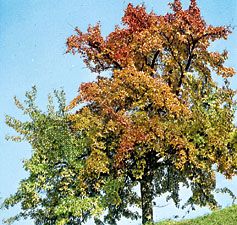
A beech of the family Fagaceae is tall, round-headed, and wide-spreading, with smooth, steel-gray bark and alternate, toothed, parallel-veined, shiny green leaves. Yellow-green male flowers hang from threadlike stems; the female flowers, usually in pairs on short, hairy stems on the same tree, develop into prickly burs enclosing three-sided, sweet-flavoured nuts.
The American beech (F. grandifolia), native to eastern North America, and the European beech (F. sylvatica), distributed throughout England and Eurasia, are the most widely known species. Both are economically important timber trees, often planted as ornamentals in Europe and North America; they may grow to 30 m (100 feet). The narrow, coarsely saw-toothed, heavily veined, blue-green leaves of the American beech are about 13 cm (5 inches) long and turn yellow in autumn; the slightly shorter, egg-shaped, dark-green leaves of the European beech turn red-brown in autumn but, in mild climates, persist through the winter.
Pale, red-brown beech wood, durable under water, is valued for indoor use, tool handles, and shipping containers. The nuts provide forage for game animals, are used in fattening poultry, and yield an edible oil.
Beeches are often cultivated as ornamental and shade trees, especially varieties of the European beech, such as the copper, or purple, beech, with copper-coloured foliage; the Dawyck beech, a narrow, spirelike, glossy-leaved tree; the fernleaf, or cut-leaved, beech, with narrow, deeply lobed, fernlike leaves; the oak-leaved beech, with deeply toothed, wavy-margined, oaklike leaves; and the weeping beech, with long, pendulous branches and wide-spreading, horizontal limbs.
Beeches grow best in sandy loam. They are slow-growing but may live to 400 years or more. Propagation is usually by seed; the shallow, spreading root system often sends up suckers that may grow into thickets.