

 tiny
animals in the plankton, which is eaten by little fish which in turn are eaten
by bigger fish and so on up through the food chain. Plankton has been studied
by marine scientists for decades and in I 920 the British Parliament agreed on
the need for a program of biological exploration to preserve the country's
rich whaling industry. The research team was led by Stanley Kemp and
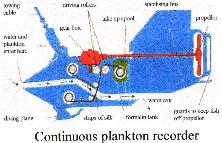
Alister Hardy was chief zoologist and he designed a continuous plankton
recorder which when towed through the water trapped plankton on a roll of silk
which was then covered by another roll of silk and rolled into a preserving
tank full of formalin and later taken to the laboratory for study. With this
device he probed the depths to 600ft across the oceans and discovered that the
sea is not covered with a continuous and uniform blanket of plankton but has
patches here and there which creatures must search out in order to survive. The
main food of whales is Krill and Krill exists in the oceans in such numbers
that their total weight is greater than all the weight of all the humans on
Earth.
tiny
animals in the plankton, which is eaten by little fish which in turn are eaten
by bigger fish and so on up through the food chain. Plankton has been studied
by marine scientists for decades and in I 920 the British Parliament agreed on
the need for a program of biological exploration to preserve the country's
rich whaling industry. The research team was led by Stanley Kemp and
Alister Hardy was chief zoologist and he designed a continuous plankton
recorder which when towed through the water trapped plankton on a roll of silk
which was then covered by another roll of silk and rolled into a preserving
tank full of formalin and later taken to the laboratory for study. With this
device he probed the depths to 600ft across the oceans and discovered that the
sea is not covered with a continuous and uniform blanket of plankton but has
patches here and there which creatures must search out in order to survive. The
main food of whales is Krill and Krill exists in the oceans in such numbers
that their total weight is greater than all the weight of all the humans on
Earth.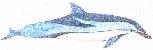 A newly dead Striped Dolphin was found washed up on
Woolacombe Beach about mid February and because the dolphin was still fresh the
Natural History Museum decided to carry out an autopsy and the dolphin was
buried until they collected it. They hope to find out whether pollution was the
cause of death. The Striped Dolphin is a beautiful animal with a striking
pattern on its flank and a stripe from its eye nearly back to its tail, and
often with a bright pink underside. It is not a rare dolphin but is not often
seen close inshore.
A newly dead Striped Dolphin was found washed up on
Woolacombe Beach about mid February and because the dolphin was still fresh the
Natural History Museum decided to carry out an autopsy and the dolphin was
buried until they collected it. They hope to find out whether pollution was the
cause of death. The Striped Dolphin is a beautiful animal with a striking
pattern on its flank and a stripe from its eye nearly back to its tail, and
often with a bright pink underside. It is not a rare dolphin but is not often
seen close inshore. The winter months have seen the usual crop of beach casualties. By the end of February over 100 dead sea birds such as Guillimots and Razorbills have been found on Cornish Beaches, most of these were badly oiled and were thought to be victims of rogue ships illegally washing out their tanks at sea. Carcasses of Seals, Common and Stripped Dolphins, Porpoises, and one Pilot Whale have also been found, 19 stranding's on Cornish Beaches and 13 in Devon.
Sightings of living cetaceans have been few during February, two Bottlenosed Dolphins were seen off Marazion on the 2nd, and an Adult with a juvenile off Porthpean, St. Austel Bay on the 15th. Basking Sharks are not often seen during the winter months but they have been seen this winter, one was seen at Lamorna on December 5th and another off Chyandour on the 19th February.
You may recall that I brought around a petition form for you to sign last year against the shooting of birds in France. The French government took the first step to coming in line with the European Union on February 16th with tighter hunting laws, but I don't think there is much to cheer about yet for local police chiefs will set the dates of the hunting season between Sept. 1st and Jan.31st, but as most of our migratory birds would be passing over France in March and April and the notoriously bad record of France in enforcing existing laws, I fear the situation has little improved.
