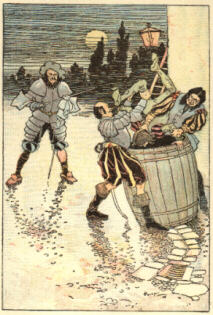
THE-POOR-LITTLE-PAGE:TOO-HIMSELF
GOT-NO-QUARTER.

BACK
TO CATALOGUE
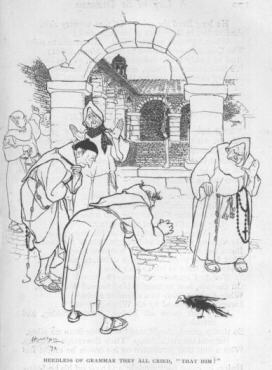
HEEDLESS OF GRAMMAR THEY ALL CRIED "THAT HIM"
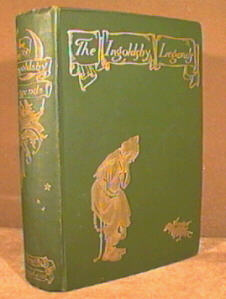
THE INGOLDSBY LEGENDS |
Introduction THE first appearance in
collected form of The Ingoldsby Legends ; or, Mirth and
Marvels, by Thomas Ingoldsby, Esquire, was in three
separate series, the first in 1840, the second in 1842,
and the third, posthumously, in 1847; and it was in his
son's preface to this third series that the name of the
Rev. Richard Harris Barham was first attached to the
book, although it had long been pretty generally known
that he was the author. The Legends had been appearing in
various periodicals for some years before they were thus
collected in volume form ; the London Chronicle, of which
he was the last editor before its change of name to the
St James' Chronicle, containing some of the earliest.
Some also appeared in Blackwood's Edinburgh Magazine, but
the larger number first saw light in Bentley's
Miscellany, some of the latest appearing in Colburn's New
Monthly Magazine. It was at Bentley's suggestion,
however, that the Legends were published in collected
form, and the prefaces here reprinted to the first and
second series are characteristic letters from Barham
addressed to Richard Bentley, Esq., whose judgement is
amply evidenced by the large sale and continued
popularity, of the volumes. Richard Harris Barham, who
came of an old Kentish family, was the only son of his
father, who bore the same name. He was born at
Canterbury, the 6th of December 1788 and considered that
he could trace his descent through that Sir Randal
Fitzurse, who was one of the murderers of Thomas a
Becket, back to one Ursus, who came over with the
Conqueror. His father owned a farm known' as Tappington
or Tapton Wood, the Tappington Everard of the Legends,
and it was here that, in 1798, he died, leaving young
Barham, whose mother was in very delicate health, to the
care of guardians. At the age of nine he was sent to St
Paul's School and on one occasion when he was about
fourteen, on his way back to the school by the Dover
coach, he met with an alarming and painful accident
through the bolting of the horses at Bricklayers' Arms.
The driver and guard had both jumped off, and he
imprudently put his hand out to open the door when, the
coach overturning, his right arm was caught beneath it,
and in this position he was dragged along for some
distance, his hand beirtg fearfully crushed and nearly
torn off On his arrival at the school Mrs Roberts, the
wife of the High-Master, who regarded him with unusual
interest, gave him the most motherly attention, and
although the doctors feared the worst, nursed him to
convalescence. At St Paul's School, amongst others who
were life-long friends, he met Richard Bentley, whose
name must always be associated with the Ingoldsby
Legends; and it was whilst he was here that his first
verses were published, and received favourable notice
from " Mr Sylvanus Urban " in the Gentleman's
Magazine. He was often a guest at the house of Dr and Mrs
Roberts, where he was encouraged to read or recite some
of his own compositions, and here he met Miss Smith
(afterwards Mrs Bartley) the actress, and was by her
instructed in the art of elocution. On leaving St Paul's
School he entered Brasenose College, Oxford, where
amongst his friends he numbered Lord George Grenville,
afterwards Lord Nugent, and Theodore Hook. Whilst at
Oxford, although he studied hard, chiefly at night, his
days were spent as far as possible mixing in society ;
this seems to have led him at one period into rather high
play ; in fact, on one occasion he lost so heavily that
he was unable to pay. His application to one of his
guardians for an advance was met with a decided refusal,
but a refusal accompanied by the most sensible advice,
and what was equally to the point the free gift of the
sum required. This had its effect; for from that time he
never gambled, nor would he even embark in any investment
of the least speculative character. At this period, and
in fact throughout his life, the theatre had great
attractions for him. When at home in Kent for the
vacations he was a constant attendant at the theatre at
Canterbury, both before and behind the scenes, on one
occasion at least writing an epilogue to be spoken at an
amateur performance given by the officers quartered in
that city. He had been originally intended for the bar,
and had, in fact, for a short time read with Mr Chitty,
but after a severe illness, and perhaps influenced by the
death of a college friend under somewhat painful
circumstances, he decided to devote himself to the
church. He was a man of unfeigned but unostentatious
piety, as every reader of his life, written by his son
and interspersed with his own letters, will know. In 1813
after taking his B.A. degree, he was appointed to the
curacy of Ashford in Kent, being transferred the
following year to that of Westwell, also in Kent, and
worth £70 per annum, in which he was succeeded in i 82o
by the Rev. G. R. Gleig, author of The Subaltern and
other military novels and biographies, and afterwards
chaplain-general of the forces. In 1814 he married
Caroline, third daughter of Captain Smart of the Royal
Engineers, who, taken ill at the same time as he was,
only outlived him a few years. At Westwell two boys were
born to him, one of whom died in infancy. In 1817 he was
appointed rector of Snargate and curate of Warehorn, one
in Romney Marsh and the other on the borders, a district
mentioned and described in more than one of the Legends.
His first novel, Baldwin, and the earliest chapters of My
Cousin Nicholas, were written about this time, during an
enforced rest through a broken leg and sprained ankle,
the results of an accident whilst he was out driving In
1821 he met in London one day a friend who was on his way
to post a letter to another clergyman, recommending him
to apply for a Minor Canonry at St Paul's, then vacant ;
his friend, instead of posting the letter, mentioned the
matter to Barham, who applied and received the
appointment. At this time Dr Hughes (grandfather of the
author of Tom Brown's School-days) was
Canon-residentiary, and to this fact lovers of the
Ingoldsby Legends are much indebted, for it was from Mrs
Hughes and Mr John Hughes, the Canon's wife and son, that
Barham derived the traditionary materials upon which many
of them are founded ; readers of his life, before
referred to, will also remember the many charming letters
to this lady there printed. His first permanent residence
in London was some distance from the cathedral, being in
Great Queen Street, Lincoln s Inn Fields, and here, in
addition to the two sons and two daughters he already
had, another daughter was born. In 1824, in addition to
his Minor Canonry at St Paul's, he received the
appointments as priest in ordinary to His Majesty's
Chapels Royal, and incumbent of the joint parishes of St
Mary Magdalen and St Gregory by St Paul's. His parochial
work now made it necessary for him to remove, and we find
him occupying a house on the south side of St Paul s
Churchyard, at the entrance to Doctors' Commons and the
Deanery; here, in 1825, he lost his eldest daughter. In
August 1825, through the introduction of his friend John
Hughes, his poem the Ghost, a Canterbury Tale appeared in
Blackwood's Magazine, although it had previously been
published in three instalments in the London Chronicle.
It was about the end of this year that he renewed his
acquaintance with his old college friend Theodore Hook,
so celebrated at that time amongst other things for his
facility of improvisation, a faculty in which Barham was
very nearly his equal : his biographer mentions the fact
that Mr Barney Maguire's Account of the Coronation was
composed in this way and published with but slight
alteration. He says of himself that he never to his
knowledge wrote anything pretending to originality either
in conception or execution ; there is no doubt, however,
that, whether in writing or conversation, he was both
ready and fluent. In May 1828 he acted as one of the
stewards of the Literary Fund Dinner, an institution with
which he was connected for many years. And when in 1831
the Garrick. Club was founded he was one of the original
members, and at the inaugural dinner some lines which he
had written for the occasion were sung, set as a glee.
During the cholera epidemic in 1832, he had a very sudden
bereavement in the loss of his second son, who, from
perfect health was taken ill, ,died, and was buried
within twenty-four hours. Some time in the early part of
1834, knowing of the existence of some portion of his
novel, My Cousin Nicholas, Mrs Hughes borrowed the MS.,
and liking the story herself, sent it to Blackwood for
his approval, and the first intimation that Barham had of
the transaction was his receipt of the magazine
.containing all that had been written, with a request for
more copy for the next month s number. In March of this
year he became Chaplain to the Vintners' Company, in
which capacity, besides saying grace at their dinners, he
paid weekly visits to the Alms-houses in the Mile End
Road conducting divine service, and visiting and patching
up disagreements amongst the alms-women, whom, in one of
his playful letters to Mrs Hughes, he describes as my
seraglio of twelve elderly odalisques Bentley's
Miscellany was started in January 1837, with Charles
Dickens as its editor, and it was only to be expected
that Bentley should invite his old friend to become one
of the regular contributors, and here the |
|
|
|
|