
BACK TO CATALOGUE
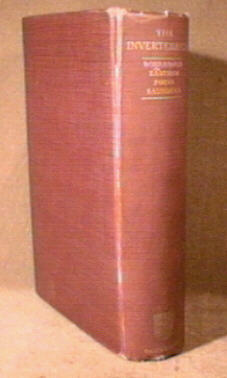
THE INVERTEBRATA |
PREFACE This book is intended for the use of
students who have completed a year's study of the
principles of zoology and of the anatomy and physiology
of a series of invertebrate types such as is provided by
any of several elementary textbooks in use in this
country. The types commonly included in these
books-various Protozoa, Hydra, Ascaris, and the Liver
Fluke, Earthworm Leech, Crayfish, Cockroach, Pond Mussel,
and Starfish-are not here described in detail. We have
endeavoured to provide the student with a classification
of the Invertebrata which proceeds as far as is usual in
an honours course, with a concise statement of the
characteristic features of each of the groups mentioned,
and with a more detailed statement and discussion of
matters of importance or interest concerning them. The
choice of examples has been difficult, and we have not
always been able to include all those we should have
wished, but a fairly full account of certain
representative genera has been given. The writing of the
book has been shared among us as follows : Chapters I-IV,
X, XI (except Onychophora), XII, XVIII and XIX have been
written by L. A. Borradaile, Chapters V (except
Ctenophora), VII-IX, XIII, XV-XVII, and the Onychophora
in Chapter XI by F. A. Potts, Chapter VI and the
Ctenophora in Chapter V by J. T. Saunders, and Chapter
XIV jointly by F. A. Potts and L. E. S. Eastham, but each
of us has read and criticized the work of the others. We
desire to express our grateful thanks for valuable advice
and criticism to Dr S. J. Hickson, Professor D. Keilin
and Dr S. M. Manton ; for much care bestowed upon the
illustrations to Messrs A. P. Hayle, J. F. Henderson, and
C. F. Pond; and for valuable assistance in the
preparation of the index and in other matters to Mr B.
Newman. 'For permission to reproduce illustrations
acknowledgement is due to Messrs Geo. Allen & Unwin,
Ltd. (Textbook of Zoology, Sedgwick); Messrs A. 8z C.
Black, Ltd. (Treatise on Zoology, ankester): the Council
of the Cambridge Philosophical Society (Biological
Reviews); Cambridge University Press (The Determination
of Sex, Doncaster, Plant Biology, Godwin, Ciliary
Movement, Gray, Zoology, Shipley and MacBride, Primitive
Animals, Smith, Palaeontology, Wood) ; Herrn Gustav
Fischer, Jena (Ergebnisse u. Fortschritte der Zoologie,
Lehrbuch der Pyotozoenkunde) ; Herren Walter de Gruyter
& Co. (Handbuch der Zoologie) ; the Council of the
Linnean Society of London (Zoological Journal) ; Messrs
Macmillan & Co., Ltd. (Cambridge Natural History,
Harmer and Shipley, Human Protozoology, Hegner and
Taliaferro, Textbook of Comparative Anatomy, Lang,
Textbook of Zoology, Parker and Haswell) ; Messrs Methuen
& Co., Ltd. (Textbook of Entomology, Imms); Oxford
University Press ( The Animal and its Environment and
Manual of Zoology, Borradaile). Acknowledgement to the
authors of the works from which these illustrations are
taken is made in the legends. |
TABLE OF CONTENTS CHAPTER I Introduction: The
Invertebrata Order Gregarinidea Subkingdom Parazoa Subkingdom Metazoa Phylum Coelenterata Phylum Platyhelminthes Phylum Nemertea Phylum Nematoda CHAPTER IX Phylum Annelida Phylum Arthropoda Subphylum Onvchophora Subphylurn Crustacea Subphylum Myriapoda Subphylum Insecta
(Hexapoda) Subphylum Arachnida |
INTRODUCTION The Invertebrata have long since ceased to constitute one of the primary divisions in the scientific classification of the Animal Kingdom. Their name is now no more than a convenience for designating a group of phyla with which it is often necessary to deal as a whole. The primary lines of real cleavage in the Animal Kingdom divide it, not into Vertebrate and Invertebrata, but into three unequal sections, the Protozoa, Parazoa and Metazoa, which are ranked in the following chapters as subkingdoms. Between the Protozoa, which are without cellular differentiation and contain a large group of photosynthetic members, and the Metazoa, in which such differentiation is always strongly marked and photosynthesis is absent, there is a gulf which is in fact far deeper than that which sunders the Protozoa from the lower plants. The view, indeed, has been put forward that these two components of the Animal Kingdom are not, as is usually held, directly related to one another, but arose, with the Plants, as entirely distinct branches of an ancestral stock of living beings. The Parazoa or sponges-unique among many-celled organisms in possessing collared flagellate cells are probably derived from the Protozoa by an origin distinct from that by which the latter group gave rise (if they did so indeed) to the Metazoa. Within the Metazoa, the most significant difference is that which exists between the Coelenterate or Diploblastica and the triploblastic phyla which constitute the rest of the subkingdom. The Coelenterate, which typically start life as a simple, two-layered, ciliate larva, the planula, either retain throughout life the two-layered condition, or depart from it only by the immigration, late in development, of cells from the two primary layers (ectoderm and endoderm, p. 120) into the space (blastocoele) between those layers. The triploblastic animals always possess a true third layer (mesoderm) which is early developed and forms important organs. They are the great majority of animals, and compose a number of phyla. The brigading of these phyla is a difficult task-one, indeed, which it is at present impossible to effect completely. Two main stocks, however, stand out fairly clearly. The Annelida, Arthropoda and Mollusca-by the plan of their central nervous system, the mode and position of origin of their mesoderm, the types of cleavage of the ovum and of larva (the trochosphere) which the Annelida and Mollusca share, and the cuticle and segmentation which the Annelida and Arthropoda have in common-constitute one of these stocks. The other comprises the Echinodermata and Chordata. Its members exhibit a common mode of origin of the mesoderm, primitively as hollow pouches, from the gut wall; they possess, or give indications of, three primary mesodermal segments; the cleavage of their ova is entirely different from that which is characteristic of the Annelida and Mollusca; and between the larvae of the lowest chordates (the Enteropneusta) and those of certain echinoderms there is a remarkable and detailed resemblance. The remaining phyla, smaller and less important, are difficult to relate either to the foregoing groups or to one another. By the type of cleavage of their ova and the possession of flame cells (p. 107), the Platyhelminthes or flatworms seem to be related to the annelid stock. Their lack of coelom is a difficulty in this respect. The structure of the adults of the Rotifera and of the larva of the Polyzoa, which has the character of a trochosphere, might link these groups to the same stock. Some other small phyla (Brachiopoda, Chaetognatha) have possibly distant relationship to the echinoderm-chordate grouping. Others, notably the Nematoda, are extremely isolated and enigmatical. In the great assemblage of triploblastic phyla, the backboned animals, or Vertebrata properly so-called, stand as a branch of one phylurn, the Chordata. Yet their considerable numbers, the size, high organization, and intelligent activity of their members, and the fact that Man is one of them, give them an importance so great that they have always been the subject of a distinct department of zoological study, and were at one time regarded as a primary branch of the Animal Kingdom. That standing they have lost; but it is still necessary for many purposes to treat them apart. The term " Invertebrata" is retained to cover all the non-chordate phyla and the chordates other than the Vertebrata. In that sense it is used in this book. Only the Cephalochorda (Amphioxus), which, though they are not vertebrates, have much in common with those animals, are left aside as best studied with them. The limits of the several phyla are, with one or two exceptions, agreed among zoologists. As much cannot be said for the lower grades of the classification. Different views upon phylogeny, and considerations of convenience, lead to many divergences as to the extent and rank of the various divisions in the systems preferred by different authorities; and even when there is agreement as to the limits of a group different names may be applied to it. In no two works will quite the same arrangement be found. This fact should be borne in mind by the student in using the table of classiflcation which will be found as the Table of Contents at the beginning of this book. |
|
|