United
Artists for Kosovo children
A
personal account of three weeks spent in Marcadonian Refugee camps, facilitating
a creative dance theatre programme for Kosovan refugee children by Claire Burrell.
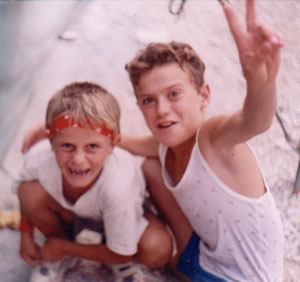 In
response to the Kosovan crisis, Rise Phoenix, a London based Children's Theatre
Charity, set out to respond to the thousands of children who were presently
living in very difficult camp conditions having witnessed the terrible atrocities
of war. They called for volunteers, artists, teachers and creative people, who
were willing to give one month of their time to help the children reclaim a
sense of their lives. As a dance movement/theatre artist with a strong conviction
in implementing the healing power of the arts I decided that this was my chance
to actively respond with a style of intervention founded on unity and creativity
where the military intervention of my own nation had actively contributed to
the destruction of lives, homes and culture.
In
response to the Kosovan crisis, Rise Phoenix, a London based Children's Theatre
Charity, set out to respond to the thousands of children who were presently
living in very difficult camp conditions having witnessed the terrible atrocities
of war. They called for volunteers, artists, teachers and creative people, who
were willing to give one month of their time to help the children reclaim a
sense of their lives. As a dance movement/theatre artist with a strong conviction
in implementing the healing power of the arts I decided that this was my chance
to actively respond with a style of intervention founded on unity and creativity
where the military intervention of my own nation had actively contributed to
the destruction of lives, homes and culture.
Operating
from Skopije, and supported by the UNICEF's psychosocial support programme,
Rise Phoenix had set out with clear objectives and intentions of practice. Beginning
with the establishment of a communal place of work, the aim was to foster and
encourage trust and friendship amongst children, to inspire, educate and socialise
in an effort to get them back in touch with their own creativity. Dragan Matijevic,
Head Co-ordinator at Rise Phoenix, suggested simply, that the key to the work
with the children was " to remind them that there was more to life than the
horrors they had just seen." The collaboration with UNICEF brought into focus
The Convention on the Rights of the Child as an umbrella for the project. The
Convention stands alone as the single most comprehensive instrument of human
rights law and remarkably has been ratified by 176 of the world's191 countries.
I have included some of it's articles, they have been interpreted by children,
for children and so are easy to understand.
Article
22
If you are a refugee (meaning you have to leave your own country because it
is not safe to live there), you have the right to special protection and help.
By
the time I arrived, in early August the project had already been up and running
in Marcadonian camps for six weeks. I was accompanied by two dance artist colleges
and we were all eager to commence our phase of the project. Our main focus was
to be in Refugee Camp Neprosteno, situated just outside the predominately Muslim
town, of Tetova. The war was over, those who could go back home were leaving
the camp, those who had money, contacts abroad or luck on their side had taken
their chances and moved on to begin new lives. The atmosphere in the camp was
heavy with anxiety, as the people who remained played a waiting game. Exhausted
by the devastating traumas of the previous months there was little energy left
to invest in any concept of a future tense .
Article
38
If
you have been hurt or neglected in any way, for instance in a war, you have
the right to special care and treatment.
The
initial meeting with the children of Neprosteno was both powerful and overpowering.
My diary entry reads ; " two hours after arriving home in Skopije, I can still
feel the presence of tiny hands, needy hugs, cheek pinches and kisses by the
million. Never have I received such a concentrated display of love and affection
". The camp, with it's military tents pitched on hard white gravel, supplied
a roof, food rations, running water and medical assistance. Large family tents
contained little more than the bedding provided by the camp, as most had fled
with nothing but the clothes on their backs. As adults struggled to come to
terms with all that had surpassed, children were left to run wild. Dirty and
smelly they amused themselves with aggressive games of Tag and stone throwing.
Article
3
Whenever
an adult has anything to do with you, he or she should do what is best for you.
To
respond to the situation of children departing from the camp we decided to facilitate
workshops in two tents. In a large tent, an open workshop catered for a large
group, while, a core group of twelve children, who would be returning to Kosovo
at the end of the week, had the more focused experience of working towards a
short performance. We decided that the fairy story " The Ugly Duckling" by Hans
Christian Anderson could provide a framework for the children to explore their
own stories, It was not the intention to unlock trauma but to provide a structure
for reconstruction, re-establishment and a re-connection to the self. The ugly
duckling character was played by myself in order to avoid both competition and
isolation, and to give the children the opportunity to play the role reversal
of their experience.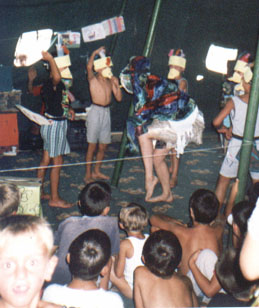
The
story was translated and told in Albanian (by our invaluable translator), and
the children created movement, text and sound to support their journey. The
story begins ; " There once was an ugly duckling, with feathers all stubby and
brown, and all of the birds, in so many words, said: " Quack! Get out of town
!"", and of course all them had been forced to flee their own homes on the grounds
of difference. The story continues "all through the winter time he hid himself
away" and again the children remembered only too well the time they had spent
in the mountains, hungry and afraid. The story ends with the ugly duckling's
acceptance back into the community and as most of the children, found, the prospect
of re-entry into Kosovo both painful and frightening, it seemed important to
inspire possibilities of growth, transformation and the realisation of change.
The children delighted in sharing the performed work to an audience of families,
bringing their hard made costumes and characters into life.
Article
30
If
you come from a minority group, you have the right to enjoy your own culture,
practise your own religion and use your own language.
Working
with the children provided a ripple effect throughout the camp society. It was
seen that through the children's imaginations there could be a way of awakening
the future for older generations. Andrew Caddell, an information officer for
UNICEF in Skopije Marcadonia wrote in his feature "The Healing Power of the
Arts", " Theatre provides hope in the sense that when the parents see their
children laughing, they realise that they still have live in them, that they
can still dream. And that provides genuine hope for a new beginning." Through
dance, conscious and unconscious expression of movement, the children gained
strength in the re-establishment of themselves and located that physicality
within their present situation.
Article
31
You
have the right to play.
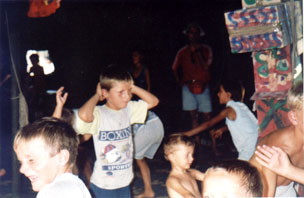
The
big tent, which was often unfocused, noisy and chaotic, brimmed with children
of all ages and was sometimes successful in engaging adults, desperate for inclusion
and stimulation. A wide range of physical movement based activities, dynamic
games and creative play were offered to support participants in developing an
interplay which communicated way beyond the boundaries of verbal and cultural
limitations. Stretching and bending, hugging and releasing, jumping and landing
required an exploration of personal boundaries while working with partners provided
a platform to negotiate support, balance and trust. There was much laughter
and constant tears as the children fought with each other in a ceaseless competition
for space, attention and material things. Fighting was a very real feature in
their lives and the survival of the fittest very much the law of the land.
Article
19
No
one should hurt you in anyway. Adults should make sure that you are protected
from abuse, violence and neglect. Even your parents have no right to hurt you.
On leaving
the camp, on our final day, there were many tears. It was obvious that the contact,
encouragement and support that we were able to give the children in communicating
and expressing their emotions and ideas had been both valuable and vital to
their time spent in the camp. But, now it was over and we were leaving to go
back to our homes and our promising futures. And suddenly a drop in the ocean
experience became a desperate cry to humanity. How many times can we ask the
children to trust us? How many times will we walk away?
Article
42
All
adults and all children should know about this Convention. You have the right
to learn about your rights and adults should learn about them too.
Article
6
Everyone
should recognise that you have the right to live