


RESEARCH INTO OVARIAN CANCER
FUNDING THE VITAL RESEARCH
ROC and it's supporters intend to raise £1 million, that is £200,000 a year for the next five years to fund the research work of the Ovarian Cancer Screening Unit.
THE RESEARCH PROGRAMME
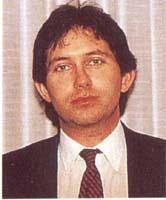 Ian
Jacobs is a consultant gynaecological oncologist at St Bartholomew's
and the Royal London Hospitals. He undertook his basic training in
Cambridge and at the Middlesex Hospital in London. Subsequently he
completed a clinical training in obstetrics and gynaecology at the Royal
London Hospital and at Addenbrooke's Hospital in Cambridge. He interrupted
his clinical training to set up the ovarian cancer screening research programme
at the Royal London Hospital and, at a later stage, to take up an MRC fellowship
in molecular carcinogenesis at Duke University in the USA. On returning
from the USA he was the Cancer Research Campaign McElwain Fellow in Cambridge.
He completed his clinical training by undertaking a fellowship in gynaecological
oncology at St Bartholomew's and the Royal Marsden Hospitals. In
1996 he was appointed to his current post which involves both surgical
care of patients with gynaecological cancer and direction of the Gynaecological
Cancer Research Unit at St Bartholomew's and The Royal London Hospitals.
In addition to directing the molecular and clinical studies organised through
this unit, he is co-ordinator of national collaborative studies of surgery
in ovarian cancer (MRC) and of screening for familial ovarian cancer (UKCCCR)
Ian
Jacobs is a consultant gynaecological oncologist at St Bartholomew's
and the Royal London Hospitals. He undertook his basic training in
Cambridge and at the Middlesex Hospital in London. Subsequently he
completed a clinical training in obstetrics and gynaecology at the Royal
London Hospital and at Addenbrooke's Hospital in Cambridge. He interrupted
his clinical training to set up the ovarian cancer screening research programme
at the Royal London Hospital and, at a later stage, to take up an MRC fellowship
in molecular carcinogenesis at Duke University in the USA. On returning
from the USA he was the Cancer Research Campaign McElwain Fellow in Cambridge.
He completed his clinical training by undertaking a fellowship in gynaecological
oncology at St Bartholomew's and the Royal Marsden Hospitals. In
1996 he was appointed to his current post which involves both surgical
care of patients with gynaecological cancer and direction of the Gynaecological
Cancer Research Unit at St Bartholomew's and The Royal London Hospitals.
In addition to directing the molecular and clinical studies organised through
this unit, he is co-ordinator of national collaborative studies of surgery
in ovarian cancer (MRC) and of screening for familial ovarian cancer (UKCCCR)
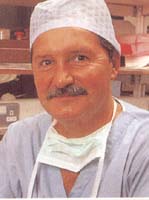 David
Oram gained his original medical degrees at King's College Hospital,
London, and later trained as a cancer specialist at Georgetown University,
Washington DC. For the past 12 years he has been consultant gynaecological
oncologist at the Royal London Hospital dealing with cancers of the cervix,
uterus, vagina and ovaries, as well as conducting research.
David
Oram gained his original medical degrees at King's College Hospital,
London, and later trained as a cancer specialist at Georgetown University,
Washington DC. For the past 12 years he has been consultant gynaecological
oncologist at the Royal London Hospital dealing with cancers of the cervix,
uterus, vagina and ovaries, as well as conducting research.
Ovarian cancer is the most lethal of gynaecological cancers. Each year over 4,000 women in the United Kingdom die from this cancer - more than twice as many as cancer of the cervix. Over 75% of women with cancer of the ovary have disease which has spread outside the ovary when they first see a doctor. At present, 72% of women with cancer of the ovary die within five years, compared to 38% and 42% with cancer of the breast and cervix, respectively. By contrast, in the small number of cases that are detected early (while the cancer is still confined to the ovary) treatment is highly effective; 90% of these patients will survive five years. It has long been suggested that many lives could be saved if a technique became available to detect more cases of ovarian cancer at an early stage.
Screening Techniques
The concept of early detection became a realistic objective with two important developments during the last decade. First, the monoclonal antibody technique was applied to produce antibodies directed against ovarian cancer. By using ovarian cancer cells to stimulate the immune system, it was possible to produce antibodies which recognise proteins in the blood of women with cancer of the ovary. Antibodies produced in this way are known as tumour markers. One of the earliest and most useful antibodies was called CA 125, but others are now available. Secondly it was found that ultrasound scanning could be used to observe the ovaries and detect abnormalities. Ultrasound is used routinely during pregnancy to observe the well-being of the developing baby. Improvements in the technique made it possible accurately to visualise and measure the ovaries so that the changes in the shape, size and appearance of the ovaries associated with cancer can be detected.
Screening Studies
The availability of CA 125 and ultrasound raised great hopes among scientists world-wide that screenng for ovarian cancer would be possible. The largest studies designed to assess the newly available tests involved women from the UK and were co-ordinated at The Royal London Hospital and King's College Hospital, London. The results of these studies have revealed that both CA 125 and ultrasound can detect many cases of ovarian cancer much earlier than they would otherwise be detected. During the last two years there have been two further exciting developments. The first involved the development of a mathematical algorithm to improve the interpretation of CA 125 results. Using this algorithm, most of the small group of women with ovarian cancer who were previously missed by CA 125 screening can now be detected. The second development has involved methods for reducing the number of abnormal screening results in women who do not have cancer. Recent evidence indicates that this problem can be overcome, by detailed analysis of tumour markers and ultrasound results, and the application of a new technique for measuring blood flow to the ovary (Doppler colour blood flow imaging).
The Research Study
As a result of the research outline above, it is realistic
to believe that screening for ovarian cancer can save many lives in the
foreseeable future. However, the introduction of a new screening
test is expensive and can only be justified if there is unequivocal evidence
that the test saves lives. The ultimate proof that screening for
ovarian cancer saves lives requires the performance of a large trial, known
as a randomised controlled study. In this trial, the mortality from
ovarian cancer amongst women who have been screened will be compared to
that of a group of women who have not been screened. If screening
reduces the number of deaths from ovarian cancer, a powerful argument can
be made for making the tests available to all women. We started this
study in 1995. It will eventually involve approximately 120,000 women
and will cost a great deal of money. It is this study that ROC has
committed itself to funding.
PATRONS
Among the many people supporting ROC is a
group of influential men from all walks of public life who have become
the Charity's patrons. England International rugby player Rob Andrew,
star entertainer Michael Ball, ICI Chairman and Chief Executive Sir Ronnie
Hampel, and media personality Michael Parkinson, all believe completely
in ROC's aims.

"The personal tragedy of losing a dear friend has made
me determined to do whatever I can, through ROC to prevent other families
suffering in the same way." Michael Ball
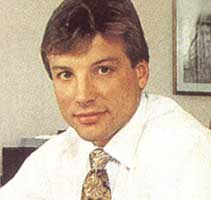
"Through my links with the world of rugby, I want to help ROC to achieve its aims of saving the precious lives of so many of our women" Rob Andrew

"The work of the research unit at St Bartholomew's Hospital,
London, and the fund-raising efforts of ROC are crucial if this disease
is to be conquered." Michael Parkinson
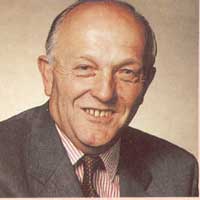
"It is vital that we find a screening test to protect 5000 women in the UK each year. ROC has my unequivocal support for its efforts" Sir Ronnie Hampel
MICHAEL'S BENEFIT
CONCERT

All roads led to the Drury Lane Theatre in London in November 1998 for Michael Ball's third sell-out ROC Concert. In a glittering evening, Michael, a ROC Patron, was joined on stage by a host of celebrities including Anthony Andrews, Lily Savage, Con O'Neil and Rt Hon John Major.
Wonderful entertainment and a massive £40,000 was
raised. An additional £1,100 was collected after the concert
from sales of programmes through Michael's fan club, bringing the toal
to a magnificent £41,100.
ROC UPDATE
"The Ovarian Cancer Screening Programme that ROC, with massive support from Michael, has been funding for the past eight years has now attracted the attention of the major cancer research agencies in this country. Accordingly there was an announcement last week in the national press confirming that, on the strength of the support given to the project by ROC, a total of £20,000,000 is to be given over the next 10 years to expand the screening, alongside the CA 125 tumour marker blood test that has been used so far and 200,000 women participating instead of the original number of 120,000.
Obviously we are over the moon at
the news and everyone has been very complimentary abot ROC's contribution
to the project to date. For years we have been the only people who
believed in and backed this research study. Now the 'big boys' are
prepared to join in! However, their involvement is completely dependant
on ROC remaining committed to the project and we still need to work hard
to raise the £1,000,000 we have pledged (just under £300,000
to go). This massive funding validates the project's worth, as well
as bringing our ultimate goal, which is to provide women with screening
with ovarian cancer, that much nearer fruition."
RESEARCH INTO OVARIAN CANCER
PO BOX 3872
LONDON SW15 1XR
Telephone: 0181 789 1406
Fax: 0181 789 1008
Patrons: Rob Andrew, Michael Ball, Sir Ronnie Hampel, Michael
Parkinson
Registered Charity No. 1043465
If you want to help in any way, would like more information
or want to make a donation (cheques payable to ROC), then please get in
touch with us at the above address.