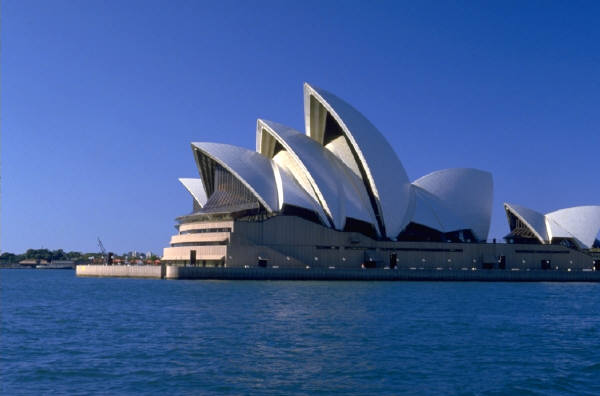
Sydney
In just two centuries of white settlement, Sydney has taken root, sprawled out and blossomed far beyond the visions of the original settlers. Now the skyline resembles more that of New York than London. Surprisingly, in the canyons below, echoes of Empire survive but the associated ideals of strength, stability and prosperity have been diluted by the mix of cultural influences that is modern Australia.
As part of the Pacific Rim, Sydney's dynamic vitality and buzz now draws Indonesians, Thais, Malaysians, Japanese and Americans in search - as we were - of fortune, power, and that ever elusive ideal; paradise on earth. Judging by the plush, flourishing shopping malls and plazas, Down Under is still that land of opportunity.
Here, in this largely underground consumer world of shop-lined walkways, underpasses and malls, Sydney's cultural diversity puts on its show. Bold ethnic fashions and memorabilia jostle with tempting culinary delights for your dollar. The exotic is daily life, with dim-sum and ripe fruit salad replacing the pre-packed sandwich and tasteless apple for lunch. Travel agents package weekend breaks to Ball and Fiji as we would the Lake District. London becomes the holiday of a lifetime.
Down Under, the pages of the International Daily Mail speak increasingly of a strange, exotic land I left behind. I read the British weather reports with a smile, knowing that outside the temperature nudges 40 celsius for the third time this week. For me, why go to Bali when Sydney offers deep blue skies, year-round swimming, cosmopolitan lifestyle and the beauty of the South Pacific.
Relaxing on it, in it or beside it, Sydney's most endearing feature is beyond doubt - the sea. It is not difficult to see why so many British choose to migrate here: all those images of paradise the media feed us are to be found all around. And what could be better than a dip in the South Pacific after work? Local radio stations thoughtfully provide surf reports during the evening rush hour for those wishing to unwind.
This playground paradise however is occasionally tarnished by pollution and storm-water run-off. Radio stations now update microbe levels, and signs put up on affected beaches. Sydney has discovered just how fragile the natural environment can be. Perhaps it is just human nature - to seek out beauty and through doing so accidentally destroy its very attractions. Australia was paradise because it was remote, colourful and different. Thanks to the media and air-travel, it is accessible and known. For residents, Bali, Fiji and London provide those exotic images.
Tradition states that Christmas day shall be spent on Bondi Beach, and I did not wish to offend. One small Lion Rampant, carefully packed for this very occasion, alas proved no match for the sea of Union Jacks that descended. The Australians, Norwegians, Germans, Swedes and Danish also found out about the party, bringing christmas trees, three-piece suites, barbecues and plenty of loud music to add yet more spice to the well-oiled celebrations. One such reveller shared his ideas on 'paradise'.
Michael had lived in Sydney for some ten years, and was about to embark on one last binge of OZ before returning to the UK. He talked not of beautiful landscapes nor unique flora and fauna nor untold riches but of geographical isolation, corruption, disgruntled and disillusioned suburban citizens and a shallow history that only really started in 1901. As with all cities, Sydney attracts people in. Many however only join the ranks of the have-nots, struggling to eke out a fragile living. Even as long ago as the turn of the last century, the poet Henry Lawson was forced to put pen to paper:
They lie, the men who tell for reasons of their own ,
That want is here a stranger, and that misery unknown
For where the nearest suburb and the city proper meet,
My window-sill is level with the faces of the street.
Today, these people are rarely seen in Bondi or downtown or Glebe. Their lot is the suburban sprawl that is Strathfield, Liverpool and Bankstown. When temperatures and humidity rise, levels of domestic disputes follow suit. A few only end when a gun is discharged. In August 1991 I read in the newspaper that a part-time taxi driver, disillusioned with life, fired into one of those popular shopping plazas before turning the gun on himself. That too was in Strathfield.
One block up from my hotel, the World Plaza (under construction, according to the map) highlights that this disillusionment goes right to the heart of the city. The gap site that is World Plaza is yet another victim of recent recessions. Gazing down to the foundations one hundred feet below street-level, I can see the plants once again taking root.
I realise that the reason I haven't learnt the names of the streets I've been walking along is not because much of it is grid-city but because Sydney, for all its modern achievements, just doesn't feel permanent. True Oz, the really big bit that almost everyone ignores, could easily re-colonise these attempts to build a controlled environment.
That ignorance, even today, ensures that the creatures of the continent continue to strike fear into residents and tourists alike. If only those first settlers had known that their proposed site was home to the world's most deadly spider - the now named Sydney Funnel Web, or that the country was blessed with fourteen lethal snakes, again including the world's worst.
Whilst in Sydney I only had the pleasure of meeting one true Australian; someone who did not try to change Australia to suit themselves but who understood and thrived on the challenge. He was known simply as Ozzy John. Thanks to him, I now know what these life-threatening snakes, spiders, scorpions and sharks look like and, more importantly, how to survive them.
Two months later I after crossing the Tasman Sea, the Nullabor Plain, been marooned by floodwaters in Broome, Alice Springs, Darwin, Cairns, Bemerside and Townsville, and slept out on the only dry land for miles with the snakes, spiders and cane toads for company, it is no longer the underlying fragility of Sydney that amazes me, but that it exists at all.
© Neil R Jamieson, MA MBA (2001-4)
All text and photographs are original and protected under copyright law