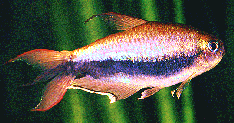
Nematobrycon palmeri is the rightful contender for the name Emperor tetra
First introduced to the hobby in 1959 Nematobrycon palmeri has maintained its popularity because it is colourful and peaceful, making it an ideal community tank fish. It's also easy to breed if given the right conditions.
Original reports about N. palmeri suggested that they were kept in very soft water with an acid pH. These fish were from wild stock.
Now the fish we see in dealer's tanks are from captive stock and accustomed to some variations in water quality- but still not a hard-water fish.
They look their best if kept in small groups or shoals.
The male with fairly long extensions to the middle rays of their caudal fins is easiest to spot. When the fish are young, just look into their eyes the males have a bright blue iris. Females tend to be a bit smaller than the males when fully grown.
The Emperor Tetra is an easy fish to breed if young adult are chosen. It spawns readily when in condition and will supply between 50 to 100 eggs. The fry should not be a problem to feed and raise.
Emperors don't require a large tank to spawn in. An 18" x 10" x10" tank, filled to a depth of 8" is quite large enough. The tank is filled with tapwater at a pH around 7 and a very low dH. The tank is left bare with nylon wool mops and an airline for a slow flow of bubbles. Do not fit a filter at this stage. maintain temperature of between 24 deg.C(76degF) to 28 degC(82° F). Allow 24 hours to pass before placing the selected pair of fish into the tank. Select a pair of young adults. Emperor females do not have to be all that plump to breed we are dealing with fish that will only supply a maximum of 100 eggs.
Place the fish in the tank in the evening. This gives the fish chance to become acclimatized to the breeding tank.The majority of pairs will spawn on the second morning. The male drives the female into the mops and here she lays the tiny eggs. Not many eggs will be scattered outside the mop area. Spawnings can be a lengthy affair, up to 5 hours. This is the time to remove the parents, as they'll soon eat the eggs if left in the tank. If you're not sure if they've spawned remove them from the tank after two days.
At this stage fit a small sponge type filter. At 28 degC(82degF) the eggs will hatch within 30 hours. The fry stay hidden in the confines of the mops and if you lift one, you should see the very tiny fry fall to the tank floor. This stage lasts for about five days, until you notice the fry free-swimming. Now they need food and even at this point, somewhere to hide, like one suspended spawning mop.
First food should be infusoria. Brood numbers are small, but they can get through copious amounts of infusoria, feeding on it for about 10 days. Now and then drop a few brine shrimp nauplii into the tank. If the fry take it, move onto brine shrimp in the morning and microworm in the. evening. Once on this food, the growth rate is accelerated. When the fry are about 3mm move them to a larger growing on tank. At the end of 12 weeks you should have young fish of 20mm to 25mm in length.
by Peter Turner
