
Common name |
Kuhli Loach. | |
Scientific name: |
Acanthophthalmus Kuhli. | |
Family: |
Cobitidae. | |
Distribution: |
From the southern part of the Malayan peninsula to Sumatra, Java and Borneo. | |
Food |
Fresh and frozen animal and vegetable food omnivorous. | |
Description |
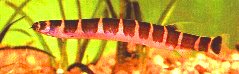
The Kuhli Loach has an eel shaped, elongated body that is very slightly compressed at the sides. The fins of this fish are all small. The dorsal fin starts just after half way down the back and the anal fin is well behind this. The eyes are covered with a transparent skin and have a movable spine beneath them, there are four pairs of barbells and no lateral line is visible. T he entire body of the fish is covered with fifteen to twenty dark brow n to black vertical bars, the gaps between them range from a salmon pink in some species to a rich yellow in others. The underside is light. | |
Size. |
Up to 3 inches (8 cm). | |
Sexual differences. |
Unknown for non-breeding fish. Females often become extremely fat before spawning. | |
Breeding |
In the wild, the fish spawn communally in very shallow water. | |
Aquarium requirements. |
Temperature between 75-86F (24-30C). pH : 6.5 - 7.0. Water hardness: on the soft side, preferably below 10 degrees GH but will tolerate higher. This fish prefers subdued lighting in the bottom area of the tank. Lots of cover in the form of stone cavities, flowerpots and anything else that provides a dark hiding place. A thick layer of soft sand as a substrate will also allow the fish to burrow. Thick vegetation is also recommended. | |
Behavior. |
Very active at twilight and night time, often buried in the substrate or hiding during the day. This is an attractively marked fish, which is easily kept with other non-aggressive fishes. | |
|
Martin Kelly. |
||
Those of you Practical Fishkeeping readers with long memories, may remember an article I wrote back in early 1990 about my own experience with a couple of Kuhli Loaches some nine years prior to that.
It was titled 'Mystery of the resurrected Kuhli' and told how I introduced two of these strange fish into a four foot community tank. They settled in quite well at first and were very active. However, after three months or so, they disappeared without trace and I assumed that they had perished and /or been eaten.
Shortly after this, I discovered my love for Oscars and although I enjoyed my community fish I would have to trade them in to make way for my new found interest, in those days I only had one tank and although the Oscars probably wouldn't have minded sharing, I don't think my other fish would have thanked me.
With this in mind, I arranged for my local shop to take my existing fish on a part exchange sort of basis and spent one Saturday morning catching and bagging them up. I then re-arranged my tank decor to be more suited to keeping Oscars and set off for the shop.
I returned home about an hour later with two, four inch Oscars and a packet of frozen Lancefish. The ensuing months saw them grow at an alarming rate on a diet of Lancefish, Pellets, live River Shrimp and Earthworms.
After about twelve months, both Oscars had reached an impressive size of ten inches and had become quite tame. I am sure what they say about Oscars being able to recognize their keepers is quite true. This pair used to get very excited when I came home from work but would totally ignore anyone else who entered the room.
After they had been in the tank for about two years, I can't remember the exact reason now, but I decided to strip it down for a major cleanout. I moved the Oscars into temporary accommodation and started to siphon out the gravel. Once this had been done, I removed the under gravel filter plates and guess what I found?
Yep! Two Kuhli Loaches in perfect condition. Obviously my Oscars had never spotted them either.
The only conclusion I can make is that they must have swam down the airlifts against the flow of water and been living in complete darkness for two years.
Martin Kelly.