
Athenian painted pottery
The science of Athenian pottery
Pottery is made from clay - a sedimentary rock made up of very tiny particles of various mineral. The exact composition is dependent on which rocks were eroded to form the clay originally.
Attic clay is unique (but then so are all clays) - and uniquely suited to a particular method of potting which the Athenian potters miraculously discovered and exploited.
 The Red and the Black
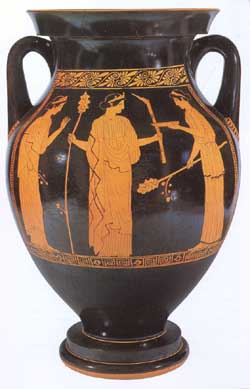
How does Athenian pottery have two colours - red and black - when it's all made from the same clay?
When "raw" the clay is reddish-orange: this is due to the large quantity of Iron Oxide (Fe2O3) it contains. If you heat a lump of this clay in the open (in oxidising conditions) it remains red.
However, it's quite easy to make it go black: heat it up in a closed space in a kiln (reducing conditions). Add wet sawdust or green wood, and these will - as they try to burn (ie burn incompletely) - rob oxygen from the red clay, turning it from Fe2O3 to FeO, and giving off Carbon Monoxide (CO) instead of CO2. FeO is black. If there is even more water vapour present, it can even produce Fe3O4 - a magnetic oxide of Iron which is even blacker. So - if you want a black pot - all you need to do is heat it up in a reducing atmosphere.
Two problems
- As soon as you take the fired black pot out of the reducing atmosphere,
it quickly replaces the lost oxygen from the air, and in no time it's
bright red again!
- Athenian pots are black AND red. To start with they have black figures on a red background (Black Figure or BF - down to about 500 BC) - later examples have red figures on a black background (Red Figure or RF - from about 525 BC)
The solution
Simple! All you need to do is to stop the oxygen getting back into the parts of the pot you want to remain black. How? The clay, as well as containing iron to give its color also contains minute particles of quartz. The "paint" used to cover the areas on the pot that stay black is chemically the same as the clay used for the pot itself - but it has been refined, by shaking it up with water many times, and removing the larger particles that sink to the bottom first. So in the paint, the quartz particles, being very tiny, are closer together.
When you heat the "painted" pot, the quartz particles in the painted areas fuse together (a process called sintering), and enclose the clay beneath in a sort of glassy film. This does not happen on the unpainted clay, because the quartz particles are too far apart. When the pot cools, no oxygen can reenter the painted area, and so it stays black while the rest of the pot reverts to red. Hey presto - you have your black and red pot!
But sintering is very tricky - you need to reach a temperature in your kiln of between 900 and 950 degrees Celsius. And if you get it hotter than 1050 during the reoxidising phase the whole pot will reoxidise and any black color will be lost. So somehow, the Athenian master potter - without any thermometer - needed to ensure the temperature in his kiln reached 900, but did not pass 1050. This is technical knowhow of a very high order indeed.