
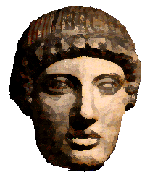
Oedipus
The Theban story and its interpretation
On this page :
- Oedipus the King - the myth
- Interpretations
On other pages : 
- The Oedipus Game - an interactive web game to test your grasp of the tragedy. Not as easy as you think! Click on the mask to start.
- The Antigone Game - how well do you know the plot of Antigone? Test yourself!
- Was Oedipus the "King"? - Oedipus Tyrannos: the king? the president? the boss?
- The Riddle of the Sphinx - who was the Sphinx, and why does the play include this weird monster?
- The so-called "tragic flaw" (why there isn't one)
- The Old Shepherd - key to the plot of Oedipus Tyrannos
- Jocasta - an original interpretation from a reader
- The Place Where Three Roads Meet - what does it look like today?
- Sophocles' Antigone - intoduction to a series of pages on the play
- Who was Sophocles?
- Tiresias - the old blind transsexual prophet
Oedipus the King by Sophocles
There once lived a man called Oedipus Rex.
You must have heard about his odd complex.
His name appears in Freud's index
Because he loved his mother ...Tom Lehrer
There are a number a versions of the myth, which differ in important details - but the starting point must be the story as told by SOPHOCLES in Oedipus Tyrannus (King Oedipus) performed in Athens for the first time in about 425 BC.
The First Oracle
Laius, ruler of Thebes is told in an oracle that his son will kill him. With agreement of his wife, Jocasta, the baby's feet are pinioned and it's given to a slave to be "exposed" on nearby Mt Cithaeron, haunt of wolves and other wild beasts. The slave, a shepherd of Laius' flocks, takes pity on the baby, and instead of leaving it to die, gives the boy to a fellow-shepherd from Corinth, the other side of the mountain. The Corinthian shepherd presents the baby to the childless King of Corinth, Polybus, who brings him up as his own, presumably giving him the name "Oedipus" (Swollen Foot) because of his deformity.
The Second Oracle
![[A Map to show the location]](image3.gif) Eighteen years (or so) later, someone at a party calls the young Oedipus
a bastard - and the insult rankles. He leaves Corinth for Delphi, to confirm
his parentage at the oracle of Apollo. The oracle, however, gives him
instead a horrific prediction : he will kill his father and sleep with
his mother. In case the oracle could conceivably come true accidentally,
he sets off in the opposite direction to Corinth, and heads towards Thebes.
As he descends from Parnassus towards the foothills, he meets an old man
driving a waggon with a retinue of slaves at a place where three roads
meet. The man is rude and aggressive, and orders him off the road.
Oedipus refuses to budge and the man lashes out with his goad. Oedipus
(an early instance of "road rage"?) sees red, and kills the man and -
as he thinks - all the guards. He continues to Thebes.
Eighteen years (or so) later, someone at a party calls the young Oedipus
a bastard - and the insult rankles. He leaves Corinth for Delphi, to confirm
his parentage at the oracle of Apollo. The oracle, however, gives him
instead a horrific prediction : he will kill his father and sleep with
his mother. In case the oracle could conceivably come true accidentally,
he sets off in the opposite direction to Corinth, and heads towards Thebes.
As he descends from Parnassus towards the foothills, he meets an old man
driving a waggon with a retinue of slaves at a place where three roads
meet. The man is rude and aggressive, and orders him off the road.
Oedipus refuses to budge and the man lashes out with his goad. Oedipus
(an early instance of "road rage"?) sees red, and kills the man and -
as he thinks - all the guards. He continues to Thebes.
![[Thumbnail view of Oedipus Crossroads]](oidipthumb.gif) Click
for full picture and discussion of the Oedipus Crossroads
location.
Click
for full picture and discussion of the Oedipus Crossroads
location.
The Riddle of the Sphinx
![[A picture of Oedipus and the Sphinx]](image4.gif)
Thebes is terrorised by a monster - the Sphinx (a hybrid creature, with the body of a lioness. the head of a woman, and wings), who destroys all who cannot solve her riddle. Sophocles doesn't go into any detail about this riddle - other writers tell us it was: "Which animal has one voice, but two, three or four feet being slowest on three?" Perhaps Oedipus, as a man with three feet thanks to his disability was uniquely well placed to answer it : "Man". Oedipus' staff will be crutch, murder weapon and blind man's stick before the play is over. Thebes welcomes her saviour and offers him the vacant job of ruler, and the hand of Laius' widow, Jocasta, as an extra reward.
Click here or on the picture for a very full discussion of the Sphinx.
The Third Oracle
More years pass, during which Oedipus fathers four children by Jocasta. Gradually Thebes succumbs to a vile plague, which kills animals, children and crops alike. Oedipus, the king, promises to save his city. Plagues are caused by pollution which is caused by sin - and only the god can reveal its cause. Thus Oedipus sends his brother-in-law Creon to consult the oracle at Delphi once more: the god's answer is that the plague is caused by an unpunished murder - that of the former ruler, Laius. Oedipus places a terrible curse on the killer - whoever he may be, and turns for help to Teiresias, the respected prophet. Teiresias tells Oedipus that he is the killer, and hints at even worse crimes. Oedipus is enraged, believing that Teiresias and Creon have concocted this story to dethrone him and seize power for themselves. Teiresias departs with dire threats, while Creon tries to argue his innocence. Oedipus rejects his pleading, and would have had him executed but for the intervention of Jocasta - who has close ties to them both.
The Place where Three Roads Meet
Hearing that their quarrel was about an oracle, Jocasta reassures her husband by saying that oracles are nonsense - she and her Laius were given one telling them that their son would kill its father. The father was killed, by robbers at a place where three roads meet, and the son died an innocent baby. But Oedipus remembers killing a man at such a place - what if he was Laius? He himself would be the cursed polluter of Thebes. No, says Jocasta, the witness - the man who escaped - said it was robbers. One man cannot equal many. Oedipus fears will only be laid to rest if the witness can be found. He's sent for.
The Corinthian Messenger
But the new arrival isn't the witness - it's a messenger from Corinth, to tell Oedipus that Polybus, his father is dead - he will now be King of Corinth too. Oedipus says he can never go back to Corinth while his mother is alive. "But there's nothing to fear,"says the messenger, hoping to ingratiate himself with his new king, "She wasn't your mother, nor was Polybus your father." He explains how the baby was given to him by a shepherd from Thebes. Jocasta now knows the truth - that Oedipus is her son - and rushes out. Oedipus thinks she's embarrassed because her husband might have been an unwanted child, perhaps a slave's.
The Old Shepherd - the Truth at last.
At last the Theban shepherd arrives. This turns out to be the same man who had been sent for as the witness to the murder of Laius. He is very reluctant to say anything to Oedipus. Under threat of torture, he reveals that the baby was given to him by Jocasta to be killed - and that he'd passed it on to the Corinthian out of pity. Oedipus now knows the whole truth and rushes off to find Jocasta - but she 's already hanged herself. He takes the shoulder-pins from her dress and blinds himself. And so Creon does become ruler, and after allowing the blinded Oedipus to say goodbye to his daughters, orders him into the house, to await disposal at the god's pleasure. Oedipus goes in, continuing to insist he should be left to die on Cithaeron as the gods originally intended.
Possible interpretations
Ancient background
Apart from the obviously significant religious message that "you can't escape your fate" it's important to realise :
- Oedipus wasn't as innocent under Greek law as he might appear under English or Roman : (non est actus reus nisi mens sit rea - there is no guilty act without a guilty mind). To the Greeks the act counted, not the motive.
- The murder of Laius wasn't a crime per se - in fact it was any Greek's duty to harm his enemies (as well as helping his friends). And as far as he knew at the time Laius was an enemy - by insulting Oedipus he had made himself one.
- Family was everything in Greek culture. (Compare the Godfather films of Francis Ford Coppola to get the flavour of the intensity of family feeling.) Thus the worst conceivable crime was to kill one's father; the second worst was to sleep with one's mother. (More than just an incest taboo is involved here.) No Greek could imagine a worse 'double' than Oedipus'. Mass murder as in Dunblane or a serial killer such as Fred West would have been far less abhorrent. Modern cult use of the word 'motherfucker' could only happen in a culture where the power of the family is waning fast.
- Oedipus - the greatest of men, the solver of riddles - can only solve the riddle of his own origins by revealing a truth too awful to bear.
- The power of the curse - Oedipus, having cursed the murderer of Laius - feels he must carry out the sentence on himself.
Modern links
- Freud's famous 'Oedipus complex' may or may not make sense to psychologists, but it has no bearing on understanding the myth. (It is based on Jocasta's remark to her husband that many men have dreamed about sleeping with their mothers. In several years teaching the play, I've yet to find anyone prepared to confirm this from his own actual experience!) But in any case, Oedipus did not intend his actions - and thus felt no desire for his mother. For the most powerful dramatic representation of the Oedipus story in a Freudian context see Pasolini's 1967 film Edipo Re.
- My old college mate Fred Ahl has written a book proving Oedipus was innocent OK? Creon dunnit. Hilarious. (Sophocles' Oedipus by Frederick Ahl, Cornell UP)
- Steven Berkoff's play Greek has Eddy and his mum staying together despite the gruesome discovery - hey! love is all that matters, surely?
- My own feeling about the story is that Oedipus is an inspiration for mankind: he must find out the truth at whatever cost, and then accept the full responsibilty for the knowledge he has discovered. Knowledge + pain is better than Ignorance + bliss.
Oedipus is thus the patron saint of philosophers, scientists, poets and artists - of all truth-seekers. Like Mulder and Scully in the X Files, Oedipus knows "the truth is out there", but unlike them, he doesn't expect to have his eyesight restored for next week's episode!
Footnotes:
Oedipus Sheepibus
Jocasta's remarks about mother-love ("every man has dreamed of it" ie sleeping with mother), built by Freud into a whole psychological system, have now been confirmed by strong biological evidence. Experiments at Cambridge University on sheep and goats have shown that male sheep, when brought up by nanny-goats, have a distinct sexual preference for nanny-goats when they grow up. In other words, they want to marry a girl just like mum. According to the report, published in Nature, the goat-reared rams "strongly preferred to socialise with females of their maternal species" - even though the rest of their behaviour was appropriately sheep-like. Interestingly, fostered female sheep showed no such inclination to bond with their mothers. (Guardian 17 September 1998)
Oedipus for the blind
"Oedipus could be naked, transsexual, Polynesian, older than his mother, riding a unicycle picking his nose and it would not matter." Why not? Tom Morris' new production of Oedipus Tyrannus at the Battersea Arts Centre, London will take place in pitch darkness. Apart from saving on costumes, makeup and electricity, Morris wants to force audiences (audience derived from audio, I hear), jaded with hi-tech productions, to get back to using their imagination. Personally, I'd find it very distracting to imagine that Jocasta might be a stark naked Fijian doing the Times crossword while massaging low fat margarine into her buttocks. Anyway, hasn't this guy heard of radio? (Report in the Guardian, May 12th, 1998)