WHAT IS P.A.M.?

Power Assisted Micro-manipulation is a means of restoring the supple elasticity of the spine. Once this elasticity has been restored, there is less stress on the affected joints, and the back can regain its mechanical efficiency. The tool consists of a handset with four pistons powered by compressed air and programmed by a control unit that manages the touch-sensitivity of the pistons. Despite its advanced technology, it should be remembered that this is a tool, not a machine. Ultimately the real skill belongs to the practitioner.

The three modes of operation

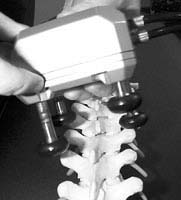
Fig.1 PAM Handset showing the operation of the pistons on the transverse proceses of a plastic model spine.

There are three programmes available: spasm, reflex, and mobilisation. Spasm mode prepares the muscles and commences and ends each treatment. In Reflex mode, the bionic fingers are employed to stimulate reflexes which cause the spine to realign automatically and with unerring accuracy. Abnormal curvatures and patterns of pre-rotated vertebrae are seen to be resolved.  If a joint has been fixed for many years, the associated reflex will not be present unless it is re-stimulated in this way. Mobilisation counter-rotates one vertebra on the one next to it. With a combination of these modes, there are very few spines which cannot be quickly and efficiently restored to supple elasticity. The patient's responsibility is to walk tall for ten minutes a day for 10 days to exercise the postural muscles.

Why use a tool?

Although the pistons are working in a vertical direction, the action on the facet joints is a tri-plane motion. There is not enough strength in human fingers to achieve this, and there is a strong tendency for the force applied to be transferred to the nearest mobile joint. As two joints are held down, the other two are counter-rotated. To understand the concept of tri-plane motion, Robert Taylor, the inventor of P.A.M. draws our attention to the axle mechanism on a skateboard which bears many resemblances to the movements of the vertebrae.

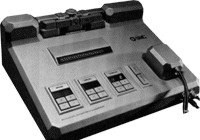
Fig. 2 The PAM control unit

What’s the connection with skateboards?

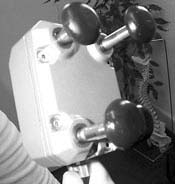
Fig.3 The PAM Handset.

The reader will quickly recognize the parts of the skateboard axle assembly which correspond to the vertebral bodies, disc, transverse processes and small joint. While the assembly looks like a spinal segment, the tilt and turn geometry is identical. Examine the assembly and the reader will readily understand issues such as why spinal segments have evolved in the way they have, why mobilisation by counter-rotation effectively generates mobility in all three planes and why pre-rotation effectively renders the joint static.