|
French Army: 2300AD
Les Troupes Coloniales Introduction The
French Army has many famous and capable fighting forces within its structure,
not least the Troupes de Marine and the Légion Étrangère. However with the
past five years of conflict one lesser known force has gained a new
prominence in the war against the Kafers. The Troupes Coloniales are regular
soldiers recruited from the colonies and reinforced by experienced NCOs and
officers drawn from the Armée Métropolitaine. They form the professional
framework of Narrative 1e
Compagnie of I/8e RIC was clearing up a battlefield that hadn’t been here
thirty minutes before. The shallow valley in front of them was home to a
shattered farm building and five burning Kafer APCs. Random volleys of
gunfire were coming from the clearance patrols as the soldiers took care to
put a bullet in the head of every Kafer body they came across, obviously dead
or not. Medics worked fast on the wounded, and every so often a Dragon would
swoop in and uplift a group of stabilised patients. Soldat
de 1e Classe Arantxa sat in the explosively dug shell scrape to one side of
the Blindicide-9 launcher. He was in over watch in case a second Kafer attack
came this way, but that was unlikely. Consequently he was wearing his béret gris and smoking his way
through a second Gauloise. The Gauloise was a genuine terran one, not a local
copy, one of the Godsends that had come through with the Napoléon and
the other reinforcements from Earth. Now
the CAF was hunting down the recently landed wave of Kafer troops which had
managed to make the surface in that fateful January. The CAF was a far cry
from the motley collection of troops who opposed the first Kafer invasion, it
was a well drilled military machine which had shattered the Kafers in a
series of sharp contacts. Now they were stamping out the remnants before they
could escape into the bled and regroup. As part of the crack 102e Division I/8e RIC had
been kept very busy. Behind
his position an international news team had set up and the reporter began to
talk using Arantxa as part of the backdrop. The soldier ignored the Anglo, not understanding much
English, but the mention of the words Foreign Legion Arantxa rolled
his eyes in exasperation and flicked away his insanely well travelled
cigarette in annoyance. There was more to the French Army than the Légion,
but not many foreigners realised it.
The
original French Troupes Coloniales were the renamed Troupes de Marine
transferred to the command of the Army in 1900. They were responsible for the
defence of French overseas territories outside of The
Coloniale gained a reputation as some of the finest French units in World War
1, while Coloniale units were amongst the first to rally to the Free French
cause in World War 2. After the French were forced from When the
ESA nations began to colonise The
eventual solution was to raise a new corps of troops for service on the
colonies. They were to be regulars raised on Earth who would serve in the
colonies, and as the colonies grew they would increasingly recruit from the
colonist populations. The new corps would initially be dominated by engineer
units and infantry who were capable of construction and pioneer tasks.
Administrative, aviation and support units would also be formed, whilst
armour and artillery would be added later. They would also be responsible for
training a local part-time defence militia, the Milice, which would bolster
the regulars in times of crisis. The new force would once again be known as
the Troupes Coloniales. The
Coloniale was always to be something of a poor relation to the Armée
Métropolitaine and with much of its equipment second hand or obsolete. In
addition the Coloniale would tend to concentrate on small unit operations and
less on the high intensity warfighting that marked units serving on Earth.
Nevertheless the Coloniale had a certain glamour thanks to its off-world
service and its low level tactical performance was always well respected by
Marine and Légion formations training alongside it. The first
unit raised was the 1e Régiment de Génie Colonial which was dispatched to
The first
major change to the Coloniale came when Nouvelle The
Central Asian War resulted in a large scale overhaul of The
Coloniale faced its first real trial on Joi during the War of Elysian
Independence. The two battalions of the 8e RIC were the colony’s first line
of defence, trained for conventional warfare they were called in to back up
the Gendarmes confronting the Rouges and Verts insurgents. Untrained in unconventional warfare 8e
RIC made numerous mistakes which were seized upon by insurgent propagandists
to raise anti-French sentiment. Numerous other Coloniale battalions were
brought in to reinforce 8e RIC and Coloniale forces were always the most
numerous French troops in Elysia and by the end of a campaign doomed by inept
political leadership had developed a respectable skill in counter-insurgency
operations. The War
of German Reunification was a happier experience for the Coloniale. On Beta
Canum the Coloniale easily dealt with minor German raiding operations and an
attempt to raise an insurgency in Germanophone populations in the west of the
Continent Français. On Adlerhorst the crack 9e RIC was the spearhead of
operations alongside Bavarian loyalists which initially crushed pro-German
partisans. These successes were inevitably overshadowed by French defeat in
Europe however. The war did not end the rivalry with Germany however and
French colonial defences were again overhauled, with Beta Canum’s military
establishment being especially expanded although funds were slow in arriving
with priority give to re-equipping Earth forces and most growth was limited
to the Milice. The
Coloniale’s greatest ordeal has inevitably been the Kafer War which has
ravaged so much of the French Arm. When the Kafers invaded the Coloniale had
only two units serving on-world, II Escadron of 4e RCC and I/9e RGC. These
units gave sterling service with the I/9e RGC outstanding as stand-in
infantry, but were combat ineffective by the time the 5e Division de Marche
arrived from Beta Canum with Coloniale and Légion reinforcements. The
Coloniale rotated several battalions through Aurore throughout the fighting
having at least one cavalry and four infantry units in place at all times.
Large numbers of Coloniale NCOs and officers were also drafted in to rebuild
and expand Aurore’s Milice. With the discipline of the Légion strained at
times and Métropolitaine units short of casualty replacements the Coloniale
battalions quickly became regarded as the most efficient units on
Aurore. The
renewed Kafer assault in 2301 fell heavily on the Coloniale. Nous Voila was
isolated and bombarded mercilessly. Kimanjano was assaulted and fell
following a six week campaign. High hopes were raised for the defence of Beta
Canum, but the reorganised 9e Corps proved a paper tiger and the force
disintegrated in a week. Only Adlerhorst and Beowulf remained free with the
Coloniale forces engaged in frantic efforts to bolster defences. New units
were organised and prepared for battle, on Beta Canum many Coloniale soldiers
slipped away to New Africa to continue the fight against the Kafers. On
Adlerhorst a new regiment of Paras Coloniaux was raised to support
Rochemont’s Fleet’s landing force. Coloniale personnel were prominent in
establishing resistance organisations on occupied worlds. The
Coloniale played its role to the full in the Liberation with units strongly
represented in the Divisions de Marche Coloniale, with the actions of the RPC
on Beta Canum and in the stalwart defeat of yet another descent on Aurore.
Since then the Coloniale’s main role has been in rebuilding the defences of
the French colonies, integrating new units into its order of battle,
regenerating destroyed units and building the Milice up again. It has not
been an easy task as strong fault lines have been opened up in colonial
society as a result of French defeats. However the Coloniale has been
strengthened by an influx of much needed funding, fresh manpower from the
core and the implementation of limited conscription on several worlds.
This is
the official Coloniale order of battle for Jan 2303. It does not include
units ‘de Marche’ or company sized element. Units
I/2e Régiment de Cavalerie Coloniale 4e
Régiment d'Infanterie Coloniale 3e
Régiment d’Artillerie Coloniale 4e Régiment de Génie Colonial 5e
Régiment de Génie Colonial 3e
Régiment d’Aviation Légère Coloniale
The Coloniale
effectively is an army in its own right, similar in some ways to the US
Marine Corps. It has the complete array of arms and services including
infantry, armour, artillery, aviation, engineers, logistics, intelligence,
communications, equipment support and admin support. This is unlike the
Légion and Troupes de Marines who rely on either the Armée Métropolitaine or
the Coloniale for much rear echelon support. The
Coloniale is commanded from Earth by the Etat-Major Colonial based in Paris
which is commanded by a full Général de l'Armée, who also nominally commands
the Armée Coloniale. The EMC answers to the Ministère de la Défense in line
with the other military arms through the Comité Militaire Colonial which
deals with the implementation of colonial military policy. The EMC controls
high level administrative, manning and equipment procedures and has an
overview of operations and intelligence although these are necessarily
matters which are routinely delegated. The EMC also has the Inspector General
of Colonial Forces under its remit. Military
command is delegated to the Commandement des Forces Coloniales or CFCs which
are established in each French colonial system and are named after the main
planet i.e. Commandement des Forces Coloniales de Kimanjano. The CFCs are
dominated by the Coloniale, but also include representatives from the Milice,
MSIF, Armée de l’Air, Gendarmerie and other parts of the army. They are
commanded by a Coloniale’s officer of General rank, the exact grade depends
on the size of the force on the world and answers to the EMC whilst working
closely with the colonial governor. The CFCs
are responsible for the defence of the colony, oversight of all planetary
military operations, the provision of trained and equipped military forces in
addition to the implementation of policy as directed from the EMC. Sometimes
the CFCs can also provide a high level operational HQ, although on some
worlds this function is the responsibility of a specific Corps HQ, and in one
case an Armée HQ. Under the CFCs are an array of divisions or formations
which are usually manned by a mixture of regular Coloniale and Milice
soldiers. It is not unusual for Marine and Légion units to be deployed in the
colonies and these also come under the CFC. During the
Kafer War it has become relatively commonplace for units of the Armée
Métropolitaine to be deployed to the colonies. If deployed specifically to a
colonial world they would also come under the control of the relevant CFC.
There are two exceptions, the TIS Brigades d’Intervention and the Armée de
Liberation, both of which remain outside the CFC structure. Although before
the war the TIS did rely on CFCs for some administrative support. Divisions
and other formations permanently deployed in the colonies under a CFC were
usually commanded and supported by Coloniale personnel who would commonly
provide both the commanders and the bulk of the staff. However the
composition of units within these formations could vary widely. The Coloniale’s
operational units are deployed in battalion, or battalion sized, strength.
The battalion remains the standard operational unit and is the cornerstone
for training and organisation. The main administrative grouping remains the
regiment, of which most worlds will have a single regiment each for infantry,
engineers and artillery. The Coloniale predominantly uses the same basic
order of battle as the rest of the French Army. However
it has been known to raise ‘compagnies de marche’ and occasionally
‘bataillons de marche’ from the regiments and outside of the normal
establishment. For example 10e RIC raised two ‘compagnies parachutiste de
marche’ during the War of German Reunification. Consequently the published
order of battle often does not completely reflect the actual state of
Coloniale deployments. Whilst
normally Coloniale units will remain deployed on the world they are raised on
it has become increasingly common since the Elysian Revolt for sub-units and
entire battalions to serve on other worlds. Small numbers of Coloniale units
served on Earth during the CAW and a brigade of French Arm units was en-route
to Earth during the WoGR but arrived after the armistice. During both major
wars the Coloniale was trawled for officers and SNCOs who then served with
Métropolitaine units to gain experience and fill in gaps in the core based
units. The Kafer
War has resulted in both massive casualties and a huge expansion of the
Coloniale. The most obvious has been the integration of several wartime combat
units into the Coloniale’s regular order of battle, however this is actually
rather less significant than the increase in combat support artillery and
engineer units allowing combat ready formations to be brought into being. Bataillon
de Cavalerie Blindée There are
no fewer than eight Coloniale units with this powerful organisation, many of
which have recently converted from other structures. The BCB is a pure
hovertank battalion and can be equipped with AC-12bis, AC-12 or AC-8
hovertanks. The BCB does not have the integral all-arms capability of the
BCBM it commonly operates with as a demi-brigade with a BFAM and divisional
support elements giving it much more versatility and combat power. The BCB
is organised with 3 hovertank Escadrons and a command and service Escadron.
The hovertank Escadron are organised with four 3 tank troops and a command
troop. In total the BCB has 41 AC-12s and numerous support and service
vehicles. Bataillon
de Cavalerie Blindée Mixte There are
currently two Coloniale units using the BCBM order of battle. The BCBM is a
unit with an integral combined arms capability and is equipped with either
the AC-8/ACVI-3 or AC-12/ACVI-4 AFV combination. The BCBM resembles the BCB
except its sabre Escadrons have two hovertank troops and two ‘cavalry’ troops
with HAPCs. The BCBM structure is popular when deploying individual units but
in line with French doctrine when operating in a divisional structure the BCB
is preferred. Bataillon
de Cavalerie de Reconnaissance There are
two Coloniale units with this organisation, both relatively newly formed. It
has the standard three manoeuvre Escadrons and a command and support
Escadron. The sabre Escadrons have three reconnaissance troops equipped with
ACR-89s, a hovertank troop for support (AC-12s in 1e RCK, LkPz-IXs in 1e RCA)
and a support troop of ACVI-3s carrying dismounted troopers and UAVs. Bataillon
de Cavalerie Mécanisés Mixte Less than
a decade ago the majority of Coloniale cavalry units followed this structure,
today only a single unit is organised in this way, although it remains
popular in the Milice. The structure is the same as the BCBM, however they
are equipped with wheeled AFVs, originally the ABR-76/VCIR but now
increasingly with the modern EBCR-97 AFV. It is hoped that the introduction
of this new, capable AFV will do much to address the vulnerability of ABR
series first revealed in the War of German Reunification and again exposed
dramatically during Beta Canum’s ‘black week’. Bataillon
de Chars de Combat The Bataillon
de Fantassins Aéromobiles The BFA
is the most common combat organisation for the Coloniale’s light role
infantry. It has four rifle companies, a support company (CEA) and a HQ
company (CCS). The rifle companies have three rifle platoons and a HQ with
small integral anti-tank and anti-aircraft elements. The support company has
reconnaissance, mortar, anti-tank and anti-aircraft elements. The command
company has the usual combat support elements and a pioneer platoon which
also functions as a defence platoon.
Bataillon
de Fantassins Légers BFLs are
garrison infantry units with only three rifle companies and a reduced support
company. They were more common before the war but the need to confront the
Kafer threat has seen most of these convert to the BFA organisation. Today
only the 7e RIC uses this organisation. Bataillon de Fantassins Aéro-Mécanisés (here,
Aéro comes from Aéroglisseur, Hovercraft) BFAMs
have become the most common type of mechanised infantry in the Coloniale and
are equipped with HAPCs. Many Coloniale BFAMs are newly formed and still
lacking polish in the manoeuvre warfare role . BFAMs can be equipped with
either the ACVI-4 or the obsolete ACVI-3. The Bataillon
de Fantassins Mécanisés BFMs are
very similar to BFAMs but are equipped with wheeled AFVs in the ABR-76/VCIR
range. The Coloniale’s BFMs took a fearful beating during the war and there
are few now organised in this way, although the Milice still has many
battalions with this organisation. The Coloniale hopes to re-equip its
remaining units with the EBCR-97 AFV. Compagnie de Chasseurs à Pied Blindée CCPB are
French combat walker companies, each has two platoons of walkers with a small
HQ for a total of 24 walkers as well as a small maintenance element. The
Coloniale is not a major user of CWs but some RICs have raised ‘de Marche’
CCPBs. These are usually equipped with BH-21s, although some have purchased
Manchurian and other commercially available CWs using discretionary funds. Compagnie de Recherche et Action Spécialisée The
Coloniale has a number of secretive ‘RAPAS’ companies in its unofficial order
of battle. These are 86 man strong companies with four 20-operator platoons.
These units are raised from across the Coloniale presence on a world and
operate directly to the CFC. The French classify these as ‘Third Tier’
special forces, however most of these RAPAS groups are very competent and
know their ground very well. Bataillon
d’Artillerie Légère Aéro-Mécanisée BALAMs
are hovermobile Bataillon
d’Artillerie Stratégique Aéro-Mécanisée BASAM’s
are artillery units equipped with inter-continental cruise missile system
with a variety of warheads. Needless to say these are very powerful units and
there are only three in the Coloniale orbat; III/6e RAC on Adlerhorst, I/8e
RAC on Beta Canum and IV/9e RAC on Aurore. They have the usual three
batteries, each with eight launchers, and a command and support battery. Bataillon
d’Artillerie Légère BALs are
artillery assigned to the support of light forces. They have three artillery
batteries, one with MRLs and two with light gauss howitzers. The weapons are
carried on light hovermobile platforms, although the guns can be dismounted
if needs be. Bataillon du Génie de Construction BGCs were
the first Coloniale engineer units, designed to conduct large scale
engineering projects and tasked as much with colonisation as military tasks.
Almost every French colony world has a Bataillon
du Génie Aéro-Mécanisé The BGAM
is a versatile hovermobile engineer unit intended to support the 1e and 2e
DLBs. The bulk of the vehicles are converted ACVI-3s although there is a vast
range of specialist models. The BGAM has three field engineer companies and a
heavy engineer company and a Bataillon
du Génie Mécanisé The BGM
is the wheeled equivalent of the BGAM. Bataillon
Léger du Génie The BLG
are light engineering units. They have a single field engineering group, one
heavy engineering group and a Groupe
d’Aviation Mixte The
Coloniale GAM are battalion sized units comprising some 48 aircraft in three
companies together with command and support elements. They usually have one
company of transport Dragon III tiltrotors, and two mixed companies with ten
gunships and five scouts. The group HQ has three scouts for liaison
tasks. Groupe
d’Aviation de Transport GATs are
the most common Coloniale air units and usually include two companies of
Dragon IIIs and a company of scouts in the liaison role. Some GATs also have
a flight of fixed wing transport aircraft. Cadre
There are
numerous Coloniale battalions that are currently cadrised, these are units
destroyed or badly damaged and cannibalised during the Kafer War. There are
plans to reconstitute these units, although some will have to wait several
years to regain operational capability.
2e Régiment de Cavalerie Coloniale I/2e RCC – BCB – 2e
DMC, Kimanjano II/2e RCC – BCB – 101e DM, QAS III/2e RCC – BCB – 2e DMC,
Kimanjano IV/2e RCC – BCB – 101e DM, QAS 2e RCC
was the Coloniale cavalry unit formed on Nouvelle Europe. It was originally
only a single regiment, the 2e RCC. As tensions with the neighbouring British
colony increased and the population grew the unit expanded ultimately to the
size of three regiments. The 2e RCC has always specialised in two main types
of operation, maritime and mountain, thanks to the geography of Nouvelle
Europe. The intercolonial tensions manifest in the Rhadamanthine Archipelago
would see the units of the 2e RCC deployed to that region on frequent
rotations. In the
2290s all three regiments of 2e RCC transitioned to the AC-10 hovertank as
part of the re-equipment of the 101e DLB. The role of the 101e DLB was to be
able to face the Alician Defence Force in high intensity warfare in the
Archipelago and it trained extensively for that role. The presence of the
AC-10s would lead the Alicians to seek to reequip in turn with modern HBTs.
In 2300 a squadron drawn from across the unit was formed and equipped with
AC-12s and dispatched to Aurore to become part of the RCMA. As it
happened, the 2e RCC was never called on to fight in the Archipelago. Instead
with the Kafer invasion a Groupe Mobile of I/2e RCC, III/2e RCC and I/4e RIC
was dispatched to Kimanjano. The GM acquitted itself very well, matching the
performance of Métropolitaine and US Marine formations, the kernels of these
units were returned to Nouvelle Europe in the Entente evacuations. They subsequently
were rebuilt as part of the 2e Division de Marche Coloniale and saw action in
the Liberation of Kimanjano. The II/2e RCC is still part of the renamed 101e
DM, the IV/2e RCC was raised from reservists and volunteers to bulk up the
101e DM. 3e Régiment de Cavalerie Coloniale 3e RCC – BCBM – 104e DM, BCV-4 The 3e
RCC was the first cavalry unit raised in the Continent Français of Beta
Canum-4, a uniqueness it was to retain for several decades. For most of this
time the unit was organised as a group of independent squadrons, however
after the War of German Reunification it reorganised as part of the newly
organised 102e DLB. The 3e RCC detached an independent squadron equipped with
old ABR-76s to Aurore in 2298 as part of the response to the invasion of that
world, this veteran sub-unit returned to Beta Canum in 2300. The regiment was
planned to convert to AC-8s but it was destroyed to all intents and purposes
in the invasion of Beta Canum and has only just been re-raised with AC-12s
and is working up to operational capability. 4e Régiment de Cavalerie Coloniale 4e RCC – BCBM – 1e DMC, Aurore Prior to
the invasion of Aurore 4e RCC was a regular Coloniale unit raised on Aurore
Français. It was organised as a BCRM in independent squadrons, following the
war with Germany all the squadrons bar one were dispatched to Beta Canum or
Adlerhorst. When the war came to Aurore only one squadron remained on Aurore
and fought itself almost to destruction. It was reinforced by other squadrons
to form the RCMA. As the war went on the 4e RCC was reassembled on Beta
Canum, re-equipped and retrained with AC-12s. It returned to Aurore in the
summer of 2300 to great local acclaim. It now forms part of the 1e DMC alongside
the veteran RCMA and 2e REC. 5e Régiment de Cavalerie Coloniale 5e RCC – Cadre 5e RCC is
the second cavalry regiment raised on Beta Canum, formed during the 2250s.
The 5e RCC was always intended to be a combat regiment and was the only hover
armour regiment on the Continent Français until the Central Asian War. One
squadron was re-equipped with AC-12s and dispatched to Aurore to join the
RCMA in 2300. The rest of the regiment, equipped with ageing AC-8s, was
almost totally destroyed in a notable stand during the invasion of Beta
Canum. A very few members of the regiment managed to escape and were
incorporated into the Spahis on New Africa. The unit has yet to be
reformed. 6e
Régiment de Cavalerie Coloniale 6e RCC –
BCB – 3e DMC, BCV-4 6e RCC
was formed on Beta Canum just after 5e RCC but was in the light armoured role
similar to the 3e RCC. It was converted to the armoured role during the
Central Asian War, and became part of the 100e DLB. Elements of the regiment
were involved in a raid on an off-lying island of the German Continent during
the war. The regiment was deployed to Nous Voila as part of a Groupe Mobile
with III/10e RIC following news of the destruction of Hochbaden. It survived
the war and the horrendous collapse of civilisation on Nous Voila and has
been returned to Beta Canum and forms a part of the 3e DMC. It is still
equipped with AC-8s. 8e
Régiment de Cavalerie Coloniale 8e RCC –
BCMM - 220e DI, BCV-4 8e RCC
was the first of three RCCs formed in 2292 on Beta Canum in response to the
massively increased tension with Germany which was spreading to the colonies.
It was the only unit that was operational before the end of the war. Elements
of the regiment were sent to Adlerhorst and then returned after the signing
of the Treaty of Darwin. 8e RCC was equipped with ABR-76s and was destroyed
in the invasion. It has just been reformed with the EBCR-97 wheeled AFV. 9e Régiment de Cavalerie Coloniale 9e RCC – BCB – 104e DM, BCV-4 9e RCC
was formed in 2292 as a hovertank regiment. It gained a fine reputation,
partly as a result of having several very competent officers posted to it
from Armée Métropolitaine who had fallen from grace due to their support of
the junta. One of its squadrons bolstered the RCMA as it converted to AC-12.
The unit shared the fate of other parts of the 100e DLB, although elements
managed to escape and form the kernel of a resistance force. The 9e RCC was
the first armoured BCV Coloniale unit to be reformed and is equipped with
AC-12bis. 10e Régiment de Cavalerie Coloniale 10e RCC – Cadre 10e RCC
was the last of the RCCs formed just prior to the Central Asian War and was
equipped with ABR-76. It became operational in 2295 and was seen as something
of a bad luck unit, suffering several unaccountable casualties on exercise.
It was destroyed in the invasion and has yet to be reformed. 1e Régiment Colonial de Blindé (11e Régiment de Cavalerie
Coloniale) 1e RBC – BCC - Troupes d'Armée d'Aurore, Aurore 1e RBC
was formed late in 2299 on Earth to provide a heavy ground tank capability
for Aurore, which was then being fulfilled by the 5e Régiment de Chasseurs, a
Métropolitaine unit. Initially the unit had three squadrons of volunteers,
one each drawn from European France, African France and Nouvelle Provence.
These volunteers were from Métropolitaine ground tank units and were
transferred into the Coloniale. Following training the unit deployed to
Aurore late in 2300 where it took over 5e RCh’s CC-21s. Ground tanks have
proved vital in attacks on Kafer positions and the 1e RBC has carried on the
good work of the 5e Chasseurs. It is a well regarded unit which suffers few
casualties. It has recently been regularised within the Coloniale as the 11e
RCC but retains its original title. 1e Régiment de Cavalerie d'Aurore (12e Régiment de
Cavalerie Coloniale) 1e RCA –
BCR – 1e DMC, Aurore 1e RCA
started life as part of the Milice Coloniale and alongside the II Esc. 4e RCC
they were the main mobile force that opposed the Kafer assault. They took
heavy casualties and were later re-equipped with a mixture of AC-8s and
German LkPz-IX hovertanks. Towards the end of 2300 they were again regrouped
as the reconnaissance force for the 1e DMC and were regularised as part of the
Coloniale. The 1e RCA has a unique organisation as it includes a mixture of
ACR-89s and its surviving LkPz-IXs, it is the only French unit to operate
these vehicles. 1e Régiment de Chasseurs de Kimanjano (13e Régiment de
Cavalerie Coloniale) 1e RCK –
BCR – 2e DMC, Kimanjano 1e RCK
was formed in February 2302 from Coloniale and Milice survivors from the
retreat from Kimanjano combined with volunteers from batches of Coloniale
reinforcements on Nouvelle Europe. The regiment had a very short gestation
period before being deployed back to Kimanjano as the recce element of the 2e
DMC. While lacking the polish of other units 1e RCK’s willingness to close
with the enemy earned it respect, but caused it heavy casualties. Since the
Liberation the 1e RCK has undergone intensive training and received an influx
of recce specialists. 1e Régiment de Spahis Coloniaux (14e
Régiment de Cavalerie Coloniale) 1e RSC –
BCB – 3e DMC, Beta Canum The 1e
RSC are one of the more unusual of the new Coloniale units. As the
Métropolitaine 1e Régiment de Spahis, a unit mostly recruited from
European French of North African extraction, it was stationed on Beta Canum
as part of the 21e DM. Elements of the unit managed to escape the Kafer
invasion and fight through to New Africa with troops from the 16e Régiment
de Tirailleurs Algériens and 5e RCC. There they reformed as the ad-hoc
Régiment de Marche de Spahis de Nouvelle Afrique and gained great honour in
action across three continents. On Earth,
unaware that a strong core of the Spahis had survived a new 1e RS was formed.
When the Liberation reached Beta Canum it was thought the RMSNA would be
disbanded. The unit had gained a notable esprit de corps under its
outspoken and charismatic commander Commandant Messaoud. Consequently the
regiment was regularised as part of the Coloniale. It is a high profile and
glamorous unit, with a waiting list of Beta Canumite recruits. Régiment de Cavalerie de Marche d'Aurore RCMA –
BCB – 1e The RCMA
was formed in 2298 to bolster the I Escadron of 4e RCC on Aurore. The
reinforcements included an ad-hoc HQ and squadrons from 1e RCC and 3e RCC.
The unit was initially equipped with ABR-76s and provided sterling service in
the early desperate fighting in Aurore. In the summer of 2300 the composition
of the unit changed with squadrons of AC-12s from 2e, 5e and 9e RCC being
brought in and the original units returning home. Despite this turnover in
personnel the RCMA has retained an excellent reputation and it might be
regularised as a 15e RCC. 4e Régiment d'Infanterie Coloniale I/4e RIC – II/4e RIC - BFAM – 101e DM, Nouvelle Europe,
Beowulf III/4e RIC - IV/4e RIC - BFA – 1e DIMaC, Nouvelle Europe, Beowulf 4e RIC
was the first Coloniale infantry regiment raised in Nouvelle Europe soon
after the French colonisation. The unit has often been deployed in the
Rhadamanthine Archipelago and is well trained and motivated. The 4e RIC has been
equipped with ACVI-3s for nearly two decades but is also well trained in
maritime and dismounted operations. I/4e RIC was deployed to Kimanjano and
took heavy casualties prior to the EN 5e Régiment d'Infanterie Coloniale I/5e RIC – BFA – 1e DLA, Nouvelle Europe,
Beowulf II/5e RIC –- BFA – 1e DIMaC, Nouvelle
Europe, Beowulf III/5e RIC – BFA – 1e DIMaC, Nouvelle Europe, Beowulf 5e RIC
was raised from Nouvelle Europe as a resource of troops to deploy away from
Beowulf elsewhere in the French Arm. The unit performed as light role
troubleshooters before being redeployed back to Beowulf as tensions rose with
Alicia. Currently the battalions of 5e RIC are roled as airmobile and
maritime units working in the Rhadamanthine Archipelago as rapid reaction
units and an extra battalion has been raised during the war. The 5e RIC is
well regarded for its robustness and seen as fully the equal of the Légion
and Marine units it works alongside. Rivalry with the 4e RIC is intense. 6e
Régiment d'Infanterie Coloniale I/6e
RIC – II/6e
RIC – Cadre – Kimanjano 6e RIC is
the Coloniale infantry regiment raised from the colony of Fromme on
Kimanjano. With little tension internally or later with the Azanian colony
the 6e RIC was seen as a rather sedentary unit. As Kimanjano was not
particularly welcoming place few NCOs and Officers sought postings here, and
training was seen to be rather lacklustre and second rate. This changed when
I/6e RIC deployed to Aurore from 2298 to 2300 becoming an efficient
operational battalion. Both
battalions of the 6e RIC put up a notable fight opposing the Kafer invasion
of their world and few escaped from the encirclement of the Cité de Fromme.
The remnants who escaped to Beowulf were combined with volunteers from the 4e
and 5e RIC and from Coloniale reinforcements to reform the 1/6e RIC which
became part of the 2e DMC. This battalion was lauded for its ruthlessness in
action during the Liberation of Kimanjano gaining a measure of revenge. II/6e
RIC is still in cadre but will be reactivated soon and a further two
battalions may be formed when conscription is fully introduced. 7e Régiment d'Infanterie Coloniale I/7e RIC – BFL – Sans Souci II/7e RIC – BFL – Nous Voila 7e RIC is
the Coloniale regiment formed to defend French outposts who lack the
population to raise their own defence forces or lack obvious rivals. It is
manned by long service soldiers from across the Coloniale and these units are
noticeably older than the normal RICs. Nevertheless they are experienced and
competent. Each outpost has a group of soldiers but these can range in size
from small companies to a full battalion which are present on Sans Souci and
Nous Voila. It is entirely possible that II/7e RIC may shortly become the
kernel of a new 15e RIC to defend Nous Voila. 8e Régiment d'Infanterie Coloniale I/8e RIC – BFA – 102e DAM, Aurore 8e RIC is
the sad remnant of the regiment raised from the colony of Elysia on Joi. It
bore the brunt of the war of independence on the French side and expanded to
a size of many battalions. Morale was often poor in the newer battalions and
one even went over to the rebels en-masse. After independence many of the 8e
RIC soldiers left the colony and a single battalion was maintained I/8e RIC –
‘Le Bataillon des Perdus’. I/8e RIC gained a roving role around the French
colonies and has seen much action on Aurore. The battalion now has few Elysians
in its ranks instead it attracts volunteers from across the Coloniale who are
attracted to its mobile role. 9e Régiment d'Infanterie Coloniale I/9e RIC – II/9e RIC – BFM – 210e DI, Adlerhorst III/9e RIC – IV/9e RIC – BFM - 210e DI, Adlerhorst V/9e RIC – BFM - 210e DI, Adlerhorst 9e RIC is
raised in the colony of Saint Benoit on Adlerhorst. It was heavily involved
in the civil war in the neighbouring Bavarian/German colony, but it was later
restricted by the Treaty of Darwin that ended the conflict. This restriction
on numbers did however mean that the 9e RIC could concentrate its budget on
training. III/9e RIC saw action on Aurore in response to the Kafer invasion
and performed excellently. The 9e
RIC was heavily hit for trained soldiers for the RPC raised following the
Kafer invasion, which in addition to raising two battalions from reservists
and militiamen decreased the efficiency of the 9e RIC. However concentrated
training in the face of the Kafer threat has brought the 9e RIC up to
standard. It currently has no fewer than five battalions, although thought is
being given to making IV and V/9e RIC into part time reservist battalions. 10e Régiment d'Infanterie Coloniale I/10e RIC – BFAM – 3e DMC, Beta Canum II/10e RIC – BFAM – 104e DM, Beta Canum III/10e RIC – BFAM – 104e DM, Beta Canum IV/10e RIC – Cadre – Beta Canum V/10e RIC – BFAM – 104e DM, Beta Canum VI/10e
RIC – Cadre – Beta Canum 10e RIC
is the regiment raised from the Continent Français of Beta Canum
Venaticorum-IV. It has grown steadily but has not gained further battalions
since before the war with Germany. Instead it has supported the strong growth
of the Milice Coloniale. II/10e and V/10e RIC were deployed to Aurore,
returning in 2300. Four
battalions of the 10e RIC were almost utterly destroyed in the ‘Black Week’
of the Continent Français. III/10e RIC and V/10e RIC were both deployed on
Nous Voila and survived. They have been repatriated to aid the reconstruction
of 9e Corps. I/10e RIC was rebuilt as part of the DML/3e DMC and fought
throughout the liberation campaign. II/10e RIC has been reformed while IV/10e
and VI/10e RIC are soon to be reformed with the next round of conscripts. 12e Régiment d'Infanterie Coloniale 'Vedettes' I/12e RIC – BFAM – 1e DMC, Aurore 12e RIC
was formed in the summer of 2300 on Aurore, to replace some of the Coloniale
infantry units deployed as reinforcements on that world. It is a regiment
formed by cherry picking the best soldiers from the Milice Coloniale and
combined them with a regular cadre from the Coloniale. Both battalions are
equipped with AVCI-4s and are much better equipped than the Milice. The 12e
RIC has a good blend of combat experience and training and has proved very
competent in action. However it has a certain lack of in-barracks discipline
which has given it a ‘wild child’ reputation. The soldiers of the 12e RIC are
regarded as very tough fighters even amongst other Auroran veterans. Demi-Brigade de Tirailleurs de Kimanjano (13e Régiment
d'Infanterie Coloniale)
II/DBTK – The DBTK
was formed in Nouvelle Europe in February 2302 from survivors of Frommois
Milice Coloniale who were evacuated in the Entente operation. Combined with
NCOs from other Coloniale units they were swiftly organised as hovermobile
infantry for the ad-hoc 2e Régiment de Marche de la Libération ; 'Chasseurs
Coloniaux' (14e Régiment d'Infanterie Coloniale) I II The 1e Régiment de Parachutistes Coloniaux I/1e RPC – BFA – Beta Canum II/1e RPC – BFA – Beta Canum III/1e RPC – BFA – Beta Canum The 1e
RPC are the new elite of the Coloniale. Raised at the instigation of
Vice-Amiral Rochemont on Adlerhorst in the late spring of 2301 from
volunteers from the 9e RIC (including many veteran III/9e RIC soldiers),
Milice, Gendarmes and Coloniale reservists. The RPC was thrown together in an
almost brutal fashion by training teams from the 1e and 4e BI and a programme
based on that of the TIS. Rochemont aimed to have a unit he could use as a
second line force behind his TIS and USMC landing units. However the loss of
the bulk of the 1e BI and his US Marines in the 1st Liberation of Beta Canum
led to the Colonial Paras gaining increased prominence in his plans. 1e RPC
had almost a full year of training and reached a very high pitch of readiness
thanks largely to the quality of its troops. The 1e RPC was used en-masse for
the first time in the 2nd Liberation of Beta Canum alongside the 4e BI and
Anglophone Joint Vogelheim Brigade. The 1e RPC fought in actions on all three
continents and took serious casualties in the 2nd Battle of Uethan. Since
then the regiment has been reformed, it is expected that the unit will be
designated as the 5e Brigade d’Intervention as part of the TIS in the near
future. 3e Régiment d’Artillerie Coloniale I Bataillon – BAAM – 2e II Bataillon – BAL –1e DLA, QAS III Bataillon – BAL – 1e DIMaC, QAS IV Bataillon – BAAM – 101e DM, QAS V Bataillon – BAAM - 101e DM, Beowulf 3e RAC is
recruited from Nouvelle Europe and has nearly doubled in size during the war.
It has a good professional reputation and it is also competent in the
infantry role due to numerous deployments to the Archipelago. II/3e RAC has
combat experience from a deployment on Aurore and I/3e RAC was a key element
of 2e DMC during the Liberation of Kimanjano. IV and V/3e RAC are war raised
battalions recruited mainly from a mixture of reservists and volunteers from
Néo-Europe. 4e Régiment d’Artillerie Coloniale I Bataillon – BAAM – 209e DI, Kimanjano II Bataillon – Cadre III Bataillon – Cadre 4e RAC is
a Kimanjano raised unit which provided support to 209e and 212e DI’s on
Kimanjano. They gave sterling service during the Kafer invasion of that world
although both II/ and III/4e RAC were destroyed in the Fall of Fromme. The
battered survivors of I/4e RAC were evacuated during Op ENTENTE having
abandoned their guns, on arrival on Beowulf they were dispersed to other
artillery units. Since the Liberation of Kimanjano that battalion has been
reformed although few of the original members are in its ranks. 5e Régiment d’Artillerie Coloniale I Bataillon – BALAM – 3e II Bataillon – BALAM – 104e DM, Beta Canum III Bataillon – Cadre IV Bataillon – BALAM – 3e V Bataillon – Cadre 5e RAC is
Beta Canum’s first colonial artillery regiment. Like the other units raised
from the Continent Français it has taken a major battering. IV/5e RAC was
deployed to Nous Voila during the invasion and escaped destruction; however
all of the four other battalions were nearly annihilated in the invasion of
Beta Canum. Coloniale gunners formed the backbone of the Bataillon de Marche
d’Artillerie de Nouvelle Afrique which formed in New Africa and later fought
on all three continents. The BMANA served with the DML before being renamed
as the I/5e RAC. II/5e RAC has just been reformed and III and V/5e RAC will
reform with conscripts when new artillery arrives from Earth. 6e Régiment d’Artillerie Coloniale I Bataillon – BALAM – 210e DI, Adlerhorst II Bataillon – BALAM – 105e BM, Adlerhorst III Bataillon – BASAM – 18e Corps, Adlerhorst IV Bataillon – BALAM – 210e DI, Adlerhorst 5e CEAP – 1e RPC, Beta Canum 6e RAC
are raised on Adlerhorst, before the war it was a two battalion regiment.
II/6e RAC saw service on Aurore with 5e DM. During the war a further two
battalions were raised, one as a corps artillery unit. 6e RAC has the high
standards typical of Sainte Benoit units. The 6e RAC also raised the
artillery company supporting the 1e RPC. 8e Régiment d’Artillerie Coloniale I Bataillon – BASAM – 9e Corps, Beta Canum II Bataillon – Cadre III Bataillon – Cadre 8e RAC is the second artillery regiment raised on Beta Canum
formed as a result of the War of German Reunification. It fulfilled a
strategic role with long range cruise missile units and also an ASAT regiment
supplementing Armée de l’Air defences. These heavy units were unable to stop
the Kafer invasion, although they did major damage to Kafer landing zones,
however they either ran out of ammunition or were overrun. Some of the
soldiers became part of the resistance or escaped to New Africa. I/8e RAC has
been reformed to provide the 9e Corps with a heavy punch. 9e Régiment d’Artillerie Coloniale I Bataillon – BALAM – 1e II Bataillon – BAL – 102e DAM, Aurore III Bataillon – BALAM – 1e IV Bataillon – BASAM – 14e Corps, Aurore 9e RAC is
the newest Coloniale artillery unit, formed in the aftermath of the Kafer
invasion of Aurore. Its first unit was formed by a mixture of drafts from
other Coloniale RACs and volunteers from the Métropolitaine, but was soon
bolstered with Auroran recruits. 9e RAC has grown rapidly and is now a
formidable force including tactical and strategic artillery. 4e Régiment de Génie Colonial I Bataillon – II Bataillon – BGAM – 2e III Bataillon – BLG – 1e DLA, QAS IV Bataillon – BLG – 1e DIMaC, QAS V
Bataillon – BGAM – 101e DM, QAS 4e RGC is
the engineer regiment raised from Nouvelle Europe on Beowulf. Prior to the
war it had three battalions of which the III/4e RGC had served on Aurore.
During the war that battalion expanded to form IV/4e RGC, whilst a V
Bataillon was raised to replace II/4e RGC which had moved into the 2e DMC.
I/4e RGC has a particular reputation for the quality of its construction work
because of Beowulf’s harsh tectonic conditions. 5e Régiment de Génie Colonial I Bataillon – II Bataillon – Cadre III Bataillon – BGAM – 3e IV
Bataillon – BGAM – 104e DM, Beta Canum 5e RGC
was the first Coloniale unit raised on Beta Canum. It suffered typical
casualties during the invasion, with only a company from the III Bataillon
surviving as it was deployed on Kimanjano. Since the war that company has
formed the basis of the new III/5e RGC supporting the 3e DMC. I/5e RGC was
quickly re-raised to aid in the urgent reconstruction of military and
civilian infrastructure in the Continent Français. IV/5e RGC was re-raised
with one of the first tranches of conscripts. 6e Régiment de Génie Colonial I Bataillon – The
entirely French world of Nous Voila had only a very small military presence,
of which 6e RGC was part. A single battalion regiment with construction tasks
as its main effort, I/6e RGC was severely tasked by the Kafer bombardment and
found itself overwhelmed by the workload and the need to operate also as
infantry to try and hold civilisation together. The unit is still working at
its construction tasks, debate is now raging about the need to expand the
Coloniale presence on Nous Voila dramatically. 7e Régiment de Génie Colonial I Bataillon - Cadre II
Bataillon – BGM – 209e DI, Kimanjano 7e RGC
was Kimanjano’s engineer regiment, initially with two battalions; one
construction and one field. They were both almost completely annihilated in
the fall of Kimanjano with only a bare handful of I/7e RGC escaping with the
ENTENTE evacuation. II/7e RGC was destroyed with most of 209e DI in the ruins
of the Cité de Fromme. Since the liberation II/7e RGC has been reformed. 8e Régiment de Génie Colonial I
Bataillon – II
Bataillon – BGM – 210e DI, Adlerhorst III Bataillon
– CGAM – 105e BM, Adlerhorst 5e CGP –
1e RPC, Beta Canum Raised on
Adlerhorst the 8e RGC saw some action during the War of German Reunification
when the II/8e RGC developed a useful EOD capacity countering
pro-Reunificationist mine and booby trap efforts. 8e RGC was one of the least
expanded Saint Benoit Coloniale units, creating only two new formations of
company strength; 5e CGP provides support to the 1e RPC and the III/8e RGC is
affiliated to the 105e BM 9e Régiment de Génie Colonial I Bataillon – II Bataillon – BGAM – 1e III Bataillon – Alongside
4e RCC, I/9e RGC was the only regular French force raised on Aurore prior to
the Kafer War. It played a vital role in the struggle fighting as infantry
and has earned the right to march at the head of any force on parade in
Aurore Français. The regiment has grown with the addition of a second
construction battalion and a field unit to support 1e DMC. 3e Régiment de Aviation Légère Coloniale I Bataillon – GAT – 15e Corps, QAS II Bataillon – GAM – 2e Corps, Kimanjano III Bataillon – GAM – 15e Corps, QAS The RALCs
fill the same role with the Coloniale as the ALAT does with the
Métropolitaine, providing immediate aviation support to the ground troops.
The 3e RALC is based on QAS a powerful mixed force of aviation assets
including some 135 transport, scout, liaison and gunship airframes. II/3e
RALC deployed with the Armée de Libération to Kimanjano where its utter ease
with night time operation earned it great kudos. 4e Régiment de Aviation Légère Coloniale I
Bataillon – Cadre 4e RALC
was based on Kimanjano and provided transportation support to the forces
based there. It was destroyed completely during the six weeks fighting on
that world. It took particular casualties trying to supply the surrounded
troops in the Cité de Fromme. 5e Régiment de Aviation Légère Coloniale I Bataillon – GAT – 9e Corps, Beta Canum II Bataillon – Cadre III Bataillon – Cadre IV Bataillon – Cadre Beta
Canum’s 5e RALC was greatly expanded following the War of German
Reunification and had two mixed and two transport battalions. 5e RALC’s fight
was rendered pointless by a mixture of heavy casualties and the collapse of
9e Corps. Some elements of 5e RALC fought on flying their aircraft from
remote parts of the Continent Français whilst others escaped with their
machines to New Africa where they proved very useful. The so called Bataillon
de Marche 5e RALC saw heavy action and was reformed as I/5e RALC following
the Liberation. II/5e RALC will reform as a GAM in the near future. 6e Régiment de Aviation Légère Coloniale I
Bataillon – GAT – 18e Corps, Adlerhorst Prior to
the Kafer War Saint Benoit’s 6e RALC was barred by the Darwin Treaty from
flying armed aircraft. However during the war I/6e 7e Régiment de Aviation Légère Coloniale I Bataillon – GAT – CFCNV, Nous Voila Like
Adlerhorst there was a single RALC battalion present on Nous Voila which was
somewhat under strength and dedicated to the support of the local authority
and units training at the commando training centre. During the war I/7e RALC
was one of the few force multipliers available to what remained of the
government and since the Liberation has flown a multitude of relief missions
to remote parts of the colony. 10e Régiment de Aviation Légère Coloniale I Bataillon – GAT – 14e Corps, Aurore II Bataillon – GAT – 14e Corps, Aurore III Bataillon – GAM – 102e DAM, Aurore 10e RALC was formed following the Kafer assault on Aurore, prior to this the only aircraft available to the garrison had been a number of robust tiltrotors controlled by the colonial ministry. These were quickly taken under military jusridiction alongside some civilan craft as the Bataillon de Marche d’Aviation Légère Coloniale. The BMALC was later renamed 1/10e RALC and would receive military aircraft to replace its civilian craft, although many of the pilots are still ‘les originaux’. 10e RALC was quickly reinforced and is now a strong aviation arm which works closely with the Commandement Aérien Tactique d'Aurore.
The Coloniale
recruits from across the French Empire, although many think it recruits
solely from the colonial territories. Its units are, however, raised on
specific colonial worlds, usually on a regimental basis, and the bulk of its
soldiers will be drawn from this colony and will identify strongly with it.
Most soldiers of the Coloniale will remain within a single regiment for the
whole of their service. The
pre-Kafer War Coloniale was a regular military service, which on most worlds
was the only opportunity for a full time military career. In addition the
Coloniale is well respected by most communities, consequently recruitment is
very strong. The Coloniale was able to exercise a fairly stringent selection
procedure and the average standard of recruits was high. In
addition to these locally recruited soldiers the Coloniale also recruit
professional soldiers from Metropolitan France. Many of its officers choose
to join the Coloniale direct from France’s military academies, where service
in the Coloniale is seen as being relatively prestigious. Many of these
officers have colonial connections whose families have several generations of
service in colonial units. The
standard initial Coloniale contract is for 5 years for those volunteering for
service away from the world they enlisted on and for 3 years for those
serving on their homeworld. Extensions of service are in 3 year blocks and
maximum length service in the enlisted ranks is 30 years. On completion of
their service Coloniale soldiers are transferred either to the reserve or
should they chose into the Milice Coloniale. The administration of the
reserve has been somewhat ad-hoc and lacking in direction. During the Kafer
War Coloniale reservists formed the backbone of the Auroran Milice’s Régiment
des Réservistes d' Aurore, whilst later in the war reservists bolstered both
regular Coloniale units as well as the Milice. An overhaul of the reserve is
underway at the EMC. The
Coloniale doesn’t recruit other ranks directly from the civilian population
of Metropolitan France, however it does recruit NCOs from the Armée
Métropolitaine and from the Troupes de Marine. These NCOs are usually
handpicked from the top 1/3rd of serving NCOs and competition for these
places is strong. This influx of highly skilled NCOs reinforces the
Coloniale’s NCO cadre which is particularly useful as the Coloniale has a
large number of instructor posts to fill.
Since the
Kafer War many worlds have been invaded and normal recruitment procedures
have fallen by the wayside. Many ad-hoc units have been formed by a whole
range of measures including volunteering and forms of conscription and been
taken into the Coloniale. The introduction of limited conscription on
Kimanjano and Beta Canum has been mainly aimed at the Milice but high
standard conscripts are creamed off into the Coloniale. These are now
flooding into the older units currently in cadre, these somewhat reluctant
soldiers mean that harsher discipline is being introduced in many of these
units. However
there remains a strong nucleus of Coloniale veterans reinforced by a strong
series of drafts of soldiers volunteering for Coloniale service from the core
worlds and these are busy ensuring the Coloniale is ready for the next
battles with France’s enemies.
The
Coloniale conducts almost all its training in-house and usually on the same
planet that units are raised from. Each colony world has a training depot
which gives basic training to all recruits to the Coloniale. This basic
training lasts 12 Terran week equivalents, of which 10 weeks follows a common
Coloniale syllabus and the remaining 2 weeks are planet specific and usually
fieldcraft and survival related. The training depot is also responsible for
delivering training to Milice Coloniale recruits and so on some worlds can be
a large organisation with several training centres. Special
to arm training is delivered by the training wing attached to every regiment,
and is role specific. On some occasions Coloniale training is combined with
that of other units to gain economies of scale, for example on Beta Canum
pre-Kafer War, Coloniale and Métropolitaine units had a combined hover tank
training wing. The Coloniale makes maximum use of high tech training
simulations and distributed learning packages. The
Coloniale takes its officers from a variety of sources. It recruits directly
from the army’s officer training academies such as St.Cyr and the Académie
Militaire Coloniale, and these make up the bulk of the commissioned officers.
It also accepts officers transferring in from other parts of the French armed
forces. Lastly it commissions soldiers from the ranks through a officer
candidate school system, which on the colonial worlds is the only way the
less well off can gain a commission and is a very competitive route. As already
noted the Coloniale actively recruits high standard NCOs from elsewhere in
the forces. However the bulk of its NCOs are promoted up through the ranks as
a result of successful service and attendance at NCO schools. It should be
noted that the Coloniale is slightly heavier ranked than other branches of
the army as it provides leadership cadres for the Milice units affiliated to
it. The promotion of NCOs is very strictly governed on a planetary and
advancement is eagerly sought after and many potential NCOs are highly
ambitions. The
Coloniale also runs courses for specialist training, where possible it runs
these on a planetary basis. Where this is not available it will dispatch
candidates off-world to courses run on a ‘train the trainer’ basis. If required,
for complex skills, the service will transfer in a qualified instructor from
the Métropolitaine rather than send a Coloniale soldier back to Earth to be
trained. The
Coloniale trains the Milice and provides it with leaders and administrators.
This training is conducted at planetary depots and regimental training wings
for basic training and in the Milice units for continuation training. Each
Milice company has two attached Coloniale NCOs and there are a SNCO and
officer at battalion level all of who are responsible for training. Should
the Milice be unable to produce effective leaders at company and battalion
level the Coloniale will be post in an officer to command the unit in the
interim. This has proved an effective way for Coloniale officers to gain
effective leadership experience.
The Coloniale
has its own very unique culture based on its role as the front line of
defence for French colonies and common doctrine combined with local pride of
being recruited from the individual worlds of the French Empire. The
Coloniale are very proud of their role as ‘colonial regulars’ and never fail
to celebrate their victories on exercise over more famous or flamboyant
French units. The trials of the Elysian Revolt and Kafer Wars have severely
dented this confidence but have failed to destroy it outright. Indeed in
places Coloniale units, defending their home worlds, fought on to
annihilation where other better equipped units broke and run. The last stand
of 5e RCC is especially celebrated, as is the performance of the Coloniale on
Kimanjano. The surviving
cadre of Coloniale officers from the invaded worlds are now extremely
forthright about what they see as the role of the Troupes Coloniale in
rebuilding the Armée Coloniale. Many have become extremely politicised
demanding a massive influx of funding to set right what they see as a
disaster brought about through a lack of funding. Still more are agitating
for the prosecution of those regarded as collaborators; others are leaning
towards advocating looser ties to France and even colonial independence. Internal
competition within the Coloniale has always been fierce, both between units
and regiments raised on the different worlds and within formations with
competition for promotion. This culture of competition has always been
regarded with amusement by other more laid back parts of the French Army and
is used as a stereotype in lampooning the Coloniale. Individual soldiers and
officers are also competitive over their annual confidential reports which
govern their postings and promotions. One
notable part of the Coloniale culture is the centralised control of
promotions. NCO promotions are examined at a planetary level while officer
promotions must be ratified by the Coloniale HQ in Paris. This centralisation
is a result of the improper use of patronage in the early years of the
Coloniale which resulted in politically well connected officers being
promoted faster than their colleagues. In response the centralised system was
introduced which has proved fairer, although it has slowed the rate of promotion
somewhat and reinforced the highly competitive culture of the Coloniale. Like
colonial soldiers from every nation the Coloniale pride themselves on their
adaptability, flexibility and ability to ‘get things done’.. Lacking the
massive resources of the Armée Métropolitaine the Coloniale relies on
self-help first, knowing that the lines of communication back to Paris are
very long and the time taken to make decisions is even longer. Consequently
the Coloniale has developed a very proactive command style which can
sometimes cause political problems back on Earth. Lastly
loyalty and esprit de corps within the Coloniale is very much focused at the
regimental level, as personnel are frequently moved between battalions.
The
Coloniale predominantly uses standard issue French Army equipment, although it
often finds itself with hand-me-downs from the Armée Métropolitaine. However
the Coloniale also has a discretionary budget controlled by the CFCs which
allows them to purchase locally produced or environmentally specialised
equipment. Canny commanders have used these funds to procure extra or more
capable equipment to available to other parts of the French Army. The
Coloniale has also recently made good use of captured enemy equipment not
wanted by the Métropolitaine. Manchurian and Germany equipment has been
stored away in depots and has been particularly useful in rapidly expanding
the Milice on Aurore and resistance cells on Kafer occupied worlds. The
Coloniale’s service rifle is still the FAA-73 7.5mm assault rifle, which
although obsolete is still prized for its reliability, stopping power and
robustness. The FAM-90 has been introduced by some regiments, including those
on Aurore, primarily for the usefulness of its 30mm grenade launcher. In
practise it has not been uncommon for French squads to deploy with a mixture
of FAA-73s and FAM-90s. The Coloniale have also been great users of machine
guns, with some units supplementing their issue M-79s with ex-Manchurian
Type-381s for extra high volume firepower. The
Coloniale is officially equipped with the Tenue de Combat Mle 2298 and
the old pattern Mle 2245 helmet, the iconic combat ‘blues’ of the
French Army. However the Coloniale also has a number of locally procured DPM
camouflage fatigue uniforms which are authorised by the CFCs for routine
field wear. On Aurore the Coloniale units have strictly worn the TdC98,
however as the war spread to other worlds images have emerged of the
Coloniale fighting in an array of different uniforms. The
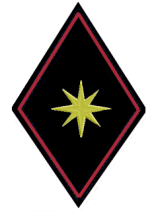
symbol of the Coloniale is a gold eight pointed star which is worn as a badge
on headgear and on the écusson on the left arm. The colour of the
Coloniale is known as grise, although actually it as a blue-grey
colour. This is the colour worn on epaulettes and on the képi and
beret. Général Hébert, commander of the Armée de Libération and the most
senior Coloniale officer, is rarely photographed without his képi grise
which has brought more exposure to the Coloniale. The
Coloniale has several more uniform peculiarities. It wears regimental
specific fourragère around the right arm of its dress uniform. The
Coloniale wear simple rank epaulettes and not the more elaborate épaulettes
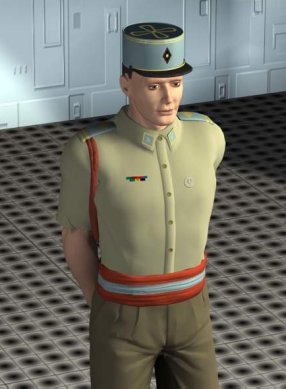
de tradition.. Lastly the service wear a wide ceinture around the
waist, the colours of the ceinture are dependent on the world the
particular unit has been raised on. For example the Coloniale units from
Nouvelle Europe have a mainly red ceinture with a band of grise
in the centre. The Coloniale never adopted the Tenue de Parade Mle.2289 for its parade dress uniform and instead continues to wear the old Tenue de Parade Mle.2267. This is a khaki two piece uniform which is worn with the ceinture, fourragère and képi grise.. There are two main walking out dress orders, one for cold seasons and one for warm. The cold season dress is similar to the TdP67 but is in white and with a longer jacket and is not worn with the ceinture. The summer walking out dress is a shirt and slacks of a lighter brown colour but it is worn with all accoutrements. It should be noted that there are several local variations of Coloniale walking out dress.
Below: A soldier of the I/4e RIC
photographed in walking out dress at a Beowulf orbital station en-route to
reinforce the garrison at Kimanjano as news of the fall of Hochbaden spreads
down the French Arm.
Général de Corps d’Armée Jean-Pierre Roland Jean-Pierre
Roland is the Inspector-General of Colonial Forces, in short he is
responsible for the training standards and efficiency of the entire Armée
Coloniale. Roland was born in Nouvelle Provence but moved to Elysia with his
parents as a boy. He joined the Coloniale’s 8e RIC as a young man and was
soon marked out for officer training because of his drive and fierce intelligence.
His officer training took place on Beta Canum but he returned to serve as an
officer with 8e RIC. He was a company commander by the time of the outbreak
of the Elysian Revolt which tore apart the once idyllic colony. Roland’s
wartime service was close to legendary. He raised 8e RIC’s first Compagnie de
Parachutiste de Marche, served as the commander of a highly successful
counter-insurgent force raised from the loyalist population in the west of
Elysia and eventually as the CO of the V/8e RIC where he averted a mutiny
similar to the one that caused the IV/8e RIC to defect. Following the
independence of Elysia he became the first commander of I/8e RIC, the
loyalist remnant of the Coloniale from Elysia. Since the
war he has risen swiftly through the ranks of senior officers and has
commanded the 101e DAM and 9e Corps on Beta Canum. However this swift rise
seemed to have been halted by his outspoken attacks on defence policy when
Chief of Staff on the Commandement des Forces Coloniale de Beta Canum and he
was shunted sideways to a similar position on Adlerhorst. During the Kafer
War it was Roland’s combination with Rochemont that revitalised
Saint-Benoit’s defences and allowed the rapid formation of 1e RPC. Following
the Liberation Roland was pushed forwards by Rochemont to become
Inspector-General and overhaul France’s shattered colonial defences. Roland
was swiftly put into position but is having trouble overcoming bureaucratic
inertia in Paris and is instead taking a very ‘hands on’ approach which is
having some success. Roland
has a very sharp mind, is resoundingly competent and is a professionally
driven man. Although well liked by his subordinates he is a man who suffers
fools very badly and speaks very bluntly to every one. Indeed it is rumoured
he recently upbraided the Emperor at a private meeting. He is notorious for
holding grudges and in particular despises the Elysian government; he also
has poor relations with his German counterparts. He is a Catholic and is
married with four children. Général
de Division Joseph Escallien Joseph
Escallien is the commander of the crack 102e DAM stationed on Aurore.
Escallien is a Néo-Provençal from the city of Durance in the south of the
colony. He was born into a family with a long history of service in the
French military and the Coloniale. The third son in a large family he
successfully gained entry into the Académie Militaire Coloniale where he
performed efficiently and was commissioned into the 5e RIC. The 5e RIC was a
hard place for an outsider to gain acceptance but this he eventually managed
although he was never at home in the battalion’s ranks. In the
early years of the Central Asian War he saw service on secondment with the
11e DP and then later with a conscript DI. Following this experience he was
transferred to the 8e RIC fighting in the Elysian Revolt, he was taken
prisoner in a maquis vert ambush in 2290 and released the following
year. Since the fall of Elysia he has served with the 10e RIC on Beta Canum.
He successfully commanded a Groupe Mobile of Coloniale units on Aurore during
2298-99 and was promoted to command the newly formed 102e DAM in 2301 a
position he retains to this door. Escallien
is an efficient and hard working, if not inspired commander, with substantial
combat experience. His detractors content that he has had opportunities not
available to his contemporaries as a result of family contacts, however if
this is true he has undeniably performed with no little ability under
pressure. His subordinates respect his ability to succeed in his missions
with low loss of life amongst his soldiers. Escallien has always had a
somewhat turbulent private life and is twice divorced and has several
children scattered around the French Arm. Lieutenant-Colonel
Isabelle Pagny Isabelle
Pagny was the commander of the 5e RCC, she is currently without a command and
under investigation for collaboration by military intelligence. Pagny is a
Breton who initially served with a regiment of Cuirassiers in the Central
Asian War as a conscript, she was commissioned from the ranks and served
throughout the war. She then transferred to the Coloniale and the 5e RCC as a
recognised manoeuvre warfare specialist and as well as serving with that
regiment, aided the formation of both 8e and 9e RCCs. During
the invasion of Beta Canum she was the commander of 5e RCC and led it into
its famous last stand. Pagny was captured during the battle following the
destruction of her AC-8 along with nearly 50 survivors of the regiment. The
PoWs of 5e RCC were kept in appalling conditions and many died from ill
treatment and brutalisation. Pagny began to cooperate with the Kafers in
order to gain better treatment for her soldiers, which she achieved prior to
the liberation of the camp by elements of 11e DP. Pagny has
since been charged with collaboration with the alien regime by zealous
members of the provisional government. The case is seen as a cause célèbre
in the Continent Français and it has exacerbated splits across colonial
society. Pagny was married but her husband was killed during the occupation,
she is childless. Caporal-Chef
Simon Koba Simon
Koba is a soldier serving in the 1e RPC. Simon Koba is a native of Saint
Benoit on Adlerhorst. He initially served in the 9e RIC in the years
following the Central Asian War and saw action on his homeworld in the War of
German Reunification. Following the armistice Koba left the Coloniale and
pursued a career as a farmer on the fringes of the French colony. With the Kafer
War in full swing he was recalled as a reservist to 9e RIC and was soon
dispatched to be an NCO in a newly raised Milice battalion. When news reached
Koba of the formation of the RPC he volunteered to serve with it and was
accepted. He served with the regiment throughout its campaigns. Koba is a
well built man of central African extraction. A natural soldier, he has
excelled with the hard-fighting RPC, bringing on the younger soldier and
proving an inspiration in action. He has been decorated personally by Admiral
Rochmont for his bravery. Nevertheless with the high tide of the Kafer
Invasion in retreat he longs to return home to his farm, wife and children.
He knows however that it may be several years until this comes to pass.
Virtually
all Ground Military careers of frontier born-French will be with the Coloniale.
Core born French citizens can also join the Coloniale, either directly as
officers (Leadership and Tactics required in the first term of service) or as
NCOs after passing a turning point. Initial
Skills:
Combat Rifleman – 3, Heavy Weapons – 2, Melee – 2, Hover Vehicle – 1, Ground
Vehicle – 1, Survival – 2 and First Aid – 1 Primary
Skills:
Combat Skills, Ground Vehicle, Hover Vehicle, Stealth, General Skills (except
Prospecting). Quality The average Coloniale unit has a skill breakdown of 15% Green, 35% Experienced, 35% Veteran and 15% Elite. However many units are more highly trained and experienced and will consequently include greater proportions of Veteran and Elite Personnel. Similarly many units were totally destroyed in the Kafer War and are being rebuilt with largely inexperienced recruits in addition to experienced leaders.
The
Coloniale is described in some detail in the military section of the Aurore
Sourcebook, however there are few other references in other works on which to
build. However the Aurore SB does provide the basic framework of
multi-battalion RICs each drawn from a single world and a similar approach
with RCCs of battalion size being drawn from individual colony worlds. The
Aurore SB is, however, heavily influenced by the French forces (the CEFEO)
that fought in the war in Indochina in the late 1940s and early 1950s. Indeed
at times it depicts an army more akin to that of France post-WW2, than one
you would expect from a power primus inter pares amongst starfaring
nation. The structure depicted is heterogeneous and some details, reservists
using Italian equipment and Manchurian weapons, do not seem appropriate for
the France described in the core manuals.
However
while the Aurore SB’s descriptions of the fighting units are fine, it does
little to detail higher levels of command. In particular I think it overlooks
a lot of the infrastructure which could only be provided by the Coloniale,
especially when the Armée Métropolitaine is described as rarely deploying
outside of Metropolitan France. Consequently
the Coloniale, as the colonial regular force must be responsible for
providing the framework organisation for French military operations in the
colonies. This contradicts the Aurore SB’s statement that the Coloniale are
‘second line of defence’ for the colonies. To take this statement at face
value raises the question as to what the first line of defence is – the Armée
Métropolitaine is ruled out already, the Troupes de Marine are described as
too small, the Milice Coloniale is a volunteer reserve. The only remaining
alternative is the Légion, which is very unlikely. As a
result I have depicted the Coloniale as an army in its own right, providing
support services as well as combat units and being the backbone of colonial
defence while also supporting the Milice and Gendarmes Coloniale. I have kept
the Aurore SB’s regimental structure almost intact. The only exception is the
1e RCC which is raised on Tirane, as Nouvelle Provence is actually a part of
Metropolitan France I have written up this unit as being part of the Armée Métropolitaine
whilst retaining its old Coloniale title. (Real world examples of this are
the presence of Spahi and Zouave units in the modern French Army long after
the disbandment of the Armée d’Afrique.) The
Aurore SB depicts the Coloniale as being slightly behind the state of the art
in terms of equipment and I have kept to this depiction as it is not
unreasonable for a colonial force. The presence of AC-12s in the Coloniale
orbat is noted in the Ground Vehicle Guide.
Clayton,
Anthony – Paths of Glory: The French Army 1914-18 – (London, Cassell,
2003) Clayton, Anthony
– Three Marshals of France: Leadership After Trauma – (London,
Brassey’s, 1992) Haythornthwaite,
Philip J – The World War One Sourcebook - (London, Arms and Armour
Press, 1992) Horne,
Alistair – A Savage War of Peace: Algeria 1954-1962 - (London, Macmillan,
1977) Windrow,
Martin – The Last Valley: Dien Bien Phu and the French Defeat in Vietnam -
(London, Weidenfeld & Nicholson, 2004)
17 July 2004 Copyright D Hebditch,
2004 Thanks to Laurent
Esmiol for feedback and corrections. The figure of the Coloniale soldier is
by Laurent Esmiol.
|