 Go
to the Archive index
Go
to the Archive index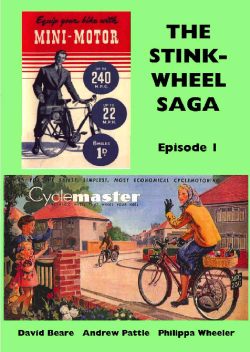
The cyclemotor, an engine for motorising a bicycle, has always been a bit of an odd man out in the world of the vintage enthusiast. Being neither a pedal cycle, nor a proper motor cycle, it gets lost somewhere between the two camps. So, although there is a plethora of books available on motor cycles, and stacks of them about bicycles, on cyclemotors there's ... nothing. Well, nothing in the English language, that is. In French: Le Temps des Mobs, and Dutch: De Grote Bromfiets Encyclopedie have been available, but nothing in English until now. A new book on the history and development of the cyclemotor: The Stinkwheel Saga, Episode One fills the gap.
Three National Autocycle and Cyclemotor Club nmembers: Dave Beare, Andrew Pattle and Philippa Wheeler, have collaborated to research, write and publish The Stinkwheel Saga, Episode One.
It would be easy to say that The Stinkwheel Saga is the best book there is on the subject - but then it's bound to be as it's the only book on the subject! Howver, it is genuinely very good. It's a book you can sit down and read from cover to cover. All the technical details are there but it's not just a load of boring data; the authors have obviously set out to engage and entertain the reader. There are digressions from the main subject of each chapter, bringing the reader odd bits of incidental information relevant to the machine being written about.
The book starts with an introduction to the subject with references to some of the pre-WWII cyclemotors, then explains how the austerity years following WWII provided the conditions for the cyclemotor to flourish. Next there's a chapter about Joseph Day and the origins of the two-stroke engine - the type of engine that powers all but one of the machines discussed in the book. Then it's on to the machines themselves. The authors have selected the nine most popular cyclemotors of the 1950s: the Cyclemaster, Trojan Mini-Motor, BSA Winged Wheel, Sinclair Goddard Power Pak, Ducati Cucciolo, Vincent Firefly, British Salmson Cyclaid, GYS Mocyc/Cairns Motamite/Mocyc and the Mosquito.
A separate chapter is devoted to each machine, illustrated with diagrams, advertisements and period photographs.
Finally, there's a final chapter headed "The Rest" with a picture and brief description of all the other 1950s cyclemotor that were available in the UK. As the full title - The Stinkwheel Saga, Episode One - the authors intend to produce The Stinkwheel Saga, Episode 2 and this will give a detailed description of the machines that are consigned to "The Rest" in Episode One.
The Stinkwheel Saga, Episode One is essential reading for everyone interested in cyclmotors, whether from an historic, social or technical viewpoint.
WS
August 2004