
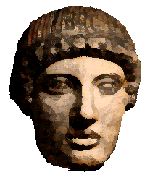
Greek Architecture
Study Greek Temples in your local town or city
You are very interested in Greek Architecture, but you may not be able to visit Agrigento, Selinus or Segesta in Sicily (best preserved Greek temples are here, not in Greece), Paestum in Italy or Athens and Bassae in Greece. Not this year anyway. But do not despair - the chances are that if you live anywhere in Europe, the Americas - or anywhere in the world where European architecture has had an influence, there is abundant material right on your doorstep.
Basic knowledge
All you need to start is the basic understanding of a few technical terms:
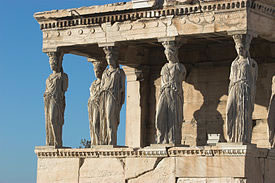 Column: the pillar-like support for the roof (originally they were tree-trunks). Usually fluted. Occasionally a caryatid (female figure) could be substituted.
- Capital : the "head" of a column (from Latin caput, head) - often decorated.
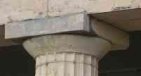 Doric: the original robust no frills style (order) in which Greek temples were built. Columns are sturdy (although tall ones - eg on the Parthenon may exhibit "entasis" - a thickening of the upper section to fool the human eye into seeing a straight line - without it columns might seem to taper unduly).
The capital is simple.
Doric: the original robust no frills style (order) in which Greek temples were built. Columns are sturdy (although tall ones - eg on the Parthenon may exhibit "entasis" - a thickening of the upper section to fool the human eye into seeing a straight line - without it columns might seem to taper unduly).
The capital is simple.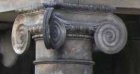 Ionic : The Ionic Order has a more "feminine" version of a column - slimmer and more elegant, with the typical "volutes" (scroll pattern) on the capital.
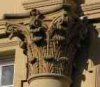 Corinthian : rare in Greek architecture, but became common in Roman times. Column has a floral design based on acanthus leaves. A composite capital - showing Ionic volutes and Corinthian acanthus is also found. On the Colosseum, the three orders are shown - Doric on the bottom floor, Ionic on the next, and Corinthian on the third. This arrangement becomes standard when used by later architects.
- Entablature. The slabs that link the columns and directly support the roof. Doric entablature is very distinctive, consisting of alternating squarish slabs - one a metope (which may be scuplted in low relief, as on the Parthenon), the next called a triglyph, with three vertical bars). The slabs that actually rest on the capitals are collectively called the architrave.
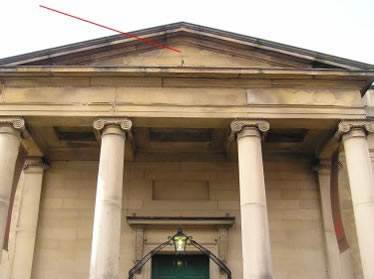 Pediment. The triangular infill above the columns at either end of a temple. Could be filled with sculpture.

Architecture Quiz
To reinforce your understanding, I suggest you take this simple illustrated quiz in order to reinforce your knowledge and understanding of these technical terms.
A Classical Tour of a typical small town
A typical architecturally dull English town can still demonstrate some striking examples of Greek building concepts. The town in question is Bedford, uncertain whether it's East Anglia, The Midlands or Home Counties. A quintessentially provincial place. I could have chosen Bath or York - places with close connections to the classical world - but I prefer to show how classical forms can be found in the least promising spots.
Start your tour (in Harpur Square)