
Oedipus & the Sphinx
The Riddle of the Sphinx
"Why didn't the Thebans simply shoot the sphinx with arrows rather than stand by and see their fellow citizens devoured? Ridiculous!" 1
The appearance of a man-eating monster in Sophocles' Oedipus Tyrannus has always been a problem for me (as it was for Carl Robert 2,
"the sphinx was the gravest problem in the logic of the narrative, one
that the poets never solved"). Why does the sphinx hold such a crucial
place in the story, which otherwise is focused on human feelings, and
human reactions to terrible human events? It seems as out of place as
Godzilla would in the New York and Sicily of Coppola's Godfather trilogy.
This brief study tries to address the question: why is the sphinx included
in the tragedy? Unlike Palaephatus, the 4th century BC sceptic whom I
quoted above, I don't just want to rationalise her away - but I do hope
to discover how she came to occupy her place in the story. There seems
to be only one logical place to start: with the original sphinx in Egypt.
The Egyptian Sphinx
![[picture of the Great Sphinx]](sphinxsm.jpg)
![[The smile of the Sphinx, before the 1920s restoration]](sphinxsm2.jpg)
![[Egyptian mini-sphinx 1785 BC]](1785bc.gif)
Appearance
The Great Sphinx at Giza in Egypt is the oldest monumental stone sculpture in the world, and still the largest. At 74m long by 20m high, not even Mt Rushmore (at a mere 18m) can compete. The mouth, with its enigmatic smile, caused by erosion and ancient vandalism rather than design, is 2 metres across. It was carved from the living rock - one of several limestone knolls in the area. The body, heavily eroded, is a soft yellowish limestone; the head is of a much harder grey limestone. It faces due east, directly towards the sunrise at the solstice. The neck is particularly badly weathered, because it was vulnerable for the very long period when only the head was visible above the sand. Herodotus, who has much to say about the pyramids does not mention the Sphinx at all - maybe it was completely buried in the 5th century BC. The head and face (which once had a beard, fragments of which are in the British Museum) are typical of Dynasty IV, with its headdress (heavily restored in the 1920s), uraeus (cobra on the forehead), and red paint (which Pliny the Elder recorded in the 1st century AD as having religious significance), traces of which are still visible. Note that is is very definitely male, and has no wings.
Date
The Sphinx is certainly to be dated to within a few years of 2500 BC. The builder was most probably Khafre (who built the second largest of the three pyramids) or possibly his successor Menkaure. Unfortunately for the various gullible amateurs who would like to see it built by refugees from Atlantis or Martians 8000 years earlier in 10,500, the archaeological evidence clearly shows the sphinx enclosure was formed by the excavation of material (to create its paws and lower parts) after the demarcation of the pyramids, and the recent geological claim that the erosion was due to rain just cannot hold water!
Purpose
The Great Sphinx was a carving with, as far as is known, no precedent. Later sphinxes tended to come in pairs, and were usually guardians of ways to significant places. Surely the first sphinx had this role: what could be more important than guarding the way to the three pyramids? On a stele between the paws (1000 years later than the sphinx itself) is an inscription which names him as "Kheperi - Re - Atum". These are the three names given by the Egyptians to the sun: in the morning, at noon, and in the evening. (It's not surpising that a country so exposed to the sun should have three gods for his three very different aspects.)
Many Egyptian divinities had animal attributes - the Greeks found this
amusing and primitive. But for the Egyptians the animal represented something
eternal and unchanging. Animals always look the same from generation to
generation, and seem to repeat the simple routines of their lives for
eternity.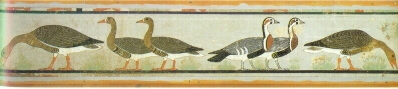 [I'm reminded of this looking at the famous Egyptian painting
of geese from the tomb of Ne-fer-maat at Medum. Dating from 2600 BC, they
are even older than the sphinx: there are white-fronted, bean and rare
red-breasted geese exactly as I've seen them in Norfolk, exactly as illustrated
in any modern bird book.]
[I'm reminded of this looking at the famous Egyptian painting
of geese from the tomb of Ne-fer-maat at Medum. Dating from 2600 BC, they
are even older than the sphinx: there are white-fronted, bean and rare
red-breasted geese exactly as I've seen them in Norfolk, exactly as illustrated
in any modern bird book.]
So the lion is the divine, immortal part (standing for the god Atum, the primal solar god of Heliopolis, the creator). The lion is commonly associated in Egypt with places of entry and exit - even such humble items as doorbolts and water-spouts, a motif which also spread to Greece. Atum's animal is the lion, but he, like the sphinx, has a human face always. But the Great Sphinx's face is not his, it is the face of Khafre, the mortal king (or maybe of Menkaure, his successor).
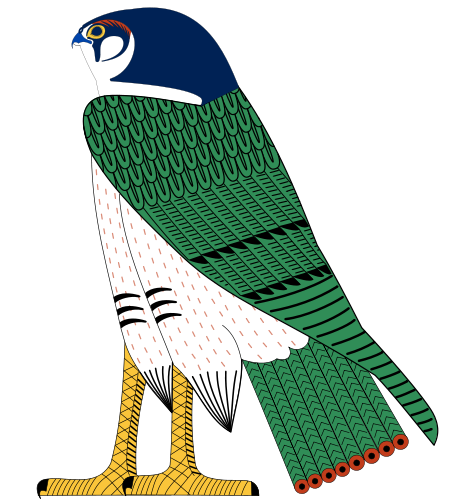 The sphinx also had an element of Horus, the falcon-headed god of the
kings: as is clear from contemporary heads of Khafre, Horus perched behind
the king's head, spreading his wings protectively. This of course has
eroded completely from the existing sphinx - but may explain how the idea
of a winged sphinx arose, from a misunderstanding of the presence of Horus.
Pliny says the locals regarded it as a tomb of their king Harmais, which
would seem to confirm the Horus connection. The type of beard shows that
the sphinx was also a god in his own right. He is the god Atum with the
individual head of his creator Khafre.
The sphinx also had an element of Horus, the falcon-headed god of the
kings: as is clear from contemporary heads of Khafre, Horus perched behind
the king's head, spreading his wings protectively. This of course has
eroded completely from the existing sphinx - but may explain how the idea
of a winged sphinx arose, from a misunderstanding of the presence of Horus.
Pliny says the locals regarded it as a tomb of their king Harmais, which
would seem to confirm the Horus connection. The type of beard shows that
the sphinx was also a god in his own right. He is the god Atum with the
individual head of his creator Khafre.
The derivation of the name "sphinx" is unknown (it is not Greek, or Indo-European at all, although it first appears in Greek in the 5th century BC), and we don't know what the Egyptians called him. But a widely accepted theory is that he was called shesepankh, which means "living image". The Greek word would then be derived from an attempt at pronouncing this! (see below). The sphinx would be the living image of the (eternal) god, and the (mortal) king simultaneously.
Connections between the Egyptian sphinx and the Theban:
- Sphinx was a guardian (who could destroy, presumably, as well as protect). But Egyptian sphinxes were benevolent, while the Theban ate people!
- Could the three-fold god Kheperi-Re-Atum somehow be connected with the later riddle? Both refer to morning , noon, and evening - but Lowell Edmunds 3 has collected large numbers of the same riddle from all over the world - it has been descibed as the sort of riddle "that might have come from a Christmas cracker" 4. It would seem that if you wanted a riddle, this was the brand leader!
Later Sphinxes
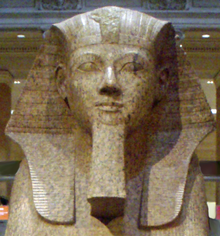 Sphinxes of all shapes and sizes continued to be produced. Little sphinxes
were buried with people, helpful guardians and guides to the next world.
Some sprouted wings, and the first female sphinx appeared about 1900 BC.
There is a most beautiful one representing Queen Hatshepsut (around 1500
BC). In c.1400 Tuthmosis IV restored the Great Sphinx , and added the
stele referred to above, and also built a new temple for him. A little
earlier Amenophis III - making overseas contacts - "exported" the idea
of the sphinx to Mesopotamia (where they always have wings, and inspired
the Cherubim), and to the Greek World. The sphinx, along with the similar
griffin - also of Egyptian origin - is found at Cnossos, and in Cyprus
already they are winged, and sitting upon their haunches with front legs
vertical like a cat, wings curving upwards.
Sphinxes of all shapes and sizes continued to be produced. Little sphinxes
were buried with people, helpful guardians and guides to the next world.
Some sprouted wings, and the first female sphinx appeared about 1900 BC.
There is a most beautiful one representing Queen Hatshepsut (around 1500
BC). In c.1400 Tuthmosis IV restored the Great Sphinx , and added the
stele referred to above, and also built a new temple for him. A little
earlier Amenophis III - making overseas contacts - "exported" the idea
of the sphinx to Mesopotamia (where they always have wings, and inspired
the Cherubim), and to the Greek World. The sphinx, along with the similar
griffin - also of Egyptian origin - is found at Cnossos, and in Cyprus
already they are winged, and sitting upon their haunches with front legs
vertical like a cat, wings curving upwards.
The Greek Sphinx
Hesiod's tale
![[Hermes between a pair of sphinxes]](hermes.gif) Homer5 refers briefly to the Oedipus
story - he killed his father
Homer5 refers briefly to the Oedipus
story - he killed his father ![[sphinx on a corinthian vase]](corinthian.gif) and married his mother, but carried on ruling
in his beloved Thebes, suffering pangs of remorse. His mother/wife, Epicaste,
was the one who paid with her life. But there's no mention of any sphinx.
The first we hear about her is in Hesiod 6.
He says nothing about what she looks like herself, although she is the
daughter of a monster, either the Echidna or the Chimaera depending on
how you interpret the Greek. Her father was the dog Orthos, and she was
the Nemean Lion's sister - presumably she had something of the lion or
dog about her, then. I prefer Chimaera, otherwise her mother conceived
her by her son, which sounds unlikely as well as rude. Her
name is Phix, which is, according to the scholiast, in Hesiod's local
Boeotian dialect: elsewhere it would be Sphix. Not Sphinx, which seems
to come from a later Greek attempt to connect her with the Greek verb sphingo, I bind, constrict or throttle (as in sphincter).
"The Strangler" sounded a plausible name for a monster - although she
seems to have favoured eating her victims raw (according to Aeschylus 7). All Hesiod tells us about her myth is that she was "trouble to the Cadmeans"
(ie Thebes). So far, then, we have a name, but no real reason to connect the name of
this monster with what we later think of as a sphinx, and no mention of
Oedipus. But the story is connected to Hesiod's native Boeotia, and "Phix"
was trouble!
and married his mother, but carried on ruling
in his beloved Thebes, suffering pangs of remorse. His mother/wife, Epicaste,
was the one who paid with her life. But there's no mention of any sphinx.
The first we hear about her is in Hesiod 6.
He says nothing about what she looks like herself, although she is the
daughter of a monster, either the Echidna or the Chimaera depending on
how you interpret the Greek. Her father was the dog Orthos, and she was
the Nemean Lion's sister - presumably she had something of the lion or
dog about her, then. I prefer Chimaera, otherwise her mother conceived
her by her son, which sounds unlikely as well as rude. Her
name is Phix, which is, according to the scholiast, in Hesiod's local
Boeotian dialect: elsewhere it would be Sphix. Not Sphinx, which seems
to come from a later Greek attempt to connect her with the Greek verb sphingo, I bind, constrict or throttle (as in sphincter).
"The Strangler" sounded a plausible name for a monster - although she
seems to have favoured eating her victims raw (according to Aeschylus 7). All Hesiod tells us about her myth is that she was "trouble to the Cadmeans"
(ie Thebes). So far, then, we have a name, but no real reason to connect the name of
this monster with what we later think of as a sphinx, and no mention of
Oedipus. But the story is connected to Hesiod's native Boeotia, and "Phix"
was trouble!
The sphinx in Archaic Greek Art
In the art of Mycenaean and Minoan times, the sphinx is a common motif:
she is usually winged and crowned.8 Sphinxes
continue to feature in Greek art through the Dark Age and on into the
Archaic World. But the Minoan pattern, as expected, disintegrates.9 There's no longer any agreement as to what constitutes a sphinx - many
are again male, often bearded, wingless, or with bodies or legs from other
animals - there's even the occasional addition of a snake's tail. The
female sphinx reappears around 750 BC, as communications reopen with the
east, and by the 7th century the winged female sphinx predominates 10.
The crouching sphinx, female and winged had evolved - mainly through the
work of orientalising Corinthian painters - into a standard type, which,
from the beginning of the 6th century influenced most subsequent painters
as well as sculptors.11
These early sphinxes are never monumental, they are decorative, and found
alone, in pairs, or among other animals (especially lions). But the classical
form had stabilised: she was female, and winged. Herodotus calls the male
sphinxes he saw in Egypt androsphinges 12,
as if sphinx was naturally feminine (and the word is in fact aways
feminine gender in Greek). The first time a representation of a winged
girl-faced lion is called sphinx (actually sphix - see above) is on an
Attic Black Figure band cup by the potters Archicles and Glaucytes, dated
to about 550 BC. The sphinxes either side of the handle are clearly labelled ![[S PH I CH S]](sphichs.gif) [Beazley Archive 310552, Munich, Antikensammlungen, J333]
[Beazley Archive 310552, Munich, Antikensammlungen, J333]
So we know that by mid 6th century - about 100 years after Hesiod - Greeks
definitely knew a sphinx when they saw one.
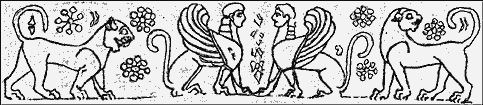
Later additions to the myth after Hesiod
Apollodorus 13, using very probably the lost work on mythology by Pherecydes of Athens (5th century BC) adds more details. According to him her parents were Echidna (did he misread Hesiod?) and Typhon. Hera sent her to punish the Thebans (what for? - see below). She had the face of a woman, the chest, feet and tail of a lion, and the wings of a bird. She sat on Mount Phikion and asked the Thebans a riddle:
"What has one voice, and is four-footed, two-footed and three-footed?"
Each time the Thebans gave a wrong answer, she ate one of them. Many perished, including eventually Haemon, son of Creon - ruler since the death of Laius, the previous king. [incompatible with Sophocles' Antigone, of course]. Creon then announced he'd give the kingship and Laius' widow (his sister Jocasta) to whoever solved the riddle. Oedipus, on his way from Delphi, gave the answer: "Man". The Sphinx threw herself off the acropolis and committed suicide (odd form of suicide for a creature with wings?).
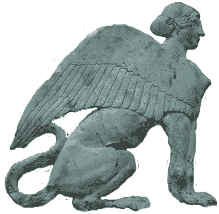 Why was the Sphinx sent and who by?14 Possibly to punish Thebes for allowing Laius get a way with a crime. Laius
(sometimes credited with the "invention" of homosexuality) had raped Chrysippus,
son of Pelops, and carried on ruling.15
Why was the Sphinx sent and who by?14 Possibly to punish Thebes for allowing Laius get a way with a crime. Laius
(sometimes credited with the "invention" of homosexuality) had raped Chrysippus,
son of Pelops, and carried on ruling.15
So the important later additions, besides the now specific rather than
implicit association with Oedipus, are the riddle, and the location, now
named as Mount Phikion ("Sphinx Mountain" - location, however, unknown). Could the mountain have looked
like a crouching sphinx (in the way that so many "Lion Mountains" resemble
lions - in Mauritius, for example)? There are references to a war between the Thebans and the Minyans
of Orchomenos which started on Mt Phikion.16 It would not be too hard to imagine a tradition developing after a battle
on Sphinx Mountain that a sphinx had somehow been defeated. Corinna 17,
the local poetess, believed Oedipus was a sort of poor man's Heracles
or Theseus, killing local monsters - besides the sphinx, he also accounted
for the Teumesian Fox. Thus he seems to have been an all-purpose hero
in Boeotia, rather than a visitor who just happened to come and solve
some riddle. Early vase paintings show him doing the deed with a sword
or spear - there was no riddle, no suicide.
So the sphinx, as local monster, could well have come about from the fancied
resemblance of the mountain between Thebes and her old enemy Orchomenos
to a sphinx. And Oedipus killed her. But where does the riddle come in?

Lion Mountain in Mauritius
The Riddle 1
The Theban story, which included Oedipus and the Sphinx, probably took shape around 600 BC, thanks to the Oidipodia, a lost epic poem, from which the various elements found in Sophocles and later writers ultimately derive. The parricide and the incest were already known to Homer. Hesiod introduces the Sphinx, without mentioning Oedipus. The Oidipodia must have included the local monster, and somehow improved her connection with Oedipus: no longer did he merely slay her like Heracles dealing with her brother the Lion of Nemea, but he destroyed her with his intellect, not his sword, forcing her to commit suicide. (Just as Jocasta does in the play.) And, it is tempting to assume, the riddle was the means by which he demonstrated his intelligence.
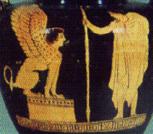 Obviously, Homer's version, where he gratuitously kills his father and
marries his mother (but still carries on as king of Thebes) is unsatisfactory
if you want to make Oedipus at all plausible. He'd have to be very stupid
(as Boeotians proverbially were!) to get involved in two such idiotic
actions. To paraphrase Lady Bracknell "to kill one's father is unfortunate;
to marry one's mother looks like carelesness." So Oedipus must kill his
father by accident (earlier versions probably had Oedipus kill him in
battle - the word used by Homer, exenarixas, for the killing of
Laius is most commonly used for killing in battle) and thus qualify to
marry the widowed queen by performing some excellent deed: say killing
a monster (a very frequent motif in folktales). The sphinx was by now
a conveniently available local one. Then, taking his cue from Odysseus,
Oedipus acquires a cunning intellect. If Oedipus is very clever, and not
stupid at all, the whole story gets much more interesting. He proves his
cleverness by solving a riddle (another folktale standby), and then, despite
his cleverness, still manages to kill his father and marry his mother.
Now we have a plot!
Obviously, Homer's version, where he gratuitously kills his father and
marries his mother (but still carries on as king of Thebes) is unsatisfactory
if you want to make Oedipus at all plausible. He'd have to be very stupid
(as Boeotians proverbially were!) to get involved in two such idiotic
actions. To paraphrase Lady Bracknell "to kill one's father is unfortunate;
to marry one's mother looks like carelesness." So Oedipus must kill his
father by accident (earlier versions probably had Oedipus kill him in
battle - the word used by Homer, exenarixas, for the killing of
Laius is most commonly used for killing in battle) and thus qualify to
marry the widowed queen by performing some excellent deed: say killing
a monster (a very frequent motif in folktales). The sphinx was by now
a conveniently available local one. Then, taking his cue from Odysseus,
Oedipus acquires a cunning intellect. If Oedipus is very clever, and not
stupid at all, the whole story gets much more interesting. He proves his
cleverness by solving a riddle (another folktale standby), and then, despite
his cleverness, still manages to kill his father and marry his mother.
Now we have a plot!
The Riddle 2
Where did the riddle come from? Discounting folk memories of the Egyptian Sphinx (see above), the first mention of a riddle is on a vase made about 470-460 BC.18 It is in hexameter form, the metre of epic, which suggests that it indeed derives from the Oidipodia. The first record of the riddle is in two fragments from Euripides' lost Oedipus play - but the riddle is also quoted in hexameters, and in the scholiast on Euripides' Phoenissae.19 Later the entire riddle is extensively quoted,20 but, as I said above, there is no especial significance in this particular riddle, which is found in various parts of the world.21 It's not a particuarly hard one either (my Year 10 pupils usually manage to solve it unaided!).
Oedipus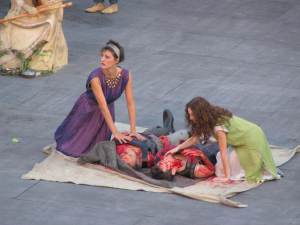
Finally, I'd like to look at the hero himself. The brilliant man who committed those two awesome crimes. Walter Burkert22 I think has the answer. The climax of the Oidipodia must have been the extinction of the family, which came when Oedipus' sons kill each other. (This is certainly the case in Aeschylus' Theban trilogy, whose scope would have rivalled the Oresteia: the dénouement came with the fratricide in the Seven Against Thebes, following the lost Laius and Oedipus.)
Why did they kill each other? Because their father cursed them.
What sort of father would curse his own sons? One who was irredeemably evil.
What's the most evil thing a man can do? Kill dad and marry mum.
(Burkert
compares the medieval story that Judas killed his father and slept with
his mother: he must have done because he was an evil man.)
This is the likely original skeleton of the story - which was improved
by the teller of the epic, who introduced the riddle and the sphinx, and
then finally by Sophocles, who makes Oedipus not only intelligent, but
one who demonstrates "strength and courage, loyalty to Thebes, and loyalty
to the truth."
Sophocles
Sophocles' genius alters the focus of the story away from the fratricidal
sons - Eteocles and Polyneices aren't even mentioned. Laius's crime, the
subject of Euripides' Chrysippos, the homosexual rape of the son
of Pelops is never mentioned. In fact no reason is given why Laius and
Jocasta should have had to lose their son, beyond the fact that it was
foretold that he'd kill his father. Euripides 23 adds details, like Laius succumbing to lust when he was drunk, and forcing
Jocasta to submit to the forbidden caresses. No, Sophocles insists that
we must look only to Oedipus himself.
- Is he guilty? There is no hamartia, mistake or guilty act that makes Oedipus deserve what happens to him. The gods don't even warn him not to do the things. Apollo simply tells him he will do them.
- Is it fate? No - the idea of fate hardly gets a mention: on the contrary, we are always hearing about Oedipus' free will. Apollo put him where he was, sure: but every action in the play is chosen by Oedipus. He chose to send Creon to Delphi, to listen to the priest, to ask for Teiresias, to have the Old Shepherd fetched. And his blinding was "freely chosen, not unchosen".24 There's nothing of the inherited guilt or curse that Aeschylus dwelt on (as he did in the Oresteia, too) - the curse which dominates Sophocles' own earlier play, Antigone.
- Is he a scapegoat? (pharmakos) Do we look to old rituals
to explain the role of Oedipus (recently argued by Daniel Ogden 25).
Was Oedipus himself the monster (teras), the deformed baby who
must be exposed and allowed to die outside the polis in order
to purify the polis? (Various sources have him exposed in a pot,
or a chest, or even thrown into the sea.)
If so, Sophocles' explanation for Oedipus' eponymous deformity is a rationalisation: Oedipus was born with deformed feet, he did not acquire them: he was exposed because he had them. But - the twist - the baby grew up and returned as an adult to pollute the polis again: and had to be expelled a second time. But Sophocles loses interest in the plague after the first scene: and, of course, as Taplin pointed out 26, Oedipus is not in fact expelled (much as he'd like to be). - Is his intelligence (the reason why the sphinx came into the
story, remember) the key? The third Chorus points the way27.
If religion (by which they mean oracles - the only ancient channel of
communication between gods and men) goes to blazes (which is what the
Greek phrase errhei de ta theia almost literally means); if there
is no foreknowledge (pronoia,), then quite simply there are no
gods. Life, as Jocasta believed, is lived at random, and Oedipus would
truly be the son of Tyche (Chance). The two possibilities are:
- There are no gods, and life is a matter of chance. Tyche (Chance, or putting it a more modern way) Chaos rules (as Democritus was teaching at about the time the play was written) .
- The gods exist, and everything has a purpose - even something
as apparently meaningless as Oedipus' life and suffering. Nous,
or Mind or Purpose rules (as Anaxagoras was arguing in Athens
about the time the play was first produced).
Oedipus courageously sees the possibilty of Chaos, but finally accepts what the gods have done to him. In this way he proves to himself and to the audience that the universe does have a meaning.
Burkert brilliantly quotes from Umberto Eco, The Name of the Rose, to show us how he imagines Oedipus' predicament. The hero, William of Baskerville, faces up to the chaos of the universe:
"...there was no plot ... only a sequence of causes and concauses, and of causes contradicting one another, which proceeded on their own, creating relationships that did not start from any plan."
Possibly Sophocles was on the threshold of such insights, suggests Burkert, but shrank from accepting them. We'll never understand the play fully - but this idea may be an interesting one to entertain until something better comes along!
His pupil, Adso, says:
"In imagining order, you still found something."
William:
The order that our mind imagines is ... like a ladder built to attain something. But afterwards you must throw the ladder away, because you discover that, even if it was useful, it was meaningless."
Conclusion
I agree with Edmunds that neither the sphinx nor her riddle were originally an important part of the Oedipus story. All Greece knew from Homer that he unwittingly killed his father and married his mother. But in his local area, he was, perhaps, still something of a hero - defeating the enemies of Thebes in battle, accounting for the odd monster. But he was stupid, as Boeotians proverbially were - so stupid that he killed his father in ignorance and then married his mother! But the epic version of the story rehabilitated the local boy. Not content with a local Heracles who slew monsters, but was none too bright, it created a local Odysseus, who could score with his brain - giving the lie to Theban idiocy. He still had to do the parricide and incest, of course - Homer had made sure of that. But by making the sphinx a riddler, Oedipus became a master problem-solver. Thus he could be excused his crimes, as Laius had been, and remain in power, all the wiser and more powerful because of the personal problems he had had to deal with. Compare Berkoff's version of the the story28, where Eddie (short for Oedipus), despite the revelations of his birth, is quite content to return to the café with the wife he still fancies.
The marriage with Jocasta (the weak woman unable to cope with the knowledge) did not last, of course - as Pherecydes tells us29. His two sons by her died bravely in yet another campaign against the Minyans of Orchomenos. His second wife gave him his two daughters, Antigone and Ismene, and the two sons Eteocles and Polyneices. Oedipus outlived her, too, and married a third wife, Astymedusa, daughter of Sthenelus. But he lived out his life, a great and respected leader (tyrannos).
In this way the Thebans reclaimed Oedipus as a hero. Sophocles, however,
came from an Athens that was no friend to Thebes, and no friend to tyrants.
But, great dramatist as he is, there is no anti-Theban or pro-democratic
subtext. But the idea of a man continuing his life as normal after such
crimes is blown away. Oedipus becomes the detective eager to unlock his
own secret, and brave enough not only to condemn himself, but also to
award the fit punishment. The blindness! Let Oedipus go on living, but
let him be blind now he can see the truth. And that will be the image
that, after the genius of Sophocles, all take away with them. Sophocles
has to keep the sphinx, because she proves that Oedipus was intelligent
- a man who sees the consequences of his actions, and freely decides on
the best punishment for them. A fragment from Euripides' lost Oedipus (later than Sophocles'), seems to sum up:
"The mind is what one must consider, the mind. What is the use of physical beauty, when one does not have beauty in the mind?"30
REFERENCES
- Palalaephatus peri apiston (on incredible things), tr Jacob Stern 1996
- Carl Robert, Oidipus, 1915
- Lowell Edmunds, The Sphinx in the Oedipus Legend 1981
- Paul Jordan, Riddles of the Sphinx 1998
- Homer Odyssey 11.273
- Hesiod Theogony 326 ff
- Aeschylus, hypothesis of Seven Against Thebes
- eg see illustrations in Reynold Higgins, Minoan and Mycenaean Art 1997
- eg see illustrations in John Boardman, Early Greek Vase Painting 1998
- eg The Analatos Painter, Louvre CA2985
- eg BM 1910.6; Louvre A439; Vatican 73, 74
- Herodotus 2.175
- Apollodorus 3.5.8
- Suggestions include: Hera (sch Euripides Phoenissae 1760); Dionysus (sch Hesiod Theogony 326); Hades (Euripides Phoenissae 810); Ares (hypoth Eur. Phoen); the sphinx was a bastard daughter of Laius according to sch Eur.Phoen 36
- Apollodorus 3.5.5
- Pherecydes F95 in Jacoby FGrH
- Corinna fr 672 in PMG
- Beasley ARV2.451.1
- J.Vaio, The New Fragments of Euripides' Oedipus in GRBS 5, 1964; sch Eur.Phoen 50
- The riddle: Athen.10 456B (citing Asclepiades, FGrH 12F); AP 14.64; Tz.Lyc.7; Apollod 3.5.8; Diodorus 4.64.3-4; sch Eur.Phoen.50; sch Homer Od.11.271; hypoth Aesch.Septem; Myth Vat 2.230; Eur. Oedipus fr 83.22-25
- Lowell Edmunds, Oedipus, The Ancient Legend and Its Later Analogues 1985
- Walter Burkert, Oedipus, Oracles and Meaning (from Sophocles to Umberto Eco) 1991
- Euripides, Phoenissae 21
- Sophocles, Oedipus Tyrannos 1230-1
- Daniel Ogden What was in Pandora's Box? in Archaic Greece: New Approaches and New Evidence ed Fisher and Van Wees 1998
- Oliver Taplin, Greek Tragedy in Action 1978
- Sophocles, Oedipus Tyrannos 893-910
- Steven Berkoff, Greek
- Pherecydes F95 in Jacoby FGrH
- Euripides, Oedipus fr 548