Classical oddments in the news
Herodotus would have approved!
More in Press Cuttings
-
Sun and Mirror ineffective?
Earlier:
It's long been a an article of faith that Archimedes used mirrors to set fire to and destroy the Roman fleet during the siege of Syracuse in 213 BC. The story in fact comes from Iohannes Zonaras, a Byzantine chronicler of 12th century AD, who précised the works of earlier writers (including Cassius Dio, for the period of the Punic Wars). A team from MIT last week tried to set fire to a ship with mirrors in San Francisco harbour- they couldn't get it to do more than smoulder a bit. Having failed themselves, they now claim that the great Archimedes could not possibly have succeeded. Seems a pretty feeble experiment to me! [Guardian 24 Oct 2005 - with Zonaras erroneously assigned to AD 12 rather that 12 century AD!] .In a programme called "A Brief History of Spin" broadcast tonight, the Oxford Historian Felipe Fernandez Armesto awards the second prize for the greatest spin doctors of all time to Gaius Maecenas, publicist to the emperor Augustus. He manipulated his patron's image so successfully that few outside the ranks of ancient historian realise that the man who "found Rome a city of brick and left it a city of marble" (not a bad sound-bite) began his career as a world class mass-murderer. Forget Ted Sorensen and Pierre Salinger, forget Peter Mandelson or even James Carville - this guy could have made Pol Pot into Mother Theresa (and who did her publicity?). [Leviathan, BBC TV September 25 1997]
 As not used by King Priam?
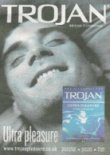
A widely advertised condom with a humdinger of a brand name. How different would the story of the Trojan royal family, with Priam and Hecuba's 50 sons and 50 daughters, have been had sensible family planning been available? On a similar tack, I salute the CD burning software that has decided to call itself Nero. See "Nero was framed" below. [April 2004]- School holiday with a difference!
You can now spend your vacation training to be a gladiator - in a Gladiator School in Rome (where else?). See this article in the Sunday Times of 22 February 2004. - Maecenas, still patronising after all these years
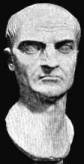
Colin Tweedy, chief executive of Arts and Business, hopes to find an extra £140m for the arts by enlisting donors in a scheme that rewards them with a modest lapel pin with the head of Maecenas, now proclaimed the founding father of giving to the arts by Arts and Business.
"The idea of Maecenas is to change the culture, to make people - individuals and businesses - proud of giving to the arts, to make them boast about it, to make them feel loved and valued in return. The money is there, we just have to extract it. We have to teach people how to give, and teach arts organisations how to ask."
A closer study of the Augustan period might have revealed that Maecenas was truly the patron of Spin Doctors rather than the arts - he recruited the top figures from popular culture and bribed them to celebrate the regime. But Horace and Virgil were clever enough to include their own agenda while apparently toeing the line. [Guardian 1 March 2004]
-
 Klassic comment
Asked why she was bringing out an album of classical music, popstrelle Myleene Klass opined that it was to educate the kids, so classical music does not die out, "like Latin". Thanks, babe.[October , 2003] - €Ave Euro!
The Euro - which became the only legal currency in most of Europe at midnight - has the Greek letter epsilon as its symbol, with an extra line to emphasise its stability. Let's hope. More here. [January 1st, 2002]
- Games ancient and modern
George Bush has said there'll be no hiatus in the war in Afghanistan for the Salt Lake City Winter Olympics. During the ancient Olympics, all combat was suspended to allow competitors to travel freely and safely from their homes to the Olympic sanctuary in Elis. I also noted that when the Republic of Ireland played Iran at football recently in Teheran, an exception was made to allow some female Irish fans to watch. In this, the ancient world was similar - no women could watch or take part in the Olympics. See my athletics page. [November 2001] - A clean breast
More and more men are shaving . . . their chests. Flip through the men's magazines. Check out your favorite TV and movie stars. Take a look at hip-hoppers, boy bands or just about any dude in his late teens or 20s preening on the campus quad or during spring break. No, not models or bodybuilders. Just regular old Middle American boys. "I think it just comes from advertising," Mangan said. "There is so much more emphasis today on the body. They are inundated from the time they are young with images that tell them they have to be sexy and have the perfect body." Today that image - chestwise - is of the hairless wonder, and it has historical precedent. Ian Worthington, a professor of ancient Greek history at the University of Missouri, says that among the younger citizens of ancient Thebes, Athens and Corinth, "it was believed that chest hair hid the body beautiful. The young especially shaved," Worthington said. "It is something the Romans picked up. The Romans had their bathhouses and athletic festivals. It was common to go to the bathhouse where they would put oil on their bodies and then have someone come and scrape it (the hair) off." Guys who shave these days say they generally use regular razors or clippers, every couple of weeks - "whenever it needs to be done, when it starts getting like a low, cheap carpet," said Kansas sophomore Dan Koob, 19, of St. Louis. And yes, Horn said, when it starts growing back, "it's itchier than (heck)." [Knight Ridder Newspapers Nov. 28, 2001] - Tempora mutantur: United States and Sparta
The new Russo-American friendship marks a huge change. It is a change not only from the Cold-War world but from the world of Sept. 10, 2001. Back then, the Russians were playing the China card and the European card while fretting about America's plans for NATO expansion and abrogation of the 1972 anti-ballistic missile treaty. Not anymore. Historians will see the roots of change before Sept. 11, when Bush had already proclaimed Putin's trustworthiness and Putin had already placed Islamic terrorism near the top of his security agenda. Yet there has been a revolution even so, for which both men deserve credit, perhaps especially Putin, who moved with lightning speed to America's side after the terror attacks. The world has turned with stunning swiftness, but that ought not to surprise us. History is full of revolutions in diplomatic affairs. States often turn on a dime. Take the ancient Spartans, for instance. For several generations after 480 BC, they basked in the heroic afterglow of the 300 Spartans who died, to the last man, at Thermopylae in northern Greece rather than let the Persian invaders through. By 412 BC, however, nostalgia wasn't what it used to be. Sparta made a treaty with its sworn enemy Persia in order to finance its blood feud with Athens. As part of the price, Sparta agreed to surrender half the Greeks of the Aegean to Persian rule. [Newsday, November 18, 2001] - 1066 and all that?
KEY events in British history remain a mystery for young people, with a third believing that D-Day marked the end of the Second World War. There is still confusion over Henry VIII's wives. A third thought he had eight wives; others were surprised to learn that Queen Victoria reigned for 64 years. One in 12 believed that 1066, the year of the Battle of Hastings, was the date of the Roman invasion of Britain, according to a survey of 1,000 people aged 15 to 24 by Encyclopaedia Britannica. Christine Hodgson, direct marketing manager of Encyclopaedia Britannica, said: “As a nation whose history has shaped the face of the world, it seems incredible that the younger generation has decided to dismiss it. Britain in particular is envied for its rich history. It's a great shame that the young take so much for granted. I think it's time for all of us, not just young people, to hit the books again.” [News report 4 November 2001] - Anthrax: was this the plague in the Iliad?
Anthrax [writes Guy Gugliotta] is one of the world's oldest afflictions, a scourge known throughout history for its ability to cripple and kill -- an old and hated enemy, as horrifying in ancient times as it is today in the age of bioterrorism. When Pharoah refused to free the Israelites, the Bible tells us, Egypt was attacked with 10 plagues. Number five was a "grievous murrain" that killed cattle, and number six, "a boil breaking forth with blains upon man and upon beast throughout the land." Homer, at the beginning of the Iliad, described a "burning wind of plague" that attacked "pack animals first, and dogs, but soldiers too." And Virgil's Georgics record an epidemic so grotesque that "in the very stalls" animal carcasses were "rotting with putrid foulness." [Washington Post Monday, November 5, 2001] - 2,000-year-old Champagne
The French have always claimed that Champagne was invented in France in the 17th century, but a professor at Rheims university (really!) now points out that "bullulae" (bubbles) in wine were appreciated by the poet Lucan, 1700 years before Dom Perignon. It was then as now a drink for special occasions - especially romantic ones. Bubbly of whatever source according to Professor Tran Ky "acts as a vaso-dilator and favours erection...sharpens our sensory perceptions ... and suppresses our inhibitions. And, unlike Viagra, it helps prevent heart attacks." Make sure you have plenty for Champagne's third millennium! [Guardian September, 1999] - Eureka!
The Walters Art Gallery in Baltimore is dispaying a unique manuscript (until September 5th). Its history is this:
- Archimedes wrote "On Floating Bodies" - containing his famous
"principle". He was killed by a Roman soldier at the siege of Syracuse
in 212 BC.
- Copies of the original MS (including the 55 diagrams) would have
been regularly made over the next millenium or so.
- Between AD 950 and AD 975 a copy was made on to vellum by a scribe
- probably in Constantinople.
- About 1150 AD a pious monk attempted to scrub off the existing
writing and diagrams, and recycle the vellum for use as a prayer-book.
He rebound the fine leather pages, after cutting each in half (as
you might cut an A4 landscape page to make 2 A5 portraits).
- From about 1400 AD to 1830 it was in a monastery in the Judaean desert (now the West Bank): it was removed to the library of the Orthodox Patriarch in Jerusalem.
- About 1850 it was moved again - to Constantinople. All this time it was lovingly preserved as a Christian object.
- 1899 - it was recognised as a palimpsest by Danish scholar, Dr
Johan Heiberg, who tried to read and translate it, with some success.
The MS was still in quite reasonable condition, but obviously difficult
to read with only a magnifying glass.
- 1908 - 1928: MS disappeared, to reappear in possession of a French
family. Mould had set in, and some extra religious "art" had been
added to 4 of the 178 pages.
- 1998. Sold by the family to an anonymous American (but not Bill
Gates!) Loaned to the Walters gallery for conservation and decipherment.
- 1999. Work begins on multispectral imaging, which will reveal the full details of the text accurately.
- Archimedes wrote "On Floating Bodies" - containing his famous
"principle". He was killed by a Roman soldier at the siege of Syracuse
in 212 BC.
- "The most explicit item I have seen" (British Museum Director)
The British Museum's latest - and (at £1.8 million) the most expensive - acquisition is now on show. The museum also regard it as its most important Greek or Roman buy of the last 30 years. It is a solid silver Roman cup, found originally in Palestine and dating from the 1st century BC. The workmanship is exquisite - and this is the reason for its purchase, according to Director Robert Anderson, not its subject matter. This is what's likely to attract the crowds, though: it shows explicit scenes of gay sex. It was collected in the early 1900s by US eccentric Edward Perry Warren (who commissioned Rodin's "The Kiss" - thought scandalously decadent at the time). It's recently been on view in the Metropolitan, New York. [The Guardian - article and picture Wednesday 5 May 1999] - Medea Violence
Young children in a Liverpool school are studying "Euripedes' Medea" (sic) as part of the city's work on violence prevention. 10-year-olds are being helped to deal with the violence in their own families through acting out with masks the confrontations between Jason and Medea. "Why is Medea dangerous?" asks the drama teacher. "She cut up her brother and threw his limbs into the sea." (TES Friday Magazine, March 12 1999)
Whatever happened to the concept of copy-cat violence? Let's hope there'll be no siblings' severed limbs floating down the Mersey. - Rubicon
Two separate headlines in today's Guardian (24th February 1999): "Blair Crosses Rubicon" and "Caesar Blair casts the die". (Referring to his decision to join the European Monetary Union - eventually.) Neither article mentioned that the Divine Julius crossed the stream called Rubicon in order to begin a Civil War. But that's not the worst - an exotic fruit-flavoured fizzy drink is currently available under the name of Rubicon Passion! Keep it away from the Prime Minister. - Dithyrambus lives!
According to the more lurid sections of the UK press (Sunday 21 Feb 1999) it will be in theory possible for men to carry a a foetus, once produced through in vitro fertilisation - in any "appropriate" part of their anatomy. The bowel was suggested by one "scientist" - but once again science struggles to catch up with myth. Know they nothing of Zeus stitching the soon-to-be Dionysus into his thigh after the incineration of his mother Semele? (Hence his epithet "Dithyrambus", the twice-born). Or Athena - springing from the head of Zeus? Are such nativities to become commonplace in the 21st century? - Latin to be legal no more
Lord Irvine, Britain's Lord High Chancellor, wants lawyers to abandon Latin and other antiquated jargon, according to an announcement on his website. From April 26th, 1999, it will be plain English, if his lordship gets his way. See an amusing leading article in the Guardian, annotated for your illumination (and corrected - it's a sign of the times that an article about Latin is riddled with lexical and grammatical solecisms: they should have checked it with the Classics Pages first - as a recent correspondent from Florida did before painting his motto on his Harley-Davidson) (Leader in The Guardian February 1999) - Sleaze-free Olympics
Revelations this week (30 January 1999) about bribery and corruption at the highest levels in the modern Olympic Games prompt two observations: bribery was a problem in the ancient games, punished by forcing the guilty party to pay for a bronze statue of Zeus, to be prominently dispayed by the entrance to the stadium. Six bronze "Zanes" (as they were called) should now be on order for Sydney.
Second thought: why not ignore the whole sordid "official" games altogether, and support the Olympic Games in Gloucestershire, England. Long before de Coubertin ever had his much-misunderstood idea for a revival of the ancient Olympics, Robert Dover had re-founded the "Olympicks" in the Cotswolds. That was back in 1612. Events included horse and foot racing, cock fighting, wrestling, stick fighting, hammer throwing, bowls, chess, card games and dancing - but the blue riband event was, and remains shin kicking, wearing the traditional straw-padded trousers. The only bribery anyone can remember was when a farmer once had to be sweetened with a bottle of whisky to remove his sheep from the arena. (Article in The Guardian January 30th 1999) - Welcome to MIM, or whatever it is
The Millennium is bugging Classicists as well as lesser mortals: what advice will they give to TV companies (and others) who still want to feature those pretentious Roman numerals at the bottom of their credits? Simplest way to denote 1999 would be MIM, following the modern practice of subtracting the smaller unit when placed in front of the larger (as in IV, IX etc - note that really old clocks always have IIII and VIIII). But MIM looks pretty uncool when pompousness is the main intention - so maybe we shall see a more authentic MDCCCCLXXXXVIIII or a compromise MCMXCIX. Watch the endscreens of those programmes. But next year there'll be no escape from MM - perhaps an opportune moment to abandon "Roman numerals" for ever. (see Guardian 1st January 1999) - Top of the PhilOsoPherS
Not since Monty Python's famous football match between the Greeks and the Germans has there been such excitement in the world of Philosophy. Philosophers' Magazine conducted a poll of philosophy students and teachers who were asked for their opinion on who have "contributed most to the advancement of human understanding." Top six were:- Aristotle 183 votes
- Plato 158
- Kant 152
- Nietzsche 114
- Wittgenstein 111
- Hume 99
So it's dear old Aristotle still at the top after 2,400 years.
- Women in Greece - the hidden truth
A paper delivered by Lloyd Llewellyn-Jones at the Classical Association conference this week suggests that women's lot in ancient Greece was even worse than previously supposed. Re-examining the evidence from art and literature, he proposes that women, if they appeared at all, were heavily veiled in public throughout Greek history. In particular, he reckons that the numerous pictures showing a bride being unveiled actually show the reverse. Using analogies from modern veiled cultures, he speculates that the Greeks, too, feared the pollution thought to stream from a woman's hair. (Report in The Times April 10th 1998) - Lucky Lords?
An article in Oxford Today (Hilary Term 1998) suggests that an ideal way of reforming the Second Chamber of the British Parliament, the House of Lords, would be to introduce the ancient Athenian democratic principle of lot. At present their lordships are largely there because of the lottery of birth: this scheme would select the peers by a true lottery - perhaps a draw as part of the National Lottery, where an alternative to the standard £1,000,000 or so could be a coronet and an ermine gown. - Sunday Drivers
Veteran Roman stunt man Sergio Casadei, 72, with the help of ex carpark attendant Liberato Mirenna is reviving the chariot race, one of the glories of ancient Rome (or at least of the film Ben Hur, in which he drove one of the chariots built by his father). Now that The Via Appia is closed to traffic on a Sunday, it will be used to stage re-runs of the world's most famous chariot race, to attract Romans and tourists to the area. Signor Casadei reaveals that his dream is to stage races in the Colosseum. This could be a first, as the ancient Romans held theirs in the Circus Maximus. (The Times, March 1998) - An Infant Hercules?
Apparently "Infant Hercules" is a medical term for an abnormally large baby - such as Ethan Gilby of Cleethorpes, Lincolnshire UK. He is one year old, but weighs 32lb and is 3 feet tall. He can already "lift the video recorder" according to his mum. But can he strangle snakes with his bare hands? (Daily Telegraph 5th March 1998) - More on Atlantis mania
While Blashers is looking in Bolivia (see below), some equally unbalanced Russians are going to be diving off the coast of Cornwall in their own quaint quest for Atlantis. The expedition will cost millions of roubles: where could I get a grant to look for Utopia or Erewhon or (preferably) The Land Where The Bong Tree Grows? (Independent on Sunday 11 January 1998; Sunday Times 28th December 1997) - Ancient Dentistry
A 1900 year old skull from Essone, France has a false tooth neatly implanted in the jawbone. The local dentist had hammmered a wrought iron implant (probably while it was still hot!) into the gap left by extraction of the molar. The bone had then grown round it , and a natural integration of bone and false tooth took place. Such an operation today (hopefully under anaesthetic and using titanium rather than iron) is still controversial, with most dentists preferring to use a "bridge" rather than implant a foreign body and wait for osseointegration.(Guardian 1st January 1998) - New edition of the Ars Amatoria deperately needed
Latin lovers, and lovers of Ovid, will be amazed to learn that a School for Seduction has been opened in Udine, Northern Italy. Incompetent lovers, for a fee, will learn the five steps to seduction from Clinical Psychologist Romina Bellandi, 26. Ovid's Art of Love caused a scandal in Augustan Rome for daring to articulate what everybody knew - in modern Italy, it seems, young people are just too busy to master the techniques in the traditional way.(The Times, November 1st 1997) - tempus festivum adest
For those in search of the gift for a sad Classicist in their life, the following are available from Past Times merchandising (many thanks to Richard H):
- Libens Volens Potens T-shirt (Ready, Willing and able), £9.99
- Lavator Amphorarum apron (Bottle-washer), £8.9
- Dux Coquorum hat (head cook), £4.99
- Maximus pater T-shirt (super dad), £?
- Maxime Fabulosum T-shirt (absolutely fabulous), £9.99 (shouldn't it be fabulosa?)
- Emptrix nata sum bag (born to shop), £9.99
- Blashers goes bonkers in Bolivia
Colonel John Blashford Snell ("Blashers") is the latest in a long line of the daft and the deluded to go looking for Atlantis. Any classicist could tell him where to look - it exists - but only in the pages of Plato's Timaeus and Critias. If anyone went to Bolivia (yes, that's where it is, apparently!) looking for Plato's Republic, they would deserve the richest mockery available. Will mad explorers of the future go looking for Utopia, or Middle Earth or Discworld? What is it about Atlantis than no one can accept its fictional status - it is as imaginary as Lear's Land Where the Bong Tree Grows. [Daily MailSeptember 18 1997] - Olympics are coming home!
Athenians were dancing in the streets following the announcement that the 2004 Olympics will be held in Athens. Perhaps it would be churlish to point out that Athens had nothing whatever to do with the running and organisation of the ancient Games - which were held in Elis in the north west Peloponnese. The Pan-Athenian Games were not particularly highly regarded - and unlike the "stephanotic" Games at Olympia, Delphi, Nemea and Isthmia - where the prize was a simple garland of vegetation - the Athenians had to offer tempting prizes of olive-oil to attract top competitiors. See Panathenaic Vases. [September 8th 1997] - Mind Sports Olympiad
The first "Mind Olympiad" took place in London recently, attracting 2000 competitors from 58 countries. But how would present Olympians compete wiith the greats of the past? According to Tony Buzan and Raymond Keene, the organisers, the most intelligent person who ever lived was Leonardo da Vinci, with a storming IQ of 220, with Goethe (215) and Shakespeare (210) in silver and bronze positions. The best Greeks are Archimedes and Aristotle, in equal 8th position on 190. No Romans get as far as 180, which is the score of the top-rated woman (George Eliot). [New Statesman 29 August 1997] - Achilles' Heel Kicked Out
A world conference conference of Anatomists in Sao Paulo, Brazil has agreed on a revised list of standard anatomical terms in Latin and English, which will enable doctors in all countries to know which bit hurts. There are casualties, though. Out go Fallopian tubes, Adam's apple - and the Achilles tendon, which will in future be known as tendo calcaneus.Behind the changes is Dr Di Dio, whose has gained linguistic immortality by being the first to name parts of the body that were previously anonymous - the gap between the breasts, for example, is now officially the "inter-mammary sulcus" (who said cleavage?). [Guardian 29 August 1997] - Gutless Greeks - offal's off
A European Economic Community directive is threatening a historic part of Greek cuisine. Since the days of Aristophanes (see Knights) Greeks have loved those choice inner organs - but now the offal offends officials of the EEC, and a ban has been proposed. "I am gutted," said an Athenian spokesman. [ UK press August 1997] - Pythagoras' Chums
The Ancient World mocked the philosopher Pythagoras, because he (allegedly) believed that the humble bean had a soul, and was thus, like himself, eligible for reincarnation. Obviously this was because beans seem, when hosted by a human, to produce their own breath, wind, flatulence - very much a life of their own. Now a British Scientist at Cambridge has genetically engineered the world's first fart-free bean. It has been christened the "prim" bean in token of its guarantee not to cause social embarrassment. Pythagoreans are aghast. Mr Bean intends to sue.[Guardian August 5 1997] - The Odyssey: Homer
Robert Fagles' eagerly-awaited new translation of the Odyssey has been published by Viking. I haven't got my copy yet, but reviews in the UK press (eg Guardian 19 June 1997) suggest it's just what's needed to win new fans for a generation who are unaware that anyone called Homer ever said much except "doh!", and would use Ajax to clean their john. - Duke as doryphoros
According to Garry Wills' new book (John Wayne, the Politics of Celebrity) the hero aka Marion Morrison modelled his famous stance on Greek sculpture. Imagine Polycleitus' spear-carrier with a cowboy hat - and yes, it's him! [Independent on Sunday Magazine May 11th 1997] - No more Hippocratic Oath
UK doctors have operated on the 2500 year old Hippocratic Oath and surgically removed it. No longer will initiates into medicine swear by Apollo the Healer, Asclepius, Hygieia and Panacea - but will be asked to subscribe to a new code of ethics described disparagingly by one expert as "in favour of motherhood and apple-pie". Out goes "I will not give a woman a pessary to procure abortion" and in comes "Where abortion is permitted, I agree that it should take place only within an ethical and legal framework." Out goes "I will refrain from the seduction of females or males" and in comes "I will be honest, respectful and compassionate." [UK papers, Friday and Saturday 29th-30th March 1997]. This seems a good time to remember Hippocrates' greatest contribution to the art of medicine - leaving things alone. Hippocrates, unlike the doctors of his time, who favoured intervention in the form of spells, potions, and the deliberate introduction of potentially infectious material into wounds, believed in doing as little as possible. In this way, most patients, left to nature, recovered spontaneously - and Hippocrates' reputation soared. - Death by a million rose petals
The painting The Roses of Heliogabalus is one of many by Sir Lawrence Alma-Tadema currently on exhibition at the Walker Art Gallery, Liverpool, UK (until 8th June). The fabulously decadent Roman emperor is "relaxed on a couch with his vicious mother, a catamite and four doxies. Time for a spot of cruelty. A minion pulls a cord, and before one can say 'Heliogabalus', a sprawl of courtiers is showered with flowers. This is death by a million rose petals, but the victims haven't yet grasped that the pink and white downpour will continue until they suffocate." (William Feaver - the Observer, 31 March 1997). Alma-Tadema, Victorian bourgeoisie's favourite soft-porn artist was a fellow countryman and older contemporary of Van Gogh (although he outlived him by 20 years). A-T was in his lifetime everything VG wasn't in his - world famous and very very rich. Small Latin and less Greek?
You won't even need "small Latin" to get into Cambridge University to read Classics, if current proposals for changing the entry qualifications go through. You won't need to know any Latin at all - Cambridge will teach you all you need to know in a summer school before you start. Cambridge is behind Oxford in this (unlike today's University Boat Race ) - they took their first non-linguists in 1995 - and the first candidates have just taken mods. [UK Press Saturday 30th April 1997]- Elvis vivit! Vivat Rex!
Finnish latinomane Jukka ("elvissimus") Ammondt took full advantage of the temporary presence in Finland of the world's two most potent leaders (albeit both symbolically crippled) to plug his latest CD. Apparently Latin is the new rock'n'roll - or is rock'n'roll the new Latin? "Latin used to unite the world - today rock music unites the world" - and the new Ammondt CD unites Latin and Rock. Most of the King's greatest numbers are included : Ne saevias ("Don't be cruel") - Clinton was urged to sing this one to Yeltsin (in Latin, of course); Quate, Crepa, Rota ("Shake, rattle and roll"); Nunc distrahor ("I'm all shook up"); Ai, nunc laudi sis, Claudia ("Lawdy Miss Clawdy") and of course Glauci calcei ("Blue suede shoes"). - Homer - a flash in the pan?
An interesting papyrus fragment, recently deciphered (Romanian Academy Journal of Comparative Papyrology), seemingly describes the first public readings of the Iliad and Odyssey in 5th century Corinth. The upshot appears to be that valuable sheepskin should not be wasted on recopying a story which is too long, too full of repetitions, with far too many "rosy-fingered dawns", too many boring bits, and for the Odyssey, such a crap ending. What is Odysseus going to do next, for god's sake? No: these old fashioned, boring, long-winded epics are not worth the vellum they're written on. There's an excellent article by George Steiner in Prospect (May 1996) - discussing the future of literature using this papyrus as his jumping-off point. See my non-boring version of the Odyssey! [27th April 1996] - Nude statues: Shock! Horror!!
The incredible fuss about the nude statues of a male and female athlete on the the route of the Olympic torch to Atlanta has caused world-wide amusement.The Times [third leader 27th April] points out that all original competitors were naked (although they fail to mention one of the important reasons for this: to ensure that no woman could compete) - and even refers to the Mutilation of the Hermae in 415 BC as a precedent for political interference with statuary!