Sophocles' Antigone
-
On this page : summary of the play and general notes
-
On other pages : discussions -
- How old was Antigone?
- The Character of Creon - persuasion and getting persuaded
- Ismene - how should she be portrayed?
- The Antigone Game. Test your command of the play
- A memorable production - with Nelson Mandela as Creon!
- Review of Irene Papas' production Syracuse 2005
- Tiresias
The plot
King Creon decrees that Polynices the traitor is not to be buried, but his sister Antigone defies the order. She is caught, and sentenced by Creon to be buried alive - even though she is betrothed to his son Haemon. After the blind prophet Tiresias proves that the gods are on Antigone's side, Creon changes his mind - but too late. He goes first to bury Polynices, but Antigone has already hanged herself. When Creon arrives at the tomb, Haemon attacks him and then kills himself. When the news of their death is reported, Creon's wife Eurydice takes her own life. Creon is alone.
The actors
Sophocles used only three actors in the original performance (all that were permitted under the drama competition regulations):
- Creon (protagonist)
- Antigone, Tiresias, Messenger (deuteragonist)
- Ismene, Sentry, Haemon, Eurydice (tritagonist)

The action
-
Prologue
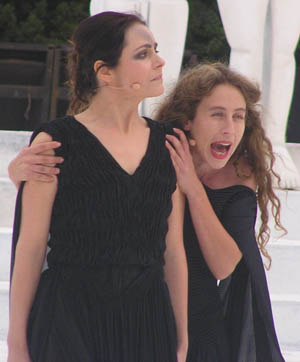
- Antigone and her sister Ismene. How do they react to the proclamation? Which one acts like a "normal" Athenian woman? ( The chorus celebrate the victory over Polynices - the man who defied the gods has been justly punished. Who do they mean, and who will it apply to by the end of the play?)
-
Creon and the Sentry
- What sort of ruler is Creon? Who do the chorus think buried the body? (The chorus discuss man's free will - to choose good or evil. Who is "good" and who "evil" at this point?)
-
Antigone is arrested and condemned
- Why has she buried the body? What is Creon's reaction? (Another chorus)
-
The quarrel between Creon and Haemon
- What sort of a son is Haemon? What is Creon's reason for punishing Antigone? Do you support the father or the son (why?)? (The chorus are shocked by Haemon)
-
Antigone's suffering
- No support from the oikos - no marriage, no funeral. (The chorus wonder if she is innocent)
-
Tiresias
- He confirms that the gods were on Antigone's side. Creon has buried the wrong one! What do the chorus now think? (They appeal to the gods to help Thebes)
-
The deaths :
- Antigone, Haemon, Eurydice. What has Creon learned?
The sequel which was written first
Sophocles wrote Antigone in 441BC - the same year in which he was elected general - and probably wrote Oedipus the King in about 425 BC (the plague at the beginning would have reminded the Athenians of the terrible plague which they had endured in 431BC - and which had killed their leader Pericles, Sophocles' friend).
Thus, although Antigone tells some of the story of "what happened next" it was not actually intended to be a sequel. You'll see, for example, that Creon in Antigone is a very different character from Creon in Oedipus.
What happened after the story in Oedipus the King?
First, Oedipus was thrown out of Thebes - but his daughter Antigone went with him to help and guide him. (This is the subject of Sophocles' third play - Oedipus at Colonus - which he wrote at the end of his life when he was over 90 in 401BC). Oedipus was forced to keep on travelling, because nowhere wanted to be polluted by having his body buried in their soil. There is another oracle - Oedipus believes he must die at a place called Colonus - in Athenian territory. The locals want to get rid of him, but he refuses to budge, and appeals to the king of Athens, Theseus. Theseus promises to help him and allow his body to be buried at Colonus - where his spirit will protect Athens.
At this point Oedipus' other daughter - Ismene - arrives with terrible news. Oedipus' two sons, Eteocles and Polynices have quarrelled over who is to rule Thebes, and Polynices has left home - to find help and support for his claim to the throne. He soon arrives, and wants Oedipus' blessing - but Oedipus is appalled at their behaviour and curses them both - a curse that they should kill each other. There is a mighty thunderstorm, and Oedipus' death follows quickly.
Oedipus' daughters returned to Thebes, where Eteocles now ruled alone. Polynices eventually reached Argos, where he was taken pity on by the king, Adrastus. Adrastus not only gave him his daughter in marriage, but also promised to restore him to the throne of Thebes. Seven armies led by seven heroes (including Adrastus and Polynices) attacked the seven gates of Thebes. Thebes under Eteocles and his uncle Creon resist - there is stalemate. To settle the quarrel, it is decided that seven Argive champions should face seven Theban champions in single combat at each of the seven gates. The Thebans are successful - but tragedy spoils the victory. Only one Theban champion died - and that was Eteocles who had faced his brother Polynices. Each had killed the other in fulfilment of their father's curse.
Creon is now undisputed king of Thebes ... and this is where the play Antigone begins.
![[Next Page?]](next.gif)