Greek Athletics
The ancient Olympics
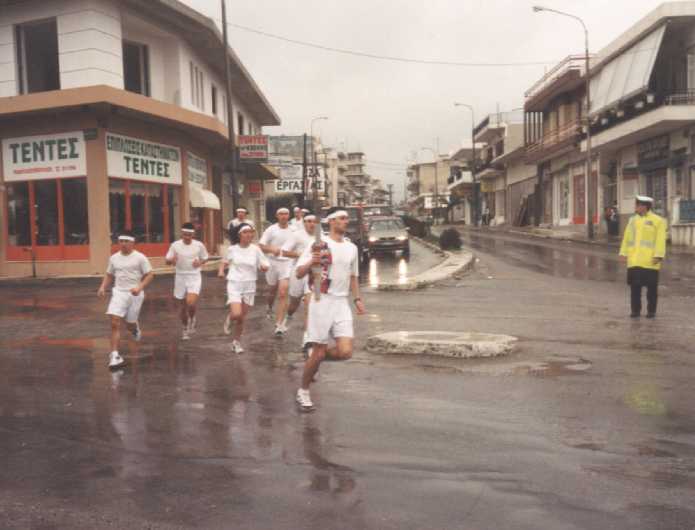
 bedraggled group of joggers from a local running club splashes though
the puddles on a gloomy afternoon in some small town.
bedraggled group of joggers from a local running club splashes though
the puddles on a gloomy afternoon in some small town.
 What
gives special significance to this commonplace scene? Look closely at the
leading runner. He is carrying something. It's a gas-powered torch, although
the flame is invisible even in this dull light. The wet, deserted streets
are in Sparta, in southern Greece. The date is March 31st 1996 - the Olympic
Flame, kindled by the sun's rays a few days earlier at the site of ancient
Olympia, is still near the start of its journey to Atlanta for the Centennial
Olympic Games.
What
gives special significance to this commonplace scene? Look closely at the
leading runner. He is carrying something. It's a gas-powered torch, although
the flame is invisible even in this dull light. The wet, deserted streets
are in Sparta, in southern Greece. The date is March 31st 1996 - the Olympic
Flame, kindled by the sun's rays a few days earlier at the site of ancient
Olympia, is still near the start of its journey to Atlanta for the Centennial
Olympic Games.
Why?
The
ancient Olympics had no "sacred flame" - this was a brainchild of Goebbels'
propaganda machine, first seen at the notorious 1936 Berlin Olympics. Ironically,
what seems to be the most potent symbol of the Games' links with ancient
Greece is actually the most bogus.
What did the ancient Games have in common with the modern Olympics?
Not the flame, to be sure, but professionalism, money, political pressure,
corruption, cheating ... to cheer yourself up, find out about the modern
Nemean Games, where all these vices are avoided.
Footnote 1998:
The Olympic Torch
The dropping of the sacred Olympic Torch by a cyclist and its consequent
extinction has led to a questioning of the whole absurd ritual
.
The torch was apparently immediately relit with an alternative flame
also kindled by the sun's rays in the Temple of Zeus Olympios on the
morning of March 30th. Memories were recalled of the Tokyo Olympics,
where a similar incident was avoided by prompt use of a cigarette lighter.
Many Classicists (even) assume the ritual is ancient. There were of
course torch races (like the one Socrates had been to at the beginning
of Republic) - but they were never part of the Olympics.
The Olympic Flame goes back only to Hitler's Games in 1936 - and was
possibly one of Leni Riefenstahl's concepts (she also wanted the runners
naked : the Greek boys involved said no!
). The opening of
Olympiad, her amazing film, is available on YouTube:
Olympics are coming home! (not)
Athenians were dancing in the streets following the announcement that the 2004 Olympics will be held in Athens. Perhaps it would be churlish to point out that Athens had nothing whatever to do with the running and organisation of the ancient Games - which were held in Elis in the north west Peloponnese. The Pan-Athenian Games were not particularly highly regarded - and unlike the "stephanotic" Games at Olympia, Delphi, Nemea and Isthmia - where the prize was a simple garland of vegetation - the Athenians had to offer tempting prizes of olive-oil to attract top competitiors. See Panathenaic Vases. [September 8th 1997]
London Olympics 2012
Please visit Ancient and Modern Olympics - the superb blog by Dr Jason Konig of University of St Andrew's , Scotland:
http://ancientandmodernolympics.wordpress.com/