Homer's Iliad
The Poem of Power
Some reflection on why the Iliad is terrifyingly relevant
today1 - The first word in the Iliad is menin2
- wrath, rage, passion, "anger that stores itself up for a long time”
“On the one hand anger is closely connected to brutality and a delight in vengeance for its own sake... On the other hand, not to get angry when horrible things take place seems itself to be a diminution of one's humanity. In circumstances where evil prevails, anger is an assertion of concern for human well-being and human dignity. ... Achilles' wrath, sweeter than honey, brought thousandfold pains upon the Achaians; and it led him to treat the corpse of his enemy in a base and dehumanising manner. It is only when, with Priam, he puts aside his anger that he is able to recognise the equal humanity of his foe.”
Martha Nussbaum in her brilliant chapter on Anger in Public Life in The Therapy of Desire (1994)

“Today in Boston, the Iliad is used in a therapeutic program for disturbed Vietnam veterans suffering from postcombat stress syndrome.”
Martha Nussbaum, op.cit.
“...as we in fact see in Homer, there is a kind of laxness and lightness in the relationships of the gods, a kind of playful unheroic quality that contrasts sharply with the more intense character of human love and friendship...In heaven there is, in two senses, no Achilles: no warrior risking everything he is and has, and no loving friend whose love is such that he risks everything on account of his friend.”
Martha Nussbaum, op.cit.
 "Corpses were tied to US tanks, and paraded around like trophies."
From This is our Guernica, article about Falluja in the Guardian 27 April 2005 by Jonathan Steele and Dahr Jamail.
“The true hero, the true subject, the center of the Iliad, is force. Force as man's instrument, force as man's master, force before which human flesh shrinks back. The human soul, in this poem, is shown always in its relation to force: swept away, blinded by the force it thinks it can direct, bent under the pressure of the force to which it is subjected. Those who had dreamed that force, thanks to progress, now belonged to the past, have seen the poem as a historic document; those who can see that force, today as in the past, is at the center of all human history, find in the Iliad its most beautiful, its purest mirror.”
“Force is as pitiless to the man who possesses it, or thinks he does, as it is to its victims; the second it crushes, the first it intoxicates. The truth is, nobody possesses it. The human race is not divided up, in the Iliad, into conquered persons, slaves, suppliants, on the one hand, and conquerors and chiefs on the other. In this poem there is not a single man who does not at one time or another have to bow his neck to force.”
Simone Adolphine Weil L'Iliade ou le poème de la force (1940)
“RAGE is the first word of the Iliad, and so Homer
announces his theme - the rage of Achilles. But it is not just Achilles
who rages through the poem. For the poem is as Simone Weil said,
a poem about rage (or la force in French): it is rage that
is its true hero and real subject, the abstract power that working
through the human hero makes a thing of him and corpse of his victim.
Death and horror of death stalk the poem, and death is always violent,
never peaceful. Into the general horror of the war between the Trojans
and the Greeks arrives a new horror for the Greeks, the quarrel
between Achilles as personification of rage and his king Agamemnon.
That quarrel leads to the withdrawal of Achilles into his tent,
while his companions are killed on the battlefield in a multitude
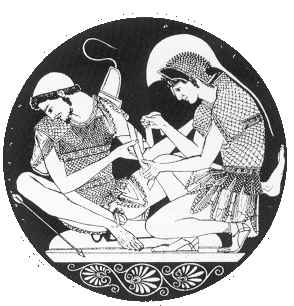
of lovingly described ways. Finally his dearest comrade Patroclus
can bear it no longer, and begs for the armour of Achilles, so that
the tide of battle may turn. Patroclus himself is killed in fair
fight by Hector, and the rage of Achilles is roused again to stalk
the battlefield hunting his victim. Hector is trapped outside the
walls of his city and hunted, to be tricked by the gods and left
to the mercy of his hate filled enemy: 'Ask for no mercy dead or
alive, dog; I wish I had the stomach to carve your flesh up and
eat it raw, for what you have done: but nothing shall keep the dogs
from you whatever your people and parents may offer.'
But once his rage is slaked, even Achilles can sense the shame of old
Priam as he comes at night 'like a murderer seeking asylum' to beg for
his son's body; and at last his rage is stilled in the recognition of
the common fate of death.
And yet the poem is also transformed by moments of tenderness between
friends, between men and women, and by visions of a world at peace or
the eternal forces of nature.The horror of war and the longing for peace
are mirror images of the human condition; and this, the founding poem
of western civilisation, presents the reality of life as a whole in a
way that no other poem does. "
Oswyn Murray
See also:
war and peace Discussion of Aristophanes' Peace and the Peloponnesian War.
Lysistrata Aristophanes against war.
The Iliad: latest tool in the battle of the sexes. A British educationalist, Nick Tate, head of the government funded Qualifications and Curriculum Agency, has recommended some books to get boys to read (we're worried that girls are now leaving boys in their educational wake - 65% of them pass GCSE English as against 43% of boys). Among them is the Iliad: "It's action-packed, it has bounce and rhythm and vitality and excitement and danger. And that is what is going to get a lot of boys interested in reading." But how are they going to make sure the girls don't get hold of it?(The Guardian 11th February 1998)
Footnotes
1. 11 November 2001 - Armistice Day! Two months since September 11 2001, and a month since the bombing of Afghanistan began. And no change when I checked the page again on 14 February 2003 - Valentine's Day, when the Dr Blix reported to the UN on Iraq. And still today (27 April 2005) - after reading a report which tells us that in the city of Falluja (pop 300,000) 36,000 homes were destroyed in the US onslaught, along with 8,400 shops. 60 nurseries and schools were ruined, along with 65 mosques and religious sanctuaries [Guardian].
2.
The word menis is normally reserved for the wrath of the gods.
Achilles is "god-like" inasmuch as he is childish and petulant: his tragedy
is that he thinks like an immortal, while being painfully aware of his
own mortality. More on what
it means to be immortal.
The Iliad Game
Revision 2011
Now revised, checked and corrected, with masses of illustrations and easier-to-follow clues.
My Game is intended to guide you through the most important characters, events and themes of the greatest poem ever written. The Iliad Game is still the most sophisticated thing on the Classics Pages (written originally in 1998).
You need javascript enabled. And to allow scripting windows, if your browser asks.
The game is mainly text based. There will eventually be a quiz at the end of each book (still under development).
There are something like 200 pages in the Game - you need to have some time available (although you can pause - see the Help menu)
You need to know the answer to a question before the game will allow you to move on. The menus (see a list of possible answers, in other words), and the pictures will give you clues if you get stuck - but the game isn't intended for people who aren't already fairly well acquainted with the Iliad. A copy by the computer for reference will occasionally be needed even by an expert. But it's easy to cheat, if you really need to!
The navigation bar is always there at the top of the page if you need help - or if you just want to choose a certain book or books. Or if you want to cheat!
You can use a variety of spellings - achilles, Achilles, ACHILLES, akhilleus, Akhilleus and AKHILLEUS are all acceptable - in other words the common anglicisations - Hector, Hecuba etc are acceptable alongside more accurate Hektor, Hekabe etc. But mis-spellings are not allowed (Appolo Apolo and Appollo will be rejected).