

 Harry Potter in ancient Greek
Harry Potter and the Philosopher's Stone


"It's an ideal job for an old bloke in retirement." Peter Needham, translator of HP into Latin.
News
Greek - English Vocabulary for Greek Harry Potter. It's not complete, but should help you get started with the Greek text. You'll need to download a Greek font in order to use it - so go to this page first. Many thanks to Mark Wutka for suggesting improvements to this program. Go to Greek Vocabulary (if you already have the Font SPIonic).
Commentary and Notes on the Greek text: only chapters 1 & 2 so far - the rest will be added as I finish them. You'll need the font as well, if you haven't already downloaded it. Go to the Greek Harry Potter Notes
How much is genuine ancient Greek? Can you tell? A test for the Hellenists! A selection of words and phrases from the Greek version - some are ancient, some are my own coinages. Which are which? And how many can you translate? Try for yourself.
Background
 Sometime in the autumn of 2001, I was searching for Classics
news for this website when I came across an article in the Daily
Telegraph revealing that a
Latin translation of Harry Potter & the Philosopher's Stone was under way (by Peter Needham, now published by Bloomsbury
Press as Harrius Potter et Philosophi Lapis). It also mentioned
that they were intending to bring out an ancient Greek version, "believed
to be the first time a children's classic will have been translated into
Greek", but were having difficulty finding a translator. "J
K Rowling [who studied Latin at Exeter university] and her publishers
hope that the translations will help children overcome the common dread
of studying the two dead languages - where wars in Gaul and Virgil's thoughts
on beekeeping can be as exciting as it gets." This would seem to
be true, as according to a
more recent Telegraph report, in the United States "The use of
Latin in J K Rowling's books has prompted a surge of interest in the classics
among high school students. After decades of decline, the numbers taking
Latin for college credits has soared by 80 per cent since the first book
was published in the United States six years ago" (Daily Telegraph 2 February 2003).
Sometime in the autumn of 2001, I was searching for Classics
news for this website when I came across an article in the Daily
Telegraph revealing that a
Latin translation of Harry Potter & the Philosopher's Stone was under way (by Peter Needham, now published by Bloomsbury
Press as Harrius Potter et Philosophi Lapis). It also mentioned
that they were intending to bring out an ancient Greek version, "believed
to be the first time a children's classic will have been translated into
Greek", but were having difficulty finding a translator. "J
K Rowling [who studied Latin at Exeter university] and her publishers
hope that the translations will help children overcome the common dread
of studying the two dead languages - where wars in Gaul and Virgil's thoughts
on beekeeping can be as exciting as it gets." This would seem to
be true, as according to a
more recent Telegraph report, in the United States "The use of
Latin in J K Rowling's books has prompted a surge of interest in the classics
among high school students. After decades of decline, the numbers taking
Latin for college credits has soared by 80 per cent since the first book
was published in the United States six years ago" (Daily Telegraph 2 February 2003).
On a wild impulse I wrote to The Children's Book Commissioning Editor at Bloomsbury Press, offering my services. Greek prose composition had been my favorite thing at school and university - though of course we spent at least three hours working on about a paragraph of English to be turned into Greek. I didn't really expect to hear any more - my offer was in a slightly jokey form - but some weeks later I received a phonecall from Emma Matthewson at Bloomsbury telling me that they were indeed serious about an ancient Greek version, and would I like to do a specimen chapter? I said yes, and took Harry (the publishers kindly supplied me with a copy, as I had never read the book!) and my Liddell & Scott lexicon on holiday with me to the Caribbean, and concocted a version of chapter 1, plus a little bit of the Quidditch episode in chapter 11. In early January 2002 I submitted my draft, it was approved and I was offered a contract to complete the task by January 1st 2003.
The aim
My intention was to recreate a version of the book which would make sense to a Greek from any era up to the 4th century AD who had managed by some magical process (such as would only be taught only to very advanced students at Hogwarts!) to reach the 21st century. Objects and ideas would be unfamiliar - but once he'd got used to his new surroundings, the book would make complete sense. So I thought it was very important to have this time-travelling Greek in mind at all times, and continually ask myself "would that have any meaning for him? what would he make of that?" In other words a cultural transposition is involved, not just finding the words. Perhaps one could conceive of a device like the Teleporter in Star Trek - no more fanciful than many things actually dscribed in the JKR corpus!
The work proceeds
Before getting down to the translation I had to find a style - J K Rowling would not lend herself to the style of Thucydides or Plato or Demosthenes (who had been our main models for prose composition). But there are Greek novels (Charitons's Callirhoe, Achilles Tatius' Cleitophon and Leucippe, Longus' Daphnis and Chloe, Heliodorus' African Story) all of whom I read, along with the entire works of Lucian - a most entertaining task. Lucian's humorous tongue-in-cheek approach, together with his fantastical notions such as The True History (which is guaranteed to contain not a single word of truth) soon convinced me that he was the closest writer in ancient Greek to J K R. So Lucian became my model - his Greek, despite his date (3rd century AD) is (almost) pure 5th century BC Attic, which was being recycled at the time. But this also gave me an excuse for using vocabulary from post-classical sources, without which it would have been impossible to proceed. He was also, like me, a Greek through culture and education, not ethnicity.
Lucian also has something in common with JKR. Many critics have remarked on her "lack of originality" - with obvious influences being Enid Blyton's school stories, Just William, Billy Bunter, Tolkien, and so on. In fact she is part of a fine classical tradition of mimesis - borrowing, adapting, personalising- not stealing, as Longinus points out. As Ted Brennan points out in a flattering review of my ancient Greek Harry Potter, if we are to condemn this in her, we must also condemn it in that supreme classical master of mimesis, Virgil himself. But Lucian too was part of the mimesis scene. Despite the unprecedented prosperity of the contemporary Roman world in his day (he lived under the "Five Good Emperors" from about 120 to about 180 AD), Lucian and his fellow writers were voluntary prisoners of the past: writing in time-honoured formats, re-using antique themes and even reprocessing the Greek language as it had been written 400 years previously in the glory days of Athens. No references to the contemporary world, total denial of the koine, the common speech of the Greek world at the time.
I also read a lot of Euripides, Aristophanes, Herodotus - and medical and magical writers, for specialised magical and medical vocabulary is not covered in Woodhouse's Dictionary! It was necessary to read Hippocrates to discover words like δοθιήν (a boil). On papyri I found spells far more outlandish that Hermione's. Liddell & Scott was indispensable - and I also needed inspiration from modern Greek quite frequently: my most useful possession is a 19th century "Dictionary of the English and Modern Greek Languages, as actually written and spoken" by A N Jannaris, PhD, published by John Murray in 1895. This helped me find ἡ ἁμαξοστοιχία [he hamaxostoichia] for "the train" rather than τὸ τρένο [to treno]. I worked in beta code, because all ancient Greek fonts map to the qwerty keyboard idiosyncratically - and I didn't want to force a particular font on to the printers. Quotations on this page will show as proper ancient Greek if you are using Windows XP or have the font Palatino Linotype installed: if not and you'd like to install the font go here to download it: http://www.ellopos.net/elpenor/greek-texts/greek-fonts.asp
You can see an extract here (whatever fonts you have on your machine!) in fully accented ancient Greek. It's Lee Jordan's commentary on the Quidditch Game - which you can also hear me read - see below. I worked mostly at home, but also very productively in the Classics Faculty Library in Cambridge, and - thanks to my trusty HP Jornada hand-held computer - on trains, boats and planes, in bars and cafés around the world. Enormous thanks are due to Keith Maclennan, formerly Head of Classics at Rugby school, for his wise advice and inspired suggestions, and to Dr Manuela Tecusan for painstaking assistance with the highly complex proof reading. But translating Harry has been the most enjoyable hard work of my life.
Ancient authors
As well as my very obvious debt to Lucian, alert readers will note numerous borrowings from other classic (Aeschylean moments for example at the start of chapter 2 - δέκατον μὲν ἔτος τόδʹ ἐπεί. I was doubtless attempting to convey the epic grandeur of JKR's little tale, and also evoke the sense of tragedy which looms over the house of Dursley as surely as it did over the House of Atreus. Mrs Dursley has something of a Clytemnestra about her; and Hagrid - like the watchman in Agamemnon - finds an ox on his tongue at some point). But there are hidden gems from Homer, Thucydides, Plato and many others for those wise enough to discern them. This is of course good classical practice, where recycling was properly regarded as a compliment to the original writer. Aristophanes' dung beetle in Peace provides Αἰτναῖος("the size of Etna" see also below under noises) for very big things (used sparingly). Other Aristophanic phrases include ἡ ἕνη καὶ νέα for the last day of the month (Clouds) and Dumbledore says somewhere χαίρομαι κεὐφαίνομαι (Frogs) - the lewd connotation may well not have escaped the astute scholar! Menander was a great source for interjections and conversational style, as were the Letters of Alciphron. There are numerous Homeric echoes - Dumbledore is particularly fond of the occasional epic turn of phrase, such as ἐπεὶ πόσιος καὶ ἐδήτυος ἐξ ἔρον ἤσθετε . Another Homeric echo is the use of τηλυγέτος to describe darling Dudley. Even the Greeks didn't really know what τηλυγέτος was supposed to mean exactly, but it's only ever used to describe some special, cherished child, Agamemnon's son Orestes for example. Ironically though, it is Harry who will have to avenge a murdered parent, not Dudley.
Problems
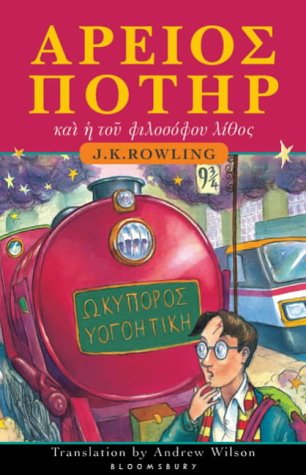
Proper names Less of a problem than I thought they'd be. I followed Herodotus' principle of trying to make outlandish names seem native to Greek - some were easy: Auntie Marge becomes Μαργή [Marge](= the mad woman in Greek), Malfoi becomes Μάλακος [malakos](= soft,wuss in Greek - not an insult to be used lightly even today: this explains why everyone laughs at his name), Crabbe and Goyle become Кάρκινος καὶ Κέρκωψ [Karkinos kai Kerkops](recalling the Kerkopes, dim-witted brothers caught by Heracles). Ron becomes ῾Ροών [Rhoon] (rather charmingly, the Greek for a pomegranate orchard), Muggles become Μύγαλοι [Mugaloi]Greek for field-mice, quite appropriately), McGonagall becomes the homophonous Μαγονωγαλέα [Magonogalea](witch-sweetie - also contains γαλέη [galea] which is a word used for a small pet animal, like a cat?) and Dumbledore is Διμπλόδωρος (double = Διπλό-, therefore dumble = Διμπλό- !). Similarly Quirrell becomes Κίουρος [Kiouros] (Greek σκίουρος [skiouros] = squirrel). The house names had to fit into iambic verse, for the Sorting Hat's song, but still end up sounding vaguely Greek. Sirius Black become Σείριος ὁ μέλας [Seirios ho melas]. And some names are already Greek (Draco, Hermione, George, Daedalus) and some could just be translated (Bane becomes Ἄτηρος [Ateros], Fang becomes Δάκος [Dakos]). Hagrid - Ἁγριώδης suggests Greek ἄγριος [agrios] (= wild, savage). Voldemort rather nicely becomes Φολιδόμορτος [Pholidomortos] = Scaly Death (φολιδο‑ [pholido-] being Greek for scale, as in snake, and the mort- root means fate - same as Latin mors, mortis death.) Hogwarts I'm particularly proud of - not only does ῾Υογοήτου [Hyogoetou] sound much like the original (by the way it's in the genitive case on the analogy of ᾉδου, Hades, standing for "the house of Hades". I imagine there must have been an eponymous Hogwart, like Tiffin or Bancroft or Blundell - or more likely in Edinburgh's Fette or George Watson), but it also derives from ὕο‐ [hyo-]the root for hog, and γοητής [goetes] the word for wizard. JKR's cunningly punning Diagon Alley becomes ὁ στενωπὸς διάγων [ho stenopos diagon] - "the lane that leads one through". And Harry Potter is Ἅρειος Ποτήρ [Hareios Poter]- ἄρειος [areios] means "belonging to Ares", the war god - appropriate for the young warrior, and ποτήρ [poter] is a Greek word for "cup" or "goblet" - presumably the cup of wisdom from which Harry must quickly learn to drink deeply. Other names: the Weaslies become the homophonous Εὐισήλιοι - suggesting good people, with sunny dispositions: Percy is of course Perseus, an equivalent crusader for right, and Fred is Φερέδικος the bringer of justice. The toad-loving Neville Longbottom transcibes to Νεφελώδης Μακρόπυγος - the first name suggests "foggy" and the surname is actually funnier in Greek. Ron's rat Scabbers has a name from Latin: σκαβρός which is catchier than the Greek ψωράλεος. The odious Snape becomes the near-homophone Σίναπυς derived appropriately from σίναπυ, mustard. The pesky poltergeist Peeves is Ποιφύκτης - the snorter or hisser, and the janitor Filch I renamed Φήληξ, Greek for a wild fig, which means "deceiver", as according to Liddell & Scott wild figs deceive people into thinking they are real figs. The amiable professor Flitwick is no longer named after an obscure Bedfordshire village, but has the more suitable but similar-sounding Φιλητικός, the lovable one. I rather wish I'd called Dudley Τεύτλιος which would have meant "he who resembles a beetroot". His skinny pal Piers is called Πίαρος (Fatso) on the analogy of Little John (or Varro's lucus a non lucendo). Uncle Vernon is Φερνίων In Greek it's very similar to φερνίον, a fish-basket. It also suggests φερνή, the personal property which belongs to the wife in a marriage. This seems very appropriate for the "hen-pecked" Dursley.
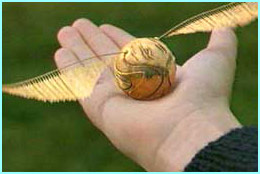
Special vocabulary - Quidditch becomes ἰκαροσφαιρική [ikarosphairike] (on the analogy of ποδοσφαιρική [podosphairike] for football and καλαθοσφαιρική [kalathosphairike] for basketball- with which Quidditch is compared). Lucian calls Menippus the philosopher Icaromenippus after his alleged trip to the moon - that's where I got the idea. The quaffle has the near homophone (with the sort of metathesis that Greeks often applied to foreign words) κολοφῶν [kolophon] which means a ball in Greek, and a bludger is ῥοπαλοσφαίριον [rhopalosphairion], reminding us of a ball which acts like Heracles' club! The beaters are ῥαιστῆρες - a word I also use for the Hammers, the football team supported by Dean the West Ham fan. The snitch is φθαστέον [phthasteon], meaning "that which must be anticipated" from φθάνω [phthano], a fantastic Greek verb with no English equivalent, meaning "I do something before someone else realises that I'm doing it". The philosopher's stone (why the apostrophe before the s, I asked myself?) becomes ἡ τοῦ φιλοσόφου λίθος [he tou philosophou lithos]. If you are worried about the gender of λίθος [lithos] I assure you it becomes feminine when referring to a special stone.
Modern terms. Train I've already mentioned - other modern phenomena such as rifles, bombs, computers, tape-recorders, watches, racing-bikes, motor-cycles, traffic lights and so on were dealt with similarly, using the oldest modern Greek I could find - preferably with obvious classical roots - like ἡ ἁμαξοστοιχία [hamaxostoichia], where the Greek evokes carriages or waggons in a line. Sometimes - in the manner of Herodotus explaining strange ethnic customs - I sometimes have a short digression which might help an ancient Greek to understand a totally unfamilar object (like a parking meter). I'm sure - like modern Greeks - he'd be quite happy to call a car an αὐτοκίνητον [autokineton],a self-moving something, and assume that the word ὄχημα, chariot, was understood. The Hogwarts Express becomes ὠκύπορος ὑογοητική [okyporos hyogoetike], with ἁμαξοστοιχία [hamaxostoichia] of course understood, and it leaves from Σταυρὸς Βασίλειος [Stauros Basileios], of course. Telephones and televisions make use of the Greek prefix τηλε- . Readers should have no trouble with terms such as βιβλιόφυλαξ (librarian), δίοπτρα (μηνοειδῆ) (spectacles - half-moon), σβεντήριον (putter-outer).
Cultural problems. There were many, one of the more obvious being relationships - the patriarchal Greeks not really concerning themselves with relationships like mother's sister (very important for Harry of course) because once married a Greek bride would have little contact with her former family. There does exist a word for aunt (mother's as opposed to father's sister), but it's rare - although the Greeks had a word for "women whose husbands are brothers" - εἰνάτερες [einateres] - because this might be important if one of the brothers died. Uncle Vernon is described as retiring to the ἀνδρῶν to listen to the news - he'd have been very happy to have his own men's quarters! There are no slaves - even though Harry is treated worse than an Athenian household slave; though Petunia does let slip that she thinks the name Harry is ἄμουσον καὶ δουλοπρεπές, which is my translation "a nasty common name". Strangely, the owl postal system is much closer to ancient Greek practice - hand a letter to someone and tell them who to deliver it to.
Time was another one - Greeks had little interest in "telling the time" although they did have devices for measuring how much had elapsed (water clocks for timing speeches, for example). Nor did they care about minutes, let alone seconds! The nearest we get to specific times are Thucydides' phrases for "at about the time the market-place begins to fill up", or "at about the time the oxen begin to head home from pasture". (I'm reminded of the remark that "There is no word in Gaelic that quite conveys the urgency of mañana.") Likewise months and years - "Ollivanders, wand-makers since 382 BC." The year 382 BC translates into "when Evander was archon" quite neatly, but dates AD have had to be done more conventionally. Each Greek city had its own system of months - so I've used the Roman ones we are familiar with to avoid complete confusion!
And colours - it's little appreciated how languages divide up the visible spectum of light in their own way - our red orange yellow etc is of course completely arbitrary- the spectrum is a continuum. The Greeks had very few real colour-words- Homer's "wine-looking, wine-faced" sea is a typical circumlocution (if it in fact means that - the traditional "wine-dark" is a romantic suggestion). So you will have to judge how I've dealt with the various yellows, blues, greens and other colours that JKR is so fond of - especially pink (the Romans invented the word - it comes from puniceus, the Carthaginian/Punic colour - which was the result of dyeing cloth with a sea mollusc whose identity is now unknown! But it was the "purple" of the emperors - inappropriate surely for a blush or or Dudley's baby photos!) So you'll have to tolerate "dust-coloured" for grey, "violet-coloured" for purple, "frog-coloured" or "leek-coloured" for green (for which the Greeks genuinely had no common word).
Food is a major preoccupation with Harry and his friends, just as it is with Odysseus - both have suffered privation, and intend to make the most of any opportunity to eat. Harry's diet, though, one has to say, is far from the healthy ideal of "five-a-day" - he eats mainly sweets, ice cream and the occasional burger. Even Dumbledore, the philospher king of Hogwarts is addicted to sweets - can one imagine Socrates or Plato sucking lemon sherbets? The Greeks ate a simple healthy diet, involving bread, vegetables and fruit - none which (except potatoes - γεώμηλα -in every guise) are available at Hogwarts. In fact one of the most disgusting flavours for Bertie Bott's Everyflavour Beans was - sprouts! JKR is not encouraging her readers to eat their greens. The Dursleys have a fried breakfast every morning - and eggs and milk are delivered daily - so why is Harry so undersized? The feasts - three in HP1 - are far more splendid than anything Aristophanes could imagine - even with his wartime deprivation to encourage him. One or two problems needed special ingenuity - trifle is ζωμὸς ᾽Αγγλικός (zuppa inglese!), a marsh mallow is μαλάκη ἑλώδης.
Clothes are obviously a particular problem. Greeks did not wear trousers, jackets, coats - and most importantly had no pockets. Hagrid's coat of many pockets would have been a thing of wonder and mystery. The school uniform at Hogwarts thankfully involves cloaks - which were well-known to the Greeks. But the knickerbockers and tailcoat worn by Dudley at Smeltings ...
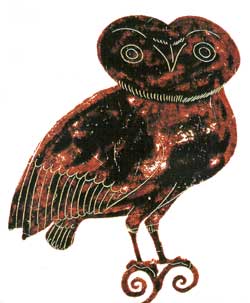
The natural world of the Mediterranean: this surfaces right at the start - there is no Greek word for privet as in Privet Drive, so I have had to substitute an equally uninteresting Mediterranean shrub - myrtle. (Nor of course did Greeks number their house or name their streets - the first sentence is the most problematical in the entire book!) Tawny and Snowy Owls are unknown in Greece - but they had a dozen or more words for owl which it's difficult to assign to particular species: the scientists call the Little Owl - the symbol of Athens - "Athene" in her honour. Hedwig is called γλαῦξ [glaux], the commonest ancient word, which does probably apply to Athene noctua, the Little Owl (Athena is called γλαυκῶπις [glaukopis] by Homer, meaning probably "owl-faced", rather than "grey-eyed" or "bright-eyed". A Little Owl might have caused the Muggles on the Underground less excitement!). Hedwig becomes Ἡδυϊκτίν [Hedyiktin] "sweet kite" which I quite like. There seems to be no word in Greek for "badger" - tough on the Hufflepuffs - they seem to have used the word γαλέη [galea] indiscriminately for all small to medium size animals. And they don't distinguish between mice and rats - μῦς [mus] has to do for both (sorry, Scabbers!). [See here for further discussion on the mouse/rat problem]. There also seems to be a gender problem with some animals - all cats are masculine (as all bears are feminine) - which makes the surprise even greater when McGonagall reveals herself to Dumbledore. Mrs Norris' gender remains female (certainly not neutered!).
And also noises: an ancient Greek got by with one or two words which did duty for every kind of noise from a snap to a crackle to a pop to a bang to a rustle to a toot to a creak to a clunk to a click - this makes life difficult, and I had to avoid over-using comparisons with Mount Etna - probably the only really loud noise ever heard in the ancient world! Somewhat bathetically, I do use it for the wizard cracker in chapter 12 which "went of with blast like a cannon". But we just take it for granted in English how many words we have for different kinds and intensities of sound.
Songs and verse: In the original these are mostly what could charitably be described as doggerel -the Sorting Hat's song for instance and the "school song" ("Hoggy Wart Hogwarts"). In Greek there is no such thing - either it is well-disciplined verse that scans or it isn't verse at all. JKR's lyrics have, I feel, in all modesty, been considerably improved in translation into iambics or elegiac couplets!
Mythological references: Fluffy, the three-headed dog is obviously Cerberus.
Towards publication
 On
1st February 2004 our local newspaper, Bedfordshire on Sunday, had as
its lead story "From Plato to Potter", describing how a retired Bedford
schoolmaster had translated Harry Potter into ancient Greek. This had
come about from a chance encounter in the Wellington Arms pub with a former
pupil, Jonathan Stewart, now an editor of the paper, who had heard rumours
of my activities over the past year or so: he arranged for an interview.
The story was picked up by local radio (BBC Three Counties, who did a
live telephone interview the following morning). This in turn was picked
up by Anglia TV, and BBC Look East, who conducted a prolonged interview
at home and with me reading extracts in Greek to some nine-year-olds at
Scott School,the local primary. They also talked to the children: one
little girl had read all the books and was looking forward to mine, but
felt she might need a Greek dictionary! An article with pictures was posted
on the BBC website. Local exposure led to contacts from Greece - a news
item to be followed up with an article in Epsilon, and in the Sunday magazine
of Eleutherotypia on February 22nd - Canada, the US - I did a telephone
interview with Scott Simon on NPR's Weekend Edition on February 14th -
and, amazingly, Russia - a TV crew from NTV - that's HTB in Russian -
spent a morning filming and interviewing for a programme on 16th February.
Incidentally Harry becomes Gary in Russian! Bedfordshire on Sunday did
a follow-up article yesterday. Today (18th February) a Greek photographer
sent by Eleutherotypia, the Greek newspaper, spent the afternoon doing
a series of portraits. He led me to believe that I'd soon by the most-recognised
Englshman in Greece: unfortunately the effect of this was somewhat undermined
when I asked him if he would be buying it. "Of course not, Ancient
Greek is like Chinese to us!"
On
1st February 2004 our local newspaper, Bedfordshire on Sunday, had as
its lead story "From Plato to Potter", describing how a retired Bedford
schoolmaster had translated Harry Potter into ancient Greek. This had
come about from a chance encounter in the Wellington Arms pub with a former
pupil, Jonathan Stewart, now an editor of the paper, who had heard rumours
of my activities over the past year or so: he arranged for an interview.
The story was picked up by local radio (BBC Three Counties, who did a
live telephone interview the following morning). This in turn was picked
up by Anglia TV, and BBC Look East, who conducted a prolonged interview
at home and with me reading extracts in Greek to some nine-year-olds at
Scott School,the local primary. They also talked to the children: one
little girl had read all the books and was looking forward to mine, but
felt she might need a Greek dictionary! An article with pictures was posted
on the BBC website. Local exposure led to contacts from Greece - a news
item to be followed up with an article in Epsilon, and in the Sunday magazine
of Eleutherotypia on February 22nd - Canada, the US - I did a telephone
interview with Scott Simon on NPR's Weekend Edition on February 14th -
and, amazingly, Russia - a TV crew from NTV - that's HTB in Russian -
spent a morning filming and interviewing for a programme on 16th February.
Incidentally Harry becomes Gary in Russian! Bedfordshire on Sunday did
a follow-up article yesterday. Today (18th February) a Greek photographer
sent by Eleutherotypia, the Greek newspaper, spent the afternoon doing
a series of portraits. He led me to believe that I'd soon by the most-recognised
Englshman in Greece: unfortunately the effect of this was somewhat undermined
when I asked him if he would be buying it. "Of course not, Ancient
Greek is like Chinese to us!"
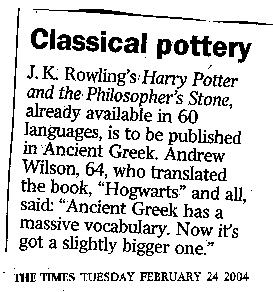
On 24 February there was a small snippet in the Times (see below), which led to an appearance the same day on BBC Radio 4's "Front Row" being interviewed by Mark Lawson. I was especially pleased to be sharing the bill with Derek Walcott, the St Lucian poet and Nobel Laureate - author of Omeros - whose work I've always venerated (and who happens to be my late mother-law's godson!).
Media attention
You can still access many of these media events (amazingly) - those marked as hyperlinks (underlined) were still online in March 2011:
- Bedfordshire on Sunday article 1 February "Plato to Potter"
- BBC Look East - article on BBC website "It's all Greek to Harry Potter"
- Article on the Eleutherotypia newspaper website, Greece Χάρι Πότερ για μαθήματα αρχαίων ελληνικών
- Intervew on Scott Simon's Weekend Edition Febrary 14th 2004 (sound clip) Includes an extract from the Quidditch game in chapter 11.NPR's Scott Simon talks with classics teacher Andrew Wilson of Bedford, England about his recent translation of the book Harry Potter and the Philosopher's Stone into ancient Greek.
- Bedfordshire on Sunday follow-up 15th February 20 "Media goes Potty for Greek Harry"
- Reuters 20 February - interview with Tim Castle [not available March 2011]
- Interview with Yiannis Vasalakis for Greek newspaper "TA NEA":
 Dear Andrew,

Once again thank you for the interview. The story got printed last =
Saturday (October 2nd) and it was quite a hit. I just hope that the book =
got published today as it was scheduled by the editors. I am forwarding =
you two links. The first one is the interview itself, and the second is =
a small comment by Yorgis Yatromanolakis, writer and professor of =
Classic Literature at the University of Athens (He was so enthusiastic =
with the idea and he loved your translation)... The text is only in =
modern greek but I hope it will not be, well, all greek to you! (ok, bad =
joke...)
- HPANA (Harry Potter News) - reactions of fans to the news that Latin and Greek translations are on the way.
- Hellenic News of America
- Outside of a dog - comments on the book
- A charming review. (pdf)
- Review by Tad Brennan in Bryn Mawr Classical Review August 2005
- Article (in German) in Spiegel Online August 15 2005 Harry, der Hellene
- Review in Amphora (Journal of American Philological Association) Fall 2005 (pdf)
- Wall Street Journal - article by Brian M Carney 21 October 2004
Other articles that have appeared:
- The Hindustan Times February 9 2004
- CBC Net (Canada)
- The BBC website in Greek
- Mugglenet News Archive (leading Harry Potter website)
- Macedonian Web Agency
- Sofia News Agency, Bulgaria
- Greece Now
You
can order it now with Amazon
 Amazon reviews:
A MUST for all Ancient Greek lovers,
October 7, 2004 Reviewer: Franco Gerevini from Bergamo, Italy
This book is a gem. The translation is gorgeous and brilliant (it really seems that Ancient Greek is Andrew Wilson's mother tongue!). Weird terms like "quidditch" (ἰκαροσφαιρική), "snitch", (φθαστέον), "Hogwarts Express" (ὠκύπορος ὑογοητική) and many others were brilliantly rendered according to their meaning. Many cultural difficulties (relationships, time, natural world, colours, noises) were wittily solved. Mr Wilson rightly attaches importance to details (even in the title: the gender of λίθος, which is normally masculine, correctly becomes feminine owing to the fact that we are referring to a special stone: ἡ τοῦ φιλοσόφου λίθος). Style is really classical.
If you are fond of Ancient Greek, buy this book.
Superb translation
21 April 2006 by JR Anderson (England)
I am not a particular Harry Potter fan, but the appeal of reading this book in Ancient Greek resulted in me rushing out to buy it! From what I can tell, the translation is superb and manages to give the story a definite Greek feel to it, without losing any of its original qualities. It was certainly a challenging read, even with a translation at my side, but I definitely think it was worth it. The book is ideal for learners of Ancient Greek as you will surely increase your vocabulary by reading it. There is also a certain satisfaction that you acquire from understanding such a complex language and I found myself feeling this a lot throughout the book. Unfortunately, I can't imagine there'd be a big demand for such a translation, but if you're mad on Harry Potter then it's worth just purchasing it to add to your collection. And those Greek experts who snigger at the idea of such a translation should really
New Life to Ancient Greek,
October 30, 2004 by Katey "kateyvic"
This review is from: Harry Potter and the Philosopher's Stone (Ancient Greek Edition) (Hardcover)
The writing of the second century AD author Lucian was the model for this translation of Harry Potter in to ancient Greek. A more appropriate author could not be found. Lucian is where we get the story "The Sorceror's Apprentice" (for his tale "The Lover of Lies"), so he provides vocabulary very relevant to JK Rowling's story.
While I don't see any universities adding this Greek translation into their classics curriculum or graduate reading lists, and nor do I see anyone really sitting down to read it cover-to-cover, it is a nice little novelty to have on one's bookshelf (next Harrius Potter, of course).
What a wonderful idea!
October 12, 2004 By Alianne (Manassas, VA)
This review is from: Harry Potter and the Philosopher's Stone (Ancient Greek Edition) (Hardcover)
I think it is a wonderful idea to translate such a popular children's book into Ancient Greek and Latin. I'm currently reading the Latin translation and am enjoying it. Unfortunately, I can't comment on the Greek translation as I'm only beginning to learn the language. I am, however, looking forward to one day being able to read it.
What I can do is provide wonderful website that contains an article by the translator telling how he came to be the translator, how he chose a style and how he chose the Greek names for the characters as well as Hogwarts, Quidditch, etc. It is a very interesting read. Do a search for Greek Harry Potter on Google and go to the Classics Page.
Great Service, Great Product
December 15, 2009 By Gwenog Jones (Seattle, WA USA)
This review is from: Harry Potter and the Philosopher's Stone (Ancient Greek Edition) (Hardcover)
This product was shipped promptly and was in pristine condition. It was a great price and I am fully satisfied. It is a wonderful translation. The book maintains its "Harry Potter-ness" while having a distinct Ancient Greek flair. It's one of the few translations that conveys the dimension of J.K.'s genius. There are puns and humor and in general it is just wonderfully clever. I am extremely happy with it.
Interesting, if nothing else
October 9, 2009 by Kelly Jackson "Shakespeare = love" (Taylor, MI USA)
This review is from: Harry Potter and the Philosopher's Stone (Ancient Greek Edition) (Hardcover)
I got this book as a birthday gift and I've got to say it's at least really interesting. If you're a student of Koine or late Attic, go for it. This reads very much like the New Testament in that it's easier to see the grammatical constructions of sentences and translate at an intermediate level (depending on your already-established vocabulary). That isn't to say that the book is easy, by any means, but it does provide an extra exercise for those who want (or need) to practice their translations.
Interesting note: Don't translate this side-by-side with the English version. Translating from English to Greek and back to English will absolutely NOT yield the same results. And read it with a Scott-Liddell nearby for piece of mind.
We're reading Harry Potter!
December 27, 2004 by Katie Konrath "Fresh Thinker" (Minnesota)
This review is from: Harry Potter and the Philosopher's Stone (Ancient Greek Edition) (Hardcover)
I beg to differ in response to another who commented that this book will not be added to any curriculum soon. Next semester, advanced Greek students at my college will be doing a Harry Potter reading club once a week. One student will be taking it as a class, while everyone else (of high enough skill) is welcome to join to have some fun. Sadly, I just graduated and can't participate... but I'm thinking of keeping up and coming when I can. The tough decision is, should I keep reading Homer or take a break for some Harry Potter...? I'm definitely going for the Latin version though!